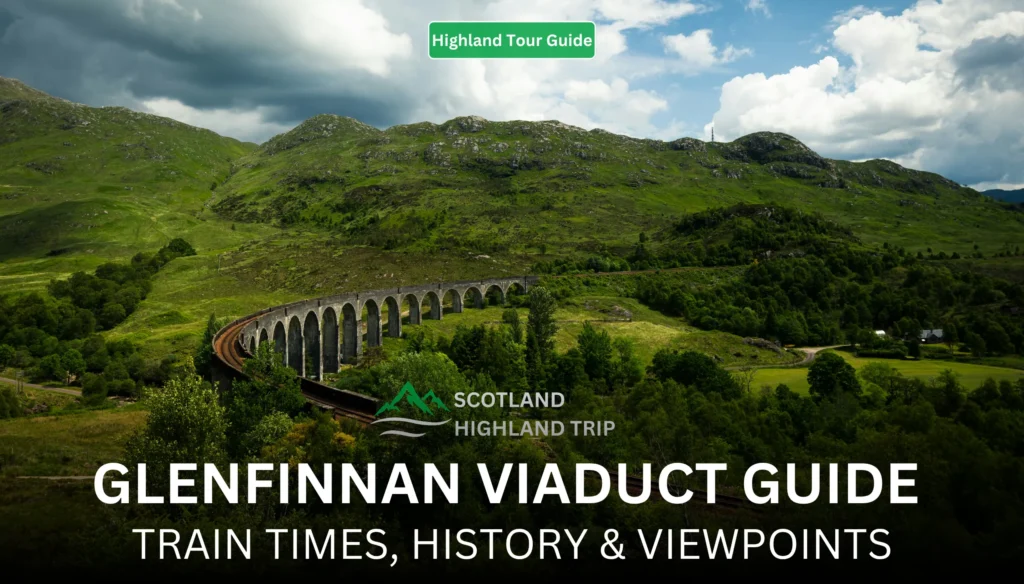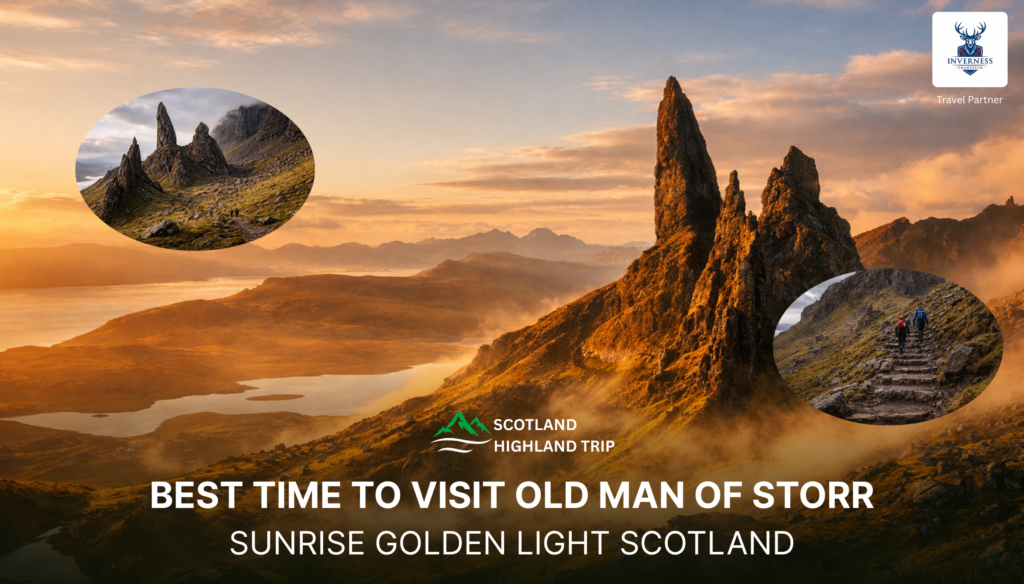

Stand on the first tee at Royal Dornoch on a clear morning and you can see the gorse burning yellow along the Dornoch Firth, a white beach below you, and not a single building spoiling the view. That, in one picture, is why people fly 4,000 miles to play golf courses in the Scottish Highlands. Scotland has more than 550 courses and welcomes around 220,000 golfing visitors a year, with golf tourism worth roughly £286 million annually according to VisitScotland. A surprising share of those visitors never make it past St Andrews. Their loss.
This guide covers the ten most scenic courses in the Highlands proper, what each one costs in 2026, when to come, and how to move between them without hiring a car. I’ve kept Aberdeenshire out of it. Plenty of lists lump the two together, but if you’re basing yourself around Inverness, the courses below are the ones that actually fit your trip.
Jump to Sections
Why Do Golfers Travel All the Way to the Scottish Highlands?
Golfers travel to the Scottish Highlands for authentic links golf on some of the oldest playing grounds in the world, dramatic coastal and mountain scenery on nearly every hole, smaller crowds than St Andrews, and green fees that are often half the price of Scotland’s most famous names.
Golf has been played at Dornoch since at least 1616. Fortrose & Rosemarkie’s club dates to 1793. These aren’t resort courses built for tourists. They’re town clubs where locals still play midweek medals, and that changes the whole feel of a round. You’ll get a friendly word from the starter, a reasonable bar tab, and zero pretension.
The scenery does the rest. Almost every course on this list sits on a firth, under a mountain, or inside a national park. And because the far north stays quieter than the Central Belt, you can often book marquee courses weeks ahead rather than a year ahead. Royal Dornoch in July is the exception, not the rule.
What Makes Highland Golf Different from St Andrews or East Lothian?
Two things: isolation and variety. The drive between courses runs past lochs, castles, and distilleries rather than motorway junctions, which is why so many visitors treat the golf as half the holiday. You’ll also find genuine heathland and woodland golf in the Cairngorms alongside the coastal links, something Fife simply doesn’t offer. If you’re building a wider trip around your rounds, our Scottish Highlands travel guide covers the non-golf side in detail.
Which Are the Best Scenic Golf Courses in the Scottish Highlands?
The standout scenic courses in the Scottish Highlands are Royal Dornoch, Castle Stuart and Old Petty at Cabot Highlands, Nairn, Brora, Boat of Garten, Fortrose & Rosemarkie, Tain, Golspie, and Spey Valley. Between them they cover classic links, mountain heathland, and modern championship golf.
Royal Dornoch (Championship Course)
Start here. Royal Dornoch, founded in 1877 with Old Tom Morris shaping the early layout, is regularly ranked among the finest courses on the planet, and it has never needed an Open Championship to prove it. The routing runs out along raised ground above a white sand beach, then turns for home with the Dornoch Firth on your left the whole way back.
The famous raised plateau greens punish anything slightly offline, so bring your short game and your patience. A single peak-season round on the Championship Course costs £360 for April to October 2026, with winter rates from £180 and the shorter Struie Course from £85 to £100. Check current rates on the Royal Dornoch visitor page before you book, and book early: summer slots go months out. The club’s new £13.9 million clubhouse opened for the 2026 season, so the 19th hole finally matches the golf.
Castle Stuart Links, Cabot Highlands
Fifteen minutes east of Inverness, Castle Stuart is the modern classic of the north. Mark Parsinen and Gil Hanse opened it in 2009 and it hosted the Scottish Open four times within its first decade, including Phil Mickelson’s playoff win in 2013. The design gives you wide, forgiving fairways, then asks hard questions with angles, wind, and infinity greens that appear to tip straight into the Moray Firth.
For visiting golfers of mixed abilities, this is probably the friendliest world-class course in Scotland. Peak green fees sit in the high £300s, which stings, but few rounds anywhere deliver views like the 3rd green with the firth and the Black Isle behind it.
Old Petty, Cabot Highlands
Here’s one most 2024-era lists still miss. Old Petty, the second course at Cabot Highlands, opened for public play in May 2026. Tom Doak designed it with Clyde Johnson on land beside Castle Stuart, and it climbed straight into the upper reaches of the Highland rankings within months of opening. Wide corridors, a shared central fairway on the 1st and 18th, and a lovely par 3 6th right beside the water. Playing both Cabot courses back to back now makes Inverness a genuine two-day golf destination on its own.
Nairn Golf Club (Championship Course)
Nairn is the quiet achiever of Highland golf. Established in 1887 and shaped over the years by Archie Simpson, Old Tom Morris, and James Braid, it has hosted both the Walker Cup and the Curtis Cup. The claim you’ll hear in the clubhouse, that the sea is visible from every hole, holds up on the ground. The opening stretch hugs the beach so closely you can hook a ball onto the sand at high tide.
Firm, fast fairways, wicked gorse, and greens as true as anything in Scotland. If your budget doesn’t stretch to Dornoch and Castle Stuart both, Nairn delivers 90 percent of the experience at a noticeably lower fee.
Brora Golf Club
Brora is where Highland golf gets properly charming. James Braid laid it out in 1891 and very little has changed, right down to the sheep and cattle that still graze the links, kept off the greens by low electric fences. Sounds like a gimmick. It isn’t. This is crofting land with shared grazing rights, and the animals have been part of the course longer than most of the bunkers.
At 6,211 yards it won’t overpower you with length. The exposed seaside position and Braid’s small, fast greens do the damage instead. Brora sits right on the North Coast 500 route, so if you’re driving Scotland’s famous coastal loop, this is the round to build a day around.
Boat of Garten Golf Club
Now for something completely different. Boat of Garten sits inside the Cairngorms National Park, and instead of dunes you get silver birch, purple heather, and the River Spey glinting through the trees. Braid designed it in 1898 and locals call it the Gleneagles of the Highlands, which undersells how pretty it actually is in late August when the heather flowers.
It’s short at 5,876 yards, and around £115 for a 2026 visitor round it’s one of the best-value scenic courses in Britain. Ospreys nest nearby. You may genuinely stop mid-hole to watch one fish.
Fortrose & Rosemarkie Golf Links
The club here formed in 1793, making it one of the oldest golf clubs anywhere, and the course occupies the whole of Chanonry Point, a narrow spit poking into the Moray Firth on the Black Isle. Water on three sides, a lighthouse at the end, and this is the part I love: Chanonry Point is one of the best places in Europe to watch bottlenose dolphins from land. Time your round around a rising tide and you’ll likely see them hunting salmon off the beach beside the fairways.
At 5,342 yards the course is short, but gorse, wind, and small greens keep the scorecard honest. Green fees stay comfortably under £100.
Tain Golf Club
Old Tom Morris designed Tain in 1890, and the course sits between the Dornoch Firth and a mountain backdrop with the Glenmorangie Distillery practically next door. That’s not a bad pairing: 18 holes, then a dram at the place that made it. The back-to-back par 3s at 16 and 17 are famous card-wreckers, so protect your score before you celebrate. Whisky-minded golfers can plan the full detour with our Inverness whisky tour guide.
Golspie Golf Club
Golspie is the sleeper pick. One round takes you through three landscapes: links holes along the beach, then heathland, then woodland, all beneath Ben Bhraggie with the giant statue on its summit staring down at you. Braid again, 1889, par 69, and green fees that make southern golfers laugh in disbelief. It’s ten minutes from Dunrobin Castle too, so non-golfing partners have somewhere spectacular to spend the morning.
Spey Valley Championship Course, Aviemore
The big modern test of the inland Highlands. Dave Thomas built Spey Valley in 2006 to full championship length, 7,118 yards from the tips, threading through pine forest and heather with the Cairngorm mountains filling the horizon. It hosted a Challenge Tour event for years and plays every bit as hard as that suggests from the back tees. Move forward a set and it becomes a gorgeous walk with mountain views on almost every shot. Staying in Aviemore anyway for the Highland wildlife and outdoor scene? This is your round.
How Much Do Green Fees Cost in the Scottish Highlands in 2026?
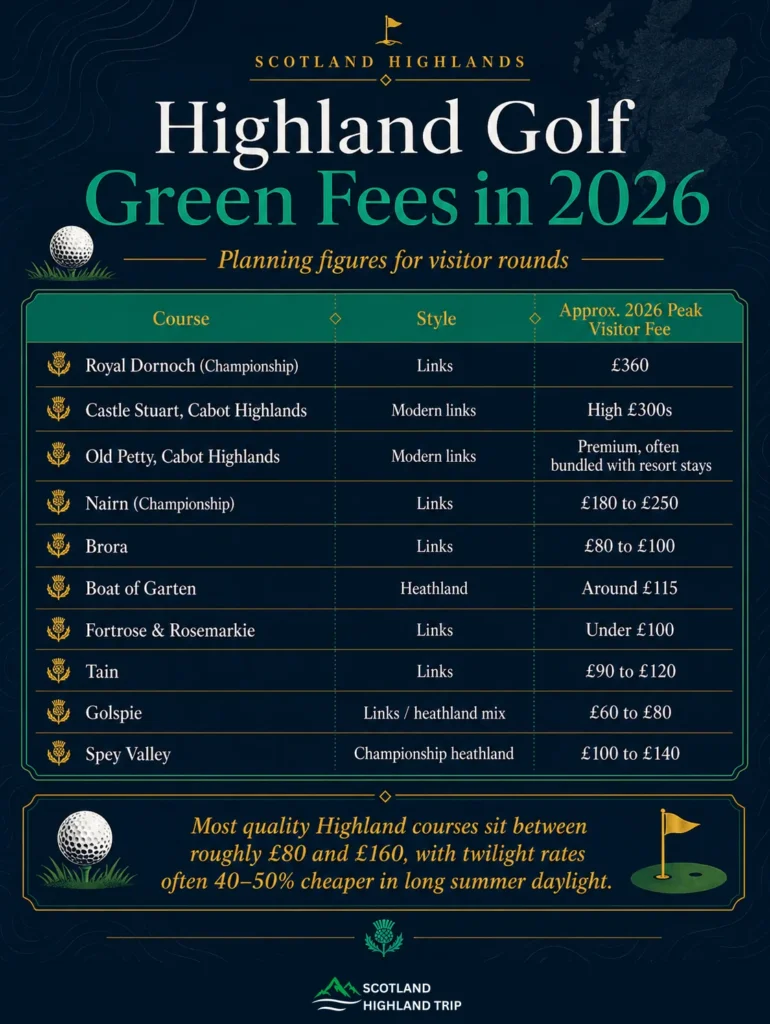
Highland green fees in 2026 range from under £50 at small local clubs to £360 at Royal Dornoch, with most quality courses charging between £80 and £160. Across Scotland’s top 100 courses the median summer fee is about £140, and the Highlands offer some of the best value inside that number.
| Course | Nearest town | Style | Par | Approx. 2026 peak visitor fee |
| Royal Dornoch (Championship) | Dornoch | Links | 70 | £360 |
| Castle Stuart, Cabot Highlands | Inverness | Modern links | 72 | High £300s |
| Old Petty, Cabot Highlands | Inverness | Modern links | 72 | Premium, bundled with resort stays |
| Nairn (Championship) | Nairn | Links | 71 | £180 to £250 |
| Brora | Brora | Links | 70 | £80 to £100 |
| Boat of Garten | Aviemore area | Heathland | 70 | Around £115 |
| Fortrose & Rosemarkie | Fortrose | Links | 71 | Under £100 |
| Tain | Tain | Links | 70 | £90 to £120 |
| Golspie | Golspie | Links/heathland mix | 69 | £60 to £80 |
| Spey Valley | Aviemore | Championship heathland | 72 | £100 to £140 |
Fees move every season and vary by month, so treat these as planning figures and confirm directly with each club. Twilight rates, often 40 to 50 percent cheaper, are the Highland golfer’s best friend: in June and July you can tee off at 6 pm and finish in full daylight.
When Is the Best Time to Play Golf in the Highlands?
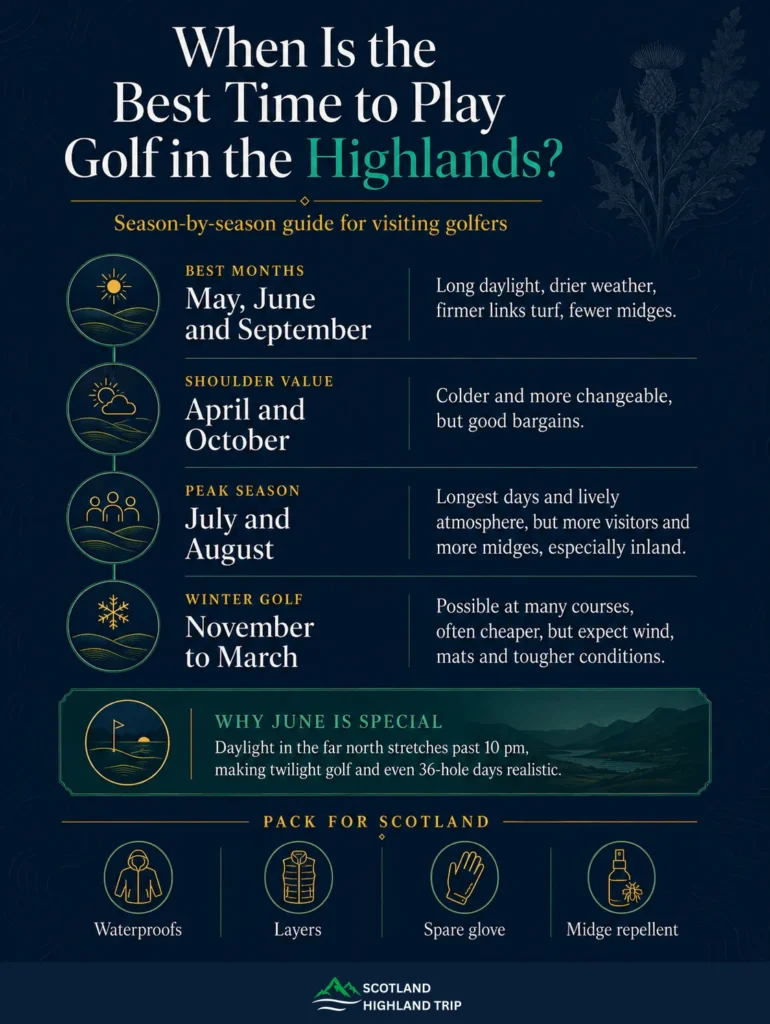
May, June, and September are the best months for Highland golf, combining long daylight, drier weather, firm links turf, and fewer midges than July and August. April and October offer real bargains if you’ll accept colder, more changeable conditions.
June daylight in the far north stretches past 10 pm, which makes 36-hole days genuinely comfortable. The catch with high summer is the midge, which loves still, damp evenings inland. Coastal links usually have enough breeze to keep them away, but if you’re playing Boat of Garten or Spey Valley in July, pack repellent. Winter golf is entirely possible here too, and clubs like Dornoch keep the Championship Course open year-round at heavily reduced rates. Just expect mats, wind, and a fair amount of character-building.
How Do You Get Between Highland Golf Courses Without Driving?
The simplest way to link Highland courses without self-driving is a private golf transfer with a driver who handles clubs, luggage, and timing while you rest between rounds. Public transport reaches Inverness, Nairn, Tain, and Brora by rail, but connections rarely match tee times.
Here’s the honest picture. The Far North railway line does stop near several courses, and it’s a beautiful ride, but a missed connection can cost you a £360 tee time. Most visiting groups either hire a car or book a private golf transfer service in Scotland with a van and club trailer, which solves three problems at once: nobody drives after the post-round dram, four sets of clubs travel safely, and jet-lagged arrivals from Inverness, Edinburgh, or Glasgow airports go straight to the first tee or the hotel. For groups of three or more, the per-person cost usually compares well with two hire cars plus fuel and parking.
Distances deserve respect here. Inverness to Dornoch is about an hour, Dornoch to Brora another 20 minutes, and Aviemore sits 40 minutes south of Inverness. Cluster your rounds by area rather than zigzagging.
How Should You Plan a Highland Golf Itinerary?
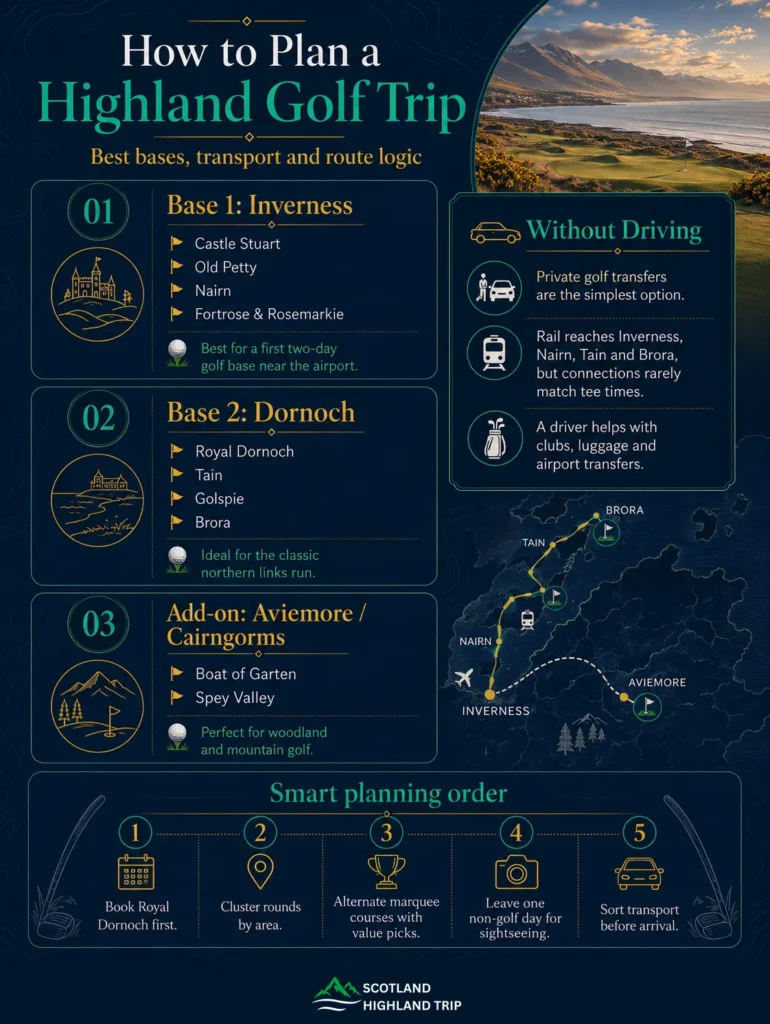
A workable plan for a first Highland golf trip looks like this:
- Fix your anchor round first. Royal Dornoch summer tee times book out furthest ahead, so secure that date, then build everything else around it.
- Base yourself in one or two places, not five. Inverness covers Castle Stuart, Old Petty, Nairn, and Fortrose. Dornoch covers Royal Dornoch, Tain, Golspie, and Brora. Our guide to the best hotels in the Scottish Highlands breaks down both bases.
- Alternate big fees with hidden gems. Dornoch one day, Golspie the next. Your wallet and your energy both last longer.
- Sort transport before you land. Book transfers or a hire car for the full trip, not day by day. Summer availability for both gets tight.
- Leave one golf-free day. Loch Ness, Culloden, a distillery, or a castle. The day trips from Inverness are half the reason to come this far north.
- Pack for four seasons. Waterproofs, layers, and a spare glove, even in July. Nobody has ever regretted bringing too many layers to Scotland.
One last opinion, freely given: don’t try to play eight rounds in six days. The golfers who love the Highlands most are the ones who left room to look around.
Frequently Asked Questions About Golfing in the Scottish Highlands
What is the best golf course in the Scottish Highlands?
Royal Dornoch is widely regarded as the best course in the Scottish Highlands, ranked among the top courses in the world. Castle Stuart, Old Petty, and Nairn complete the region’s elite group, and all four welcome visitors.
How far in advance should I book Highland tee times?
Book Royal Dornoch six to twelve months ahead for summer play. Castle Stuart and Nairn typically need two to four months for peak dates. Smaller clubs like Golspie, Tain, and Brora can often be booked within a few weeks.
Do Highland golf courses have dress codes?
Yes, but relaxed ones. Standard golf attire, a collared shirt and tailored shorts or trousers, is fine everywhere on this list. Royal Dornoch’s new clubhouse and Nairn’s dining room prefer smart casual off the course. Jeans on the course are a no everywhere.
Can beginners play these courses?
Absolutely. Castle Stuart’s wide fairways, Golspie, Fortrose & Rosemarkie, and Boat of Garten all suit higher handicappers. Most Highland clubs have no handicap certificate requirement, though Royal Dornoch recommends a reasonable playing standard for the Championship Course.
Is a caddie worth it at Royal Dornoch?
Yes, for a first visit. The raised greens and blind lines cost first-timers plenty of shots, and Dornoch’s caddie programme is among the best in Scotland. Request one when booking your tee time rather than on arrival.
What should non-golfers do while the group plays?
Plenty. Dunrobin Castle sits beside Golspie, dolphins swim off Fortrose, Dornoch has a cathedral and a beach, and Inverness offers Loch Ness cruises and Culloden Battlefield within half an hour.

Emma is a solo traveler and freelance travel writer from New Zealand who spent three weeks exploring the Scottish Highlands. With a deep appreciation for history and landscapes, she booked a series of day tours and a private chauffeur journey with Scotland Highland Trip. From Loch Ness to the Cairngorms, she documented her experience through vivid blog posts and drone footage.