
Why the Old Man of Storr Deserves a Place on Your Bucket List
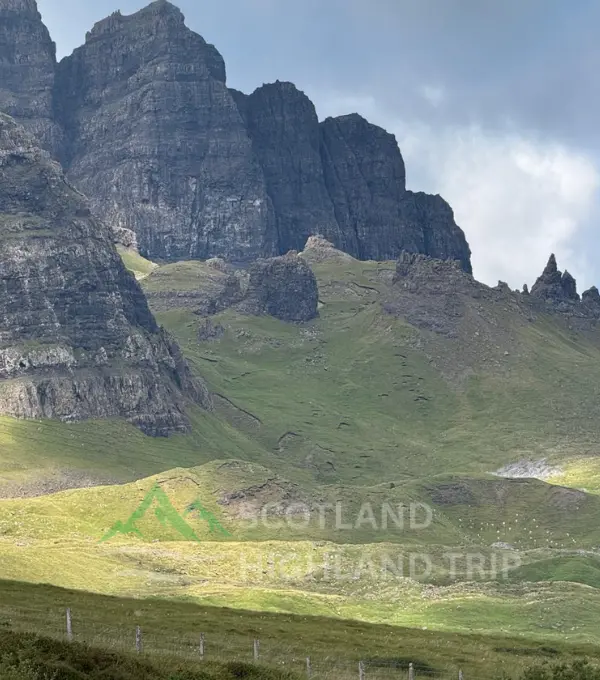
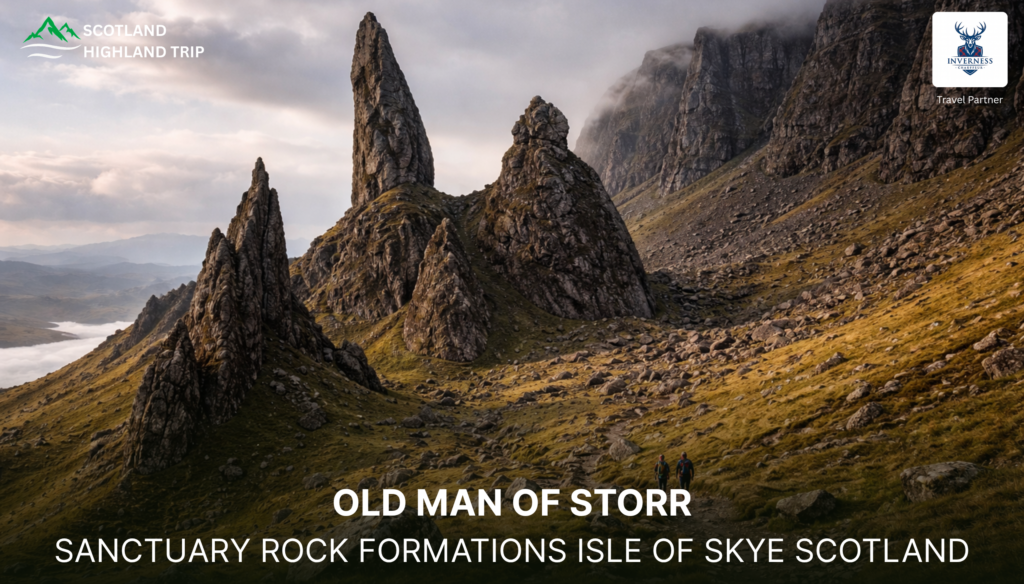
Perched on the Trotternish Peninsula of the Isle of Skye, the Old Man of Storr is more than just a rock pinnacle: it’s a geological wonder and cultural icon. This 50‑metre pillar of basalt was created by an ancient landslide and rises dramatically from the landscape, earning its nickname because it resembles the silhouette of an old man. The Storr mountain itself is part of the Trotternish landslip, the largest landslide in Great Britain, and the area in front of the cliffs is known as the Sanctuary, home to weirdly shaped pinnacles. Whether you’re chasing photographs, legend or just a memorable walk, planning the timing and logistics of your trip makes all the difference.
This guide covers everything from the best months and times of day to practical details such as transportation, parking, walking distances, gear and seasonal advice. It also explains how to reach the Old Man from Glasgow, Inverness and Edinburgh and answers frequently asked questions. By the end you’ll know exactly how and when to visit the Old Man of Storr and why this mystical monolith captures imaginations worldwide.
Jump to Section
What Is the Old Man of Storr?
Geological origins and legend
The Old Man of Storr is a 160‑foot (49‑metre) basalt pinnacle on the Isle of Skye. It formed roughly 60 million years ago when volcanic lava flowed across the area and later cooled; subsequent landslides stripped away softer material, leaving behind a striking column. The broader Storr mountain is part of the Trotternish landslip, a geologically significant landslide that produced the Sanctuary’s other dramatic pinnacles. Locals named the rock because the outline looks like the head of an elderly man or wizard. Myths speak of giants and guardians who turned to stone, but the scientific explanation is just as captivating.
The “face” phenomenon
From certain viewpoints the rock’s profile appears to have human features, eyes, brow and a jaw. This illusion occurs because of pareidolia, the brain’s tendency to see familiar shapes in random patterns. The face‑like appearance is particularly noticeable when shadows accentuate hollows and ledges. Photographers chase this effect by positioning themselves along the eastern ridges or viewing the pinnacle from afar in soft morning or evening light.
Best Time to Visit the Old Man of Storr
Seasonal considerations
Peak season (May to September): This period offers the most stable weather but also the highest visitor numbers. During summer, days are long and sunrise and sunset paint the rocks golden. Plan an early start, arriving before 10 a.m or visit late afternoon to beat the crowds and secure parking. Midday (10 a.m – 3 p.m.) is the busiest.
Shoulder seasons (March to April & October to early November): Days are shorter, and weather is less predictable, yet visitor numbers are lower. If you don’t mind changeable skies, these months provide dramatic lighting, lush greenery and easier parking.
Winter (late November to February): Expect cold temperatures, high winds and snow or ice on the trail. Facilities such as cafés and shuttle buses may be closed, but if you’re prepared and the weather cooperates, winter offers solitude and moody photographic conditions.
Best time of day
Sunrise and early morning are ideal to experience the Old Man of Storr with minimal crowds. Experience Skye suggests starting before dawn to catch the sun rising over Raasay and the Cuillin mountains. The Wandering Lens notes that visiting at sunset can also provide golden light while avoiding midday crowds. On long June days you can start walking at 9 p.m. and still reach the top by sunset. Whichever time you choose, always check the weather and pack warm layers, Scottish weather can change quickly, turning gravel paths into slippery mud.
How early should you arrive?
Arrive at least 30 minutes before sunrise if you want solitude and a guaranteed parking space. During peak season the 140‑space car park fills by mid‑morning. If you’re using the shuttle bus from Portree (available in summer), book ahead and plan to arrive 15 minutes before departure.
Planning Your Visit: Logistics and Costs
Walking distance, difficulty and timings
- Distance: The walk from the car park to the pinnacle and back is 3.8–4.5 km depending on the path chosen.
- Elevation gain: Roughly 276 metres.
- Duration: Allow 1 hour 15 minutes to 2.5 hours for the walk. Beginners may take longer; experienced hikers may complete it faster.
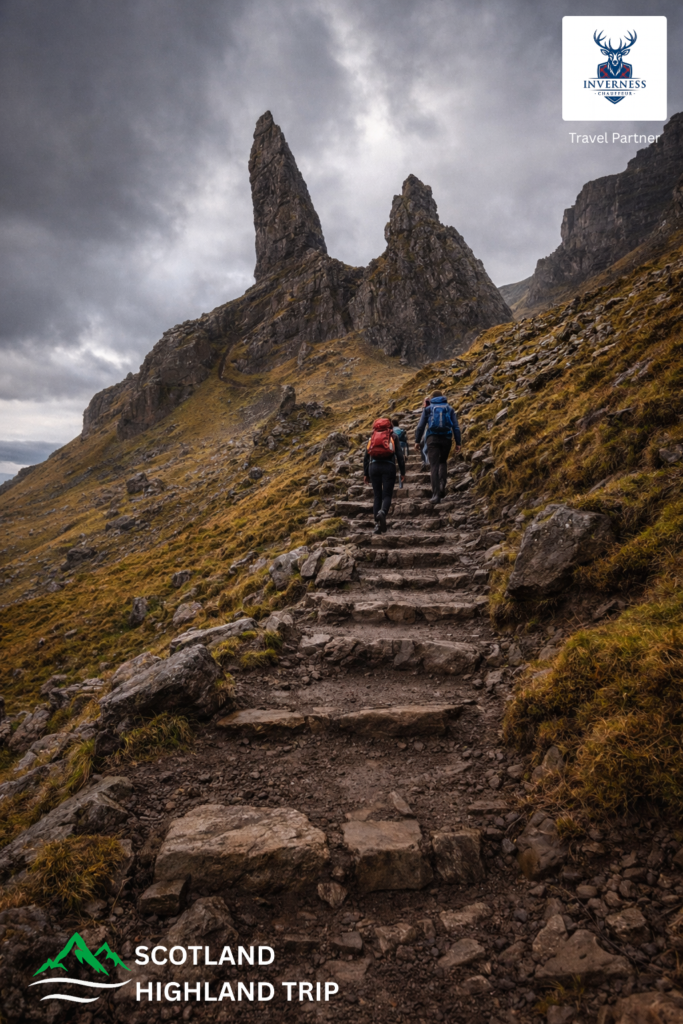
- Difficulty: The route is graded medium and includes a steep uphill climb for the first 30 minutes. Families with older children usually manage fine, but the steep sections and rough stone steps challenge inexperienced walkers.
- Terrain: A well‑constructed gravel path leads from the car park through a gate, then climbs steadily. The final section involves uneven rock steps and can become muddy after rain. Wear proper hiking boots, sneakers or sandals are not suitable.
Parking and costs
- Car park capacity: Approximately 140 spaces.
- Fees: £6 for up to 6 hours; £7 for up to 12 hours. Payment is by coins or contactless card.
- Facilities: Toilets, motorhome waste disposal, bike racks and a coffee stall across the road. The stall serves light refreshments.
- Arrival time: Get there before 10 a.m. during high season for a spot. Avoid roadside parking, it’s prohibited and dangerous.
Getting there: transport options
By car
- From Portree: The Old Man of Storr lies 6.8 miles (10.9 km) north of Portree along the A855. The drive takes about 15 minutes, making Portree the best base for an early start.
- From Inverness: Drive west on the A82 then the A887 and A87 via Loch Ness and Eilean Donnan castle to the Skye Bridge. Continue on the A87 to Portree. The distance is 191 km and takes around 2 hours 30 minutes.
- From Glasgow: The road journey is roughly 347 km and takes about 4 hours 30 minutes. The route via the A82 (past Loch Lomond, Glencoe and Fort William) is scenic but slow, plan additional time for stops.
- From Edinburgh: The drive covers 390 km and takes approximately 4 hours 42 minutes. You’ll travel via the M90 to Perth, the A9 to Inverness and then follow the A87 to Skye.
Pro Tip: Allow extra time for single‑track roads and spectacular viewpoints. Scottish journeys are rarely quick because you’ll want to stop for photos.
By public transport
- From Portree: Stagecoach bus 57A travels from Portree to the Old Man of Storr lay‑by. A return ticket costs around £3 each way, payable by card or cash. Service may run only during school holidays and does not operate on Sundays. Confirm times at the Portree visitor centre.
- From Inverness: Scottish Citylink bus 917 connects Inverness to Portree every four hours, taking approximately 3 hours 15 minutes and costing £24 to £35. From Portree, transfer to Stagecoach bus 57A or hire a taxi.
- From Glasgow: Scottish Citylink bus 915 runs from Glasgow’s Buchanan Bus Station to Portree via Fort William in about 8 hours 24 minutes. This is the cheapest option but is very long.
- From Edinburgh: Without a car you must take a train or bus to Inverness or Fort William and then transfer. The fastest combination (train to Inverness then bus) takes approximately 9 hours 13 minutes. Long public‑transport journeys make day trips impractical, plan to stay overnight on Skye.
By taxi and shuttle
Taxis from Portree are scarce and often busy with school transport; book well in advance. During peak season a shuttle bus runs from Portree to the Storr car park (booking required). This is a good solution if you don’t want to drive and want to avoid parking hassle.
Route Description: Step‑by‑Step Walk
- Start at the car park: Enter through the metal gate; an information sign marks the trailhead.
- Forest section: Walk uphill on a gravel path through clear‑felled woodland. Take the right‑hand branch at the first fork, this route is shorter and rejoins the main path further up.
- Open hillside: The trail leaves the tree line and ascends a grassy slope. Turn around periodically to admire Loch Leathan and the islands of Raasay and Rona. The path becomes rockier with occasional steps.
- Approaching the pinnacles: Continue up uneven rock steps. Here the Old Man of Storr appears on your right. After rain the steps are slippery, use caution.
- The Sanctuary and Needle Rock: Pass between the Old Man and the nearby Needle Rock in a steep section known as the Sanctuary. Needle Rock is also called the Cathedral because of its window‑like shapes.
- Money‑maker view: Continue to the trig point for the classic postcard view across the pinnacles with dramatic cliffs behind. This spot often hosts photographers capturing sunrise or sunset.
- Return: Retrace your steps or follow one of the side paths for different viewpoints. The descent takes 30 to 40 minutes and feels easier than the climb.
Pro Tip: Venture slightly off the main path (where safe) to photograph the pinnacles from varied angles. A loop around the back of the pinnacles offers quieter viewpoints and flatter terrain.
Essential Gear and Safety Tips
- Proper footwear: Wear sturdy hiking boots; rock steps become slippery and mud forms quickly after rain.
- Weather protection: Scotland’s weather changes fast. Bring a waterproof jacket, hat, gloves and layers. Experience Skye also recommends sunscreen and sunglasses, even on cloudy days.
- Hydration and snacks: Carry at least 1 litre of water per person and high‑energy snacks. Pack a picnic for the summit but dispose of rubbish responsibly.
- Navigation: The path is well‑marked and easy to follow without a map in good weather. However, carrying an offline map or GPS app is recommended in case low cloud reduces visibility. Always stick to marked paths to protect fragile vegetation and avoid erosion.
- Equipment: Trekking poles help on steep descents and can relieve pressure on knees. A camera and spare batteries are essential for photographers. Drone flights require a UK flyer and operator ID and are prohibited without permits.
- Safety: Check the weather forecast before leaving and postpone your hike if high winds or heavy rain are forecast. In winter carry microspikes or crampons.
How to Visit the Old Man of Storr From Major Cities
From Inverness
By car:
Drive via the A82 along Loch Ness, then join the A87 towards Skye. The journey takes around 2 hours 30 minutes (191 km). You’ll pass Eilean Donnan Castle, so it’s worth allowing extra time for a stop before continuing to Portree and then the Storr car park.
By bus:
Scottish Citylink route 917 runs from Inverness bus station roughly every four hours and takes about 3 hours 15 minutes to Portree. From there, you can take the Stagecoach 57A or a taxi to reach the Old Man of Storr.
Chauffeur service option:
If you want a smoother experience without worrying about navigation or timing, a private chauffeur from Inverness makes the trip far more relaxed. You can stop at Loch Ness viewpoints, Eilean Donnan Castle, and other scenic spots at your own pace, without being tied to bus schedules or parking constraints.
Day-trip viability:
A day trip from Inverness is possible, but you’ll spend around 6 hours travelling (round trip) if using public transport. Self-driving or hiring a chauffeur gives you much better flexibility to cover key highlights in one day.
From Glasgow
By car:
Take the A82 past Loch Lomond, Glencoe, and Fort William, then cross the Skye Bridge. The drive is around 4 hours 30 minutes (347 km). Breaking the journey in Glencoe or Fort William makes the trip far more enjoyable.
By bus:
Scottish Citylink route 915 runs from Buchanan Bus Station to Portree, taking about 8 hours 24 minutes with one connection. It’s cost-effective but quite tiring for a single day.
Train connections:
There’s no direct rail link to Skye. The West Highland Line ends at Mallaig, after which you’ll need a ferry and bus to reach Portree, significantly extending travel time.
Chauffeur service option:
For long distances like Glasgow to Skye, a chauffeur service from Glasgow turns the journey into part of the experience. Instead of managing an 8+ hour bus trip or driving fatigue, you can enjoy stops in Glencoe, Fort William, and along the Highlands while someone else handles the route.
Day-trip feasibility:
Due to the long travel time, a day trip from Glasgow is not practical. Plan at least two days on Skye, or consider a private chauffeur or multi-day guided experience to make the most of the journey.
From Edinburgh
By car:
Follow the M90 to Perth, then the A9 north to Inverness, and continue via the A87 to Skye. The journey is around 4 hours 42 minutes (390 km) without stops. Scenic detours via Glencoe or Glenfinnan can add extra time but are well worth it.
By train & bus:
Take a train from Edinburgh Waverley to Inverness (≈3h 40m), then the Citylink 917 bus to Portree, followed by the Stagecoach 57A. Total travel time is around 9 hours. An overnight stay is recommended.
Chauffeur service option:
A chauffeur from Edinburgh offers a far more comfortable alternative for such a long route. You can turn the journey into a scenic Highland experience with planned stops, rather than a long, fragmented trip across trains and buses.
Day-trip feasibility:
A day trip from Edinburgh is not realistic. Plan at least two nights on Skye, and combine your visit with nearby attractions like the Quiraing, Fairy Pools, and Dunvegan Castle for a more complete experience.
Viewing Without Hiking: Is It Possible?
You can see the Old Man of Storr from the A855 road and viewpoints around Loch Leathan. However, the iconic close‑up views require at least a short hike. The car park and roadside lay‑by offer distant silhouettes, but to appreciate the rock’s scale, you must ascend to the Sanctuary. If you have mobility issues, walk as far as comfortable on the gravel path and use binoculars for a better view. For wheelchair users the lower section is accessible but becomes steep beyond the first kilometre.
Old Man of Storr Facts and Trivia
- The Old Man stands about 160 feet (49 m) high and is composed of hard basalt, a product of ancient lava flows.
- The Storr sits within the Trotternish landslip, the longest landslide in Britain which created a landscape of spires and cliffs.
- The area’s Gaelic name is “Bodach an Stòir,” meaning “Old Man of Storr.”
- Scenes from Ridley Scott’s film “Prometheus” (2012) were shot here.
- The “face” effect is a result of pareidolia: the brain interprets the rock’s profile as human features.
Frequently Asked Questions (FAQ)
How early should I arrive at the Old Man of Storr?
Arrive at least 30 minutes before sunrise during peak season. The car park fills up by mid‑morning, and early arrival gives you space on the trail and magical sunrise views.
How much time do I need at the Old Man of Storr?
Plan 2 to 3 hours to hike up, explore the Sanctuary and enjoy the views. If you’re a photographer or prefer a relaxed pace, allow an additional hour for photos and rest.
Can I see the Old Man of Storr without hiking?
You can glimpse the pinnacle from the roadside, but the best views require walking at least part of the well‑made trail. If you have limited mobility, walk to the first viewpoint and use binoculars.
Is the Old Man of Storr walk difficult?
The walk is medium difficulty with a sustained uphill climb and uneven rock steps. Wear hiking boots, take your time and bring water. Fit hikers will find it manageable; beginners may need rest stops.
How far is the hike to the Old Man of Storr?
The return walk is 3.8 to 4.5 km with 276 m elevation gain. The viewpoint known as the Money‑maker is about 2 km from the car park.
Are the Fairy Pools on Skye worth visiting?
Yes! Located about 40 minutes southwest of Portree, the Fairy Pools are crystal‑clear waterfalls at the foot of the Cuillin mountains. If you’re spending more than one day on Skye, pair your Old Man of Storr hike with the Fairy Pools for an unforgettable double adventure.
Final Thoughts
The Old Man of Storr is not just a hike; it’s a journey through Scotland’s geological history and folklore. Plan your visit around sunrise or sunset, come prepared for rapidly changing weather, and give yourself ample time to savour the views. Whether you’re travelling from Inverness, Glasgow or Edinburgh, staying overnight on Skye ensures you enjoy the area without rushing.
If you want to experience the Old Man of Storr and the Isle of Skye with local knowledge and comfortable transport, consider booking a guided tour from Portree or Inverness. Guides handle logistics like parking and timing, share stories and geological insights, and can combine your hike with other Skye highlights. Ready to plan your adventure? Contact us for personalised itineraries and insider tips on exploring Scotland’s most iconic landscapes!

Emma is a solo traveler and freelance travel writer from New Zealand who spent three weeks exploring the Scottish Highlands. With a deep appreciation for history and landscapes, she booked a series of day tours and a private chauffeur journey with Scotland Highland Trip. From Loch Ness to the Cairngorms, she documented her experience through vivid blog posts and drone footage.