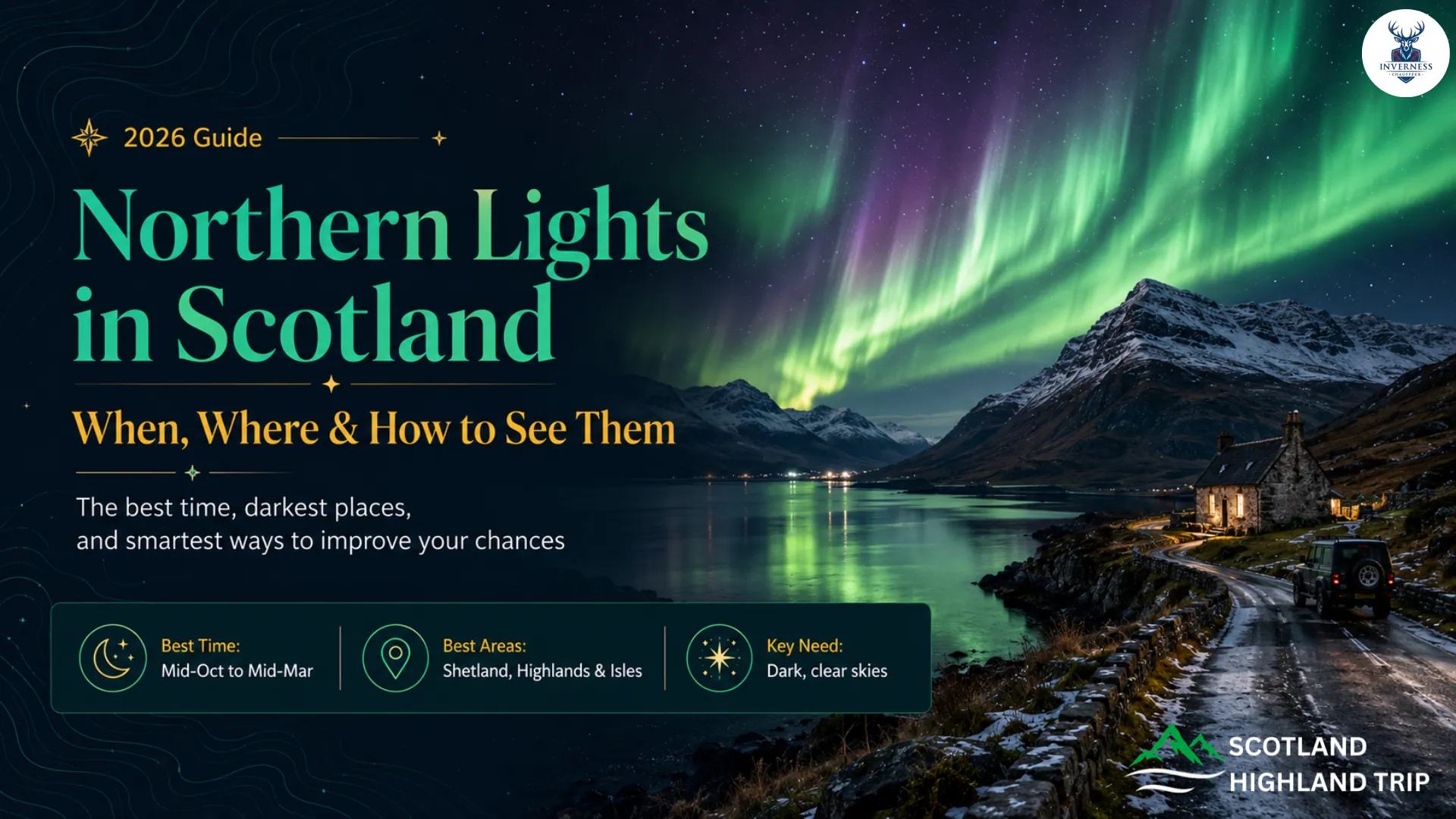
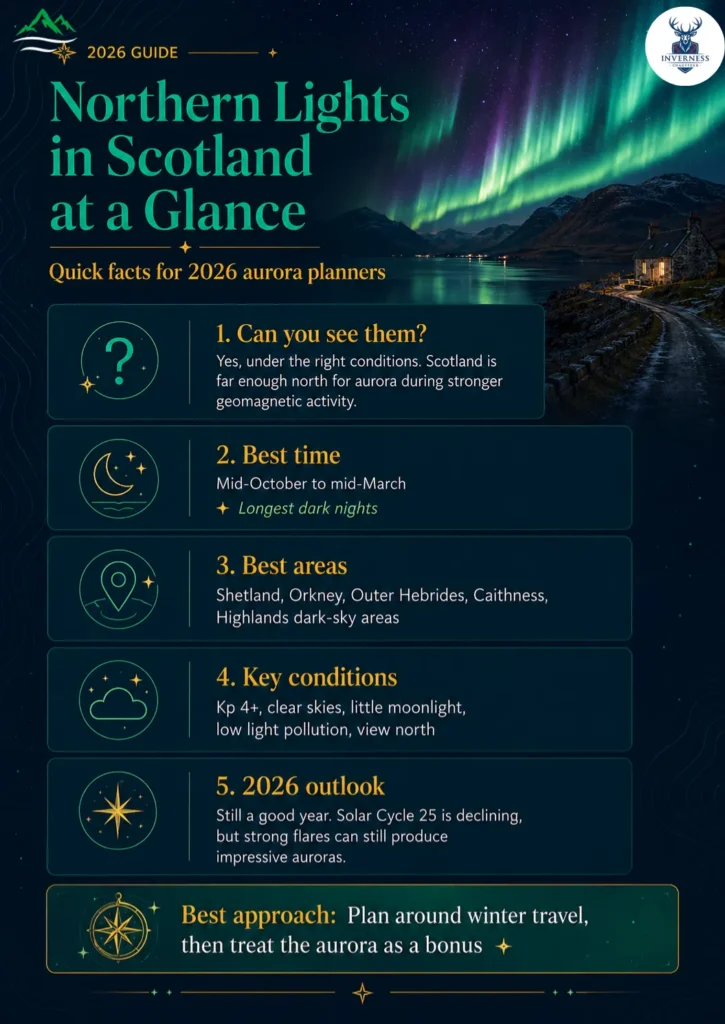
Can you see the Northern Lights in Scotland? Yes, under the right conditions. Scotland sits far enough north to fall within the auroral oval when geomagnetic activity spikes, but a sighting is never guaranteed. You need dark, clear skies, a strong enough geomagnetic storm and an open view to the north.
- Best time: Mid-October to mid-March, when nights are longest. The equinoxes (late September and late March) often bring extra geomagnetic activity, but deep winter delivers the most hours of darkness.
- Best areas: The northern isles (Shetland and Orkney), the Outer Hebrides, the Caithness headlands and remote parts of the Highlands, including the dark-sky parks in the Cairngorms and Galloway.
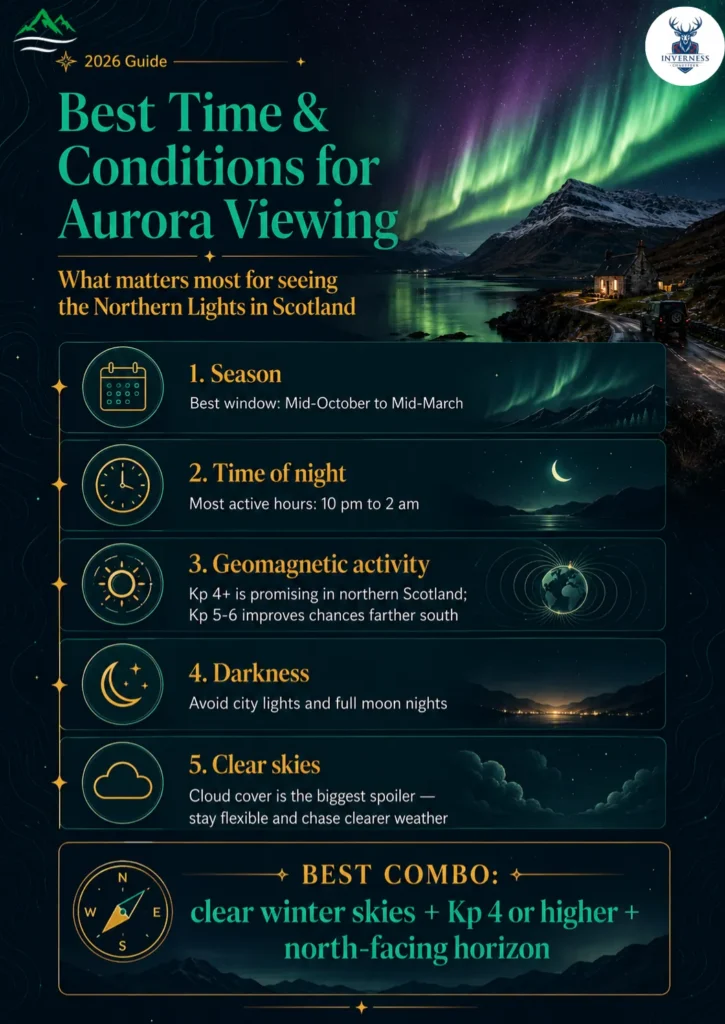
- Key conditions: Strong solar activity (Kp ≥ 4), clear skies, little or no moonlight and minimal light pollution.
- 2026 outlook: Solar Cycle 25 peaked in late 2024 and is now declining, but powerful solar flares still occur on the downslope. That keeps 2026 a promising year just not as prolific as 2024–25. Treat the aurora as a bonus rather than a certainty.
Jump to Sections
How the aurora works and why Scotland can catch it
The aurora borealis, those shimmering bands of green, pink and purple, appears when charged particles from the sun collide with atoms high in Earth’s atmosphere. The display forms a ring, the auroral oval, centred on the magnetic pole.
When geomagnetic activity rises, that oval expands southwards. Scotland lies roughly between 55° and 60° north, so during moderate storms (Kp 4–6) the oval can dip far enough for northern Scotland to slip beneath it. The further north you stand, the better your odds: as Shetland’s tourism board points out, the islands sit closer to the North Pole than anywhere else in Britain, and a keen observer scanning clear winter skies there could reasonably expect several displays across a single season.
Even there, nothing is certain. Cloud can smother a strong show, and the aurora’s timing is famously erratic. That’s why the local advice everywhere in Scotland is the same, pair aurora-watching with other winter draws like hiking, wildlife-watching or the fire festivals, so the trip rewards you whether or not the sky performs.
When to see the Northern Lights in Scotland
Seasonal windows
The aurora can technically appear at any time, but darkness is vital. In summer, the northern nights are simply too bright for auroral colours to show. The Shetland tourism board advises that aurorae are most likely between mid‑October and mid‑March. Darkness deepens after the clocks go back, and by December the nights are long enough for several observing windows.
The National Oceanic and Atmospheric Administration (NOAA) notes that the best auroral activity typically occurs around the equinoxes, when interactions between the solar wind and Earth’s magnetic field favour geomagnetic storms. Late September and late March often produce spectacular displays, but they coincide with rapidly changing daylight hours (longer days in spring and shorter in autumn), so plan accordingly.
Time of night
According to NOAA’s Space Weather Prediction Center, the most active hours are generally between 10 pm and 2 am local time. Activity peaks around midnight but can expand earlier or later when the geomagnetic field is very active. Go out after dinner, bring a hot drink and be prepared to wait, the aurora can appear suddenly, vanish, then return.
2026 and the solar cycle
Solar activity follows an 11‑year cycle. Solar Cycle 25 began in December 2019 and reached its solar maximum in October 2024, when sunspots, flares and coronal mass ejections were at their most frequent. Space.com’s solar‑physics analysis notes that 2025 entered the declining phase and 2026 will continue this trend, meaning fewer sunspots and flares overall, but not the end of strong auroras. Historical precedent shows that some of the largest flares occur in the declining phase. Hurtigruten’s aurora experts similarly emphasise that intense auroral displays are often most common during the years after solar maximum and that elevated activity is expected to last through 2026-27. In short, 2026 remains a good time to try your luck, especially during the autumn and winter months.
Where to see the Northern Lights in Scotland
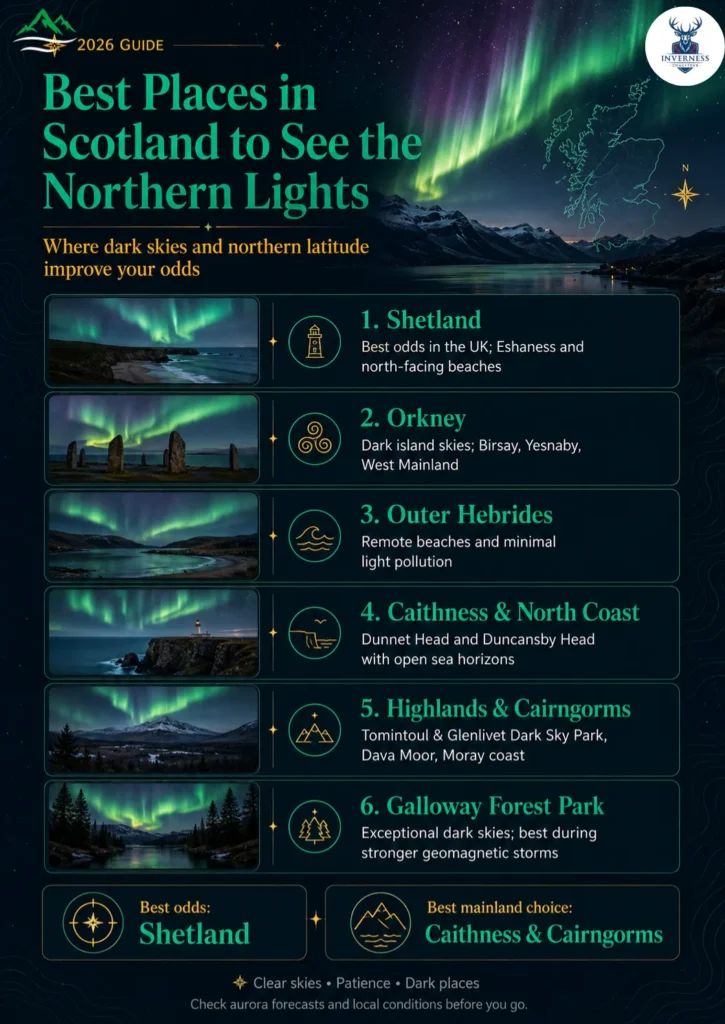
Successful aurora hunting depends on two things: latitude (how far north you are) and sky quality (darkness and clear horizons). Here’s how Scotland’s regions stack up.
Shetland Islands
- Latitude & advantage: The northernmost point of the UK, lying closer to the North Pole than any other part of Britain. Shetland’s latitude increases your odds – a keen observer can expect several displays over a typical winter.
- Viewing spots: Eshaness cliffs and north‑facing beaches offer unobstructed horizons. Avoid Lerwick’s street lights and head towards quiet headlands.
- Practicalities: Travel involves flights or overnight ferries; winter weather can be wild, so plan flexible itineraries. Combine aurora watching with coastal walks, Viking history and Up Helly Aa fire festivals.
Orkney Islands
- Slightly south of Shetland but still high in latitude; known for dark skies and archaeological sites. Good viewing points include Birsay, Yesnaby and the west Mainland coast.
- Fewer crowds than Shetland; accessible via ferry or plane from the mainland.
Outer Hebrides (Lewis & Harris)
- Remote islands in the Atlantic with almost no light pollution. Beaches like Luskentyre, Traigh Mhòr and Uig Sands provide wide horizons. The northern lights, when they appear, dance over white sand and turquoise water.
- Weather can be windy and changeable; bring waterproofs. Even if the aurora doesn’t show, the Outer Hebrides are worth the journey for landscapes and Gaelic culture.
Caithness & the North Coast
- Mainland Scotland’s extreme north offers accessible aurora spots. Dunnet Head and Duncansby Head are the most northerly points reachable by road and have open sea horizons, ideal for last‑minute aurora chases. The flat terrain gives you a wide view of the northern sky.
- Combine aurora hunting with the North Coast 500 road trip; just be aware that services are sparse in winter.
Highlands & Wester Ross
- The Highlands are not as far north as Shetland but offer darkness and wide open spaces. Wester Ross and Applecross are less busy in winter and Atlantic winds can quickly clear cloud.
- On the west coast, choose north‑facing viewpoints like Shieldaig, Torridon’s high passes and Applecross Bay. On the east, Moray Firth’s coastline often has clearer skies than the mountains.
Cairngorms National Park & Dark‑Sky Parks
- In 2018 the Tomintoul & Glenlivet area of the Cairngorms was awarded Gold Tier Dark Sky Park status, making it one of the best places in the world to stargaze. This remote upland has minimal artificial light.
- Visit Cairngorm Mountain car park or Feith Musach near Tomintoul for north‑facing views. Glenlivet Estate and Glen Tanar Visitor Centre are official Dark‑Sky Discovery Sites. Dava Moor above Forres and the Moray Coast can offer clearer skies when the mountains are cloudy.
- Bring binoculars or a telescope and give your eyes 30 minutes to adjust. The Cairngorms website stresses the importance of avoiding man‑made light, even car headlights can spoil your view. Dark‑sky events and astronomy workshops in Glenlivet teach visitors how to recognise the aurora.
Galloway Forest Park
- Britain’s first International Dark Sky Park, Galloway is special because of its remoteness. On a clear night, over 7000 stars are visible and the Milky Way arches overhead.
- Although far south, occasional auroras can be seen during strong geomagnetic storms. This is the darkest region in southern Scotland and worth visiting for stargazing.
Edinburgh & urban Scotland
- In rare cases of very strong geomagnetic storms, the aurora can be seen from Edinburgh’s hills (Calton Hill, Blackford Hill or Arthur’s Seat). However, these are exceptions; do not plan your trip around them. Light pollution means colours will appear faint if at all.
Is aurora viewing better in the Highlands?
The Highlands provide dark skies and rugged beauty, but they are not automatically “better” than the far north. Latitude matters: Shetland and Caithness sit closer to the auroral oval, so moderate storms (Kp 4-5) may produce displays there while the Highlands remain aurora‑free. However, cloud cover on the west coast is often heavier; east‑coast Highlands, Moray and Cairngorm foothills can have clearer skies. The Highlands excel in combining aurora chasing with winter hiking, distillery visits or wildlife spotting. For visitors based in Inverness, short drives to Dava Moor, Moray Firth beaches or Tomintoul offer dark horizons without crossing the Pentland Firth.
Conditions that matter most
- Geomagnetic activity: Aurora strength is measured using the Kp index, which ranges from 0 (very weak) to 9 (extreme). According to NOAA, low Kp values (0-2) keep the auroral oval around 66° north; Kp 3-5 brings the aurora further south and makes it brighter; Kp 6-7 can make it visible at Scotland’s latitude. Strong events (Kp 8-9) can send auroras deep into England, but these are rare. Apps like AuroraWatch UK provide colour‑coded alerts based on geomagnetic conditions.
- Darkness: The aurora may occur, but you need darkness to see it. NOAA advises getting away from city lights; a full moon will diminish apparent brightness. Plan your trip around the lunar cycle and avoid observing around the full moon. In summer at high latitudes, it may never get dark enough.
- Clear skies: Cloud cover is the biggest spoiler. Scotland’s weather is variable, so check local forecasts and be ready to drive to clearer areas. Coastal locations often have changeable conditions; winds can clear low cloud quickly in Wester Ross.
- Orientation and horizon: Stand somewhere with an unobstructed view to the north. The Cairngorms site recommends high points like Cairngorm car park or Feith Musach and notes that even small hills like Dava Moor offer wide horizons. Avoid mountains or trees blocking the northern sky.
- Moon phase: A bright full moon can wash out weak auroras. Target new moon or crescent phases for maximum contrast.
How to improve your chances
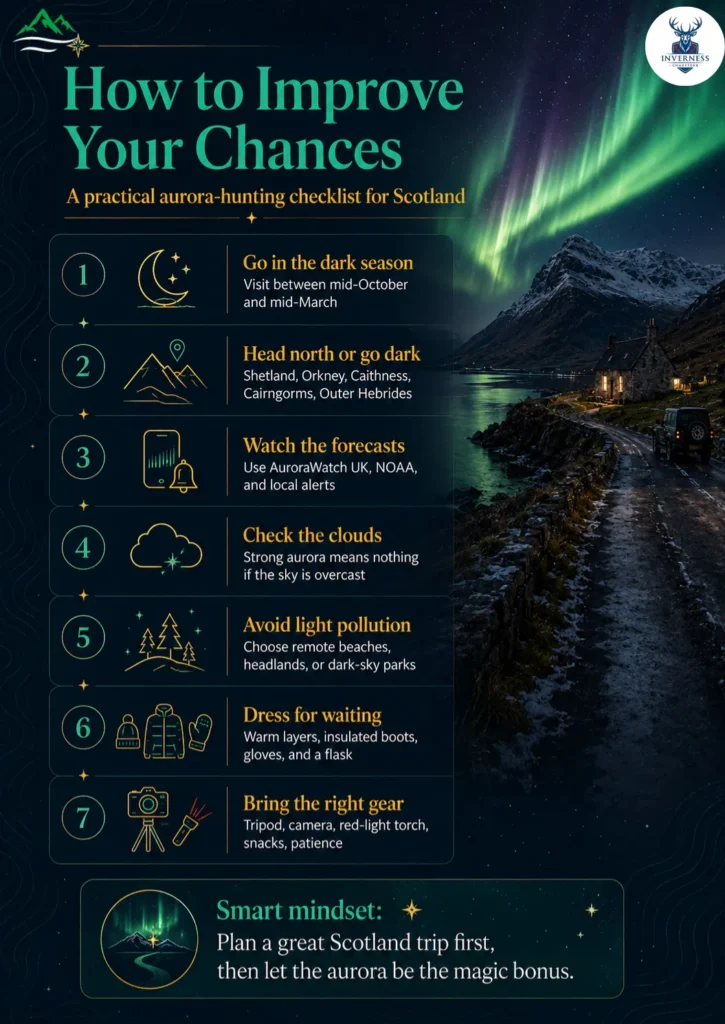
- Plan for dark months and late nights: Visit between mid‑October and mid‑March; go out between 10 p.m. and 2 a.m. when auroral activity is strongest. Avoid full‑moon nights.
- Choose the right place: If chasing the aurora is your priority, head north to Shetland, Orkney or Caithness. For a balanced trip, stay in the Highlands or Outer Hebrides where other attractions compensate if the aurora is absent. Use dark‑sky parks such as Tomintoul & Glenlivet and Galloway for the darkest horizons.
- Monitor forecasts: Use AuroraWatch UK, Glendale Skye Aurora, Aurora Alerts and NOAA’s Aurora Dashboard to track Kp indices and solar‑wind data. Follow them on social media and set up notifications. Learn what Kp value is needed for your latitude.
- Check weather and cloud maps: Even strong geomagnetic activity is useless if skies are overcast. Use local meteorological forecasts and keep a flexible itinerary.
- Avoid light pollution: Drive away from towns, street lights and even car headlights; dark‑sky sites like Glen Tanar or remote beaches provide better contrast.
- Be patient and comfortable: Bring layered clothing, hats and gloves – winter nights in Scotland can be below freezing. The Shetland page emphasises wrapping up warmly and carrying a flask of hot tea or coffee. Pack a head torch with a red filter to preserve night vision.
- Use the right equipment: For photography, a tripod is essential. The Shetland site suggests exposures around 15 seconds; some cameras work on automatic with the flash turned off. Experiment with manual focus and long exposures of 20 to 30 seconds (as suggested by local enthusiasts in the Cairngorms).
- Combine with other experiences: Because aurora sightings can’t be guaranteed, plan daytime activities: winter hikes, whisky tours, wildlife watching, exploring castles or attending Hogmanay celebrations. That way your trip is rewarding even if the aurora is shy.
What are the chances tonight?
This article is not a live forecast. Tonight’s chances depend on current geomagnetic and weather conditions. Here’s how to interpret forecast tools:
- AuroraWatch UK alerts: Developed by Lancaster University, it monitors geomagnetic activity from magnetometers across the UK and issues four‑tier alerts (green, yellow, amber, red). A red alert (Kp ~ 5-6) means auroras are likely visible from northern Scotland; amber suggests possible visibility from north/north‑east.
- Kp index: If the forecasted Kp value is 4 or above, auroras may be visible from northern Scotland; Kp 5-6 increases chances in central Scotland; Kp 7-8 may bring displays to much of the UK. Remember these are estimates; local conditions matter.
- Cloud forecasts: Even with a high Kp, heavy clouds will block the view. Check multiple weather apps and satellite imagery.
- Solar cycle awareness: Although the number of sunspots will decrease through 2026, strong flares can still occur and produce impressive auroras. Don’t assume the show is over after solar maximum.
Best places in Scotland for aurora viewing at a glance
| Region | Latitude/advantage | Key spots & notes |
| Shetland | Closest to the North Pole in Britain; highest odds of aurora in UK | Eshaness cliffs, Unst beaches; avoid Lerwick lights; unpredictable weather |
| Orkney | High latitude, dark rural landscapes | Birsay, Yesnaby, West Mainland coast; combine with Neolithic sites |
| Outer Hebrides | Remote Atlantic islands with minimal light pollution | Luskentyre, Traigh Mhòr, Uig Sands; wide horizons; windy weather |
| Caithness & North Coast | Mainland’s northern tip; accessible by road | Dunnet Head, Duncansby Head; part of NC500; clear sea horizons |
| Highlands (Wester Ross & Applecross) | Dark skies, dramatic landscapes | Shieldaig, Torridon, Applecross pass; need to chase clear skies |
| Cairngorms Dark‑Sky Park (Tomintoul & Glenlivet) | Gold Tier Dark Sky Park; less cloud than west coast | Cairngorm car park, Feith Musach, Dava Moor; Glenlivet Estate; Moray Firth coast |
| Galloway Forest Park | International Dark Sky Park; darkest skies in southern Scotland | Clatteringshaws, Stroan Loch, Glentrool; good for stargazing even if aurora absent |
| Edinburgh & Central Belt | Rarely visible; only during major storms | Calton Hill, Blackford Hill; treat as a bonus |
What to wear, bring and expect
- Warm layered clothing: Thermal base layers, insulating mid‑layers, waterproof outer layers, hats, gloves and insulated boots. Temperatures can dip below zero and wind chill makes waiting uncomfortable.
- Head torch with red filter: Red light preserves night vision and helps you navigate in the dark.
- Tripod & camera: Long exposures (15 to 30 seconds) capture more colour than the naked eye. Consider remote shutter release to avoid shake.
- Hot drink & snacks: The Shetland tourism board recommends taking a flask of tea or coffee for long nights.
- Patience & flexibility: Be ready to travel to clearer skies or wait several hours. Treat the hunt as an adventure, not just a photo opportunity.
Frequently asked questions
When can you see the Northern Lights in Scotland in 2026?
The best window is mid‑October to mid‑March, when nights are long and dark. Equinox periods (late September and late March) can deliver strong geomagnetic storms. Solar Cycle 25 is in decline after a 2024 peak, but strong flares can still occur through 2026, so keep an eye on forecasts.
Is aurora viewing better in the Highlands than on the islands?
Not necessarily. Shetland and Orkney sit further north, so moderate geomagnetic activity can produce auroras there while the Highlands stay dark. However, the Highlands offer dark skies, accessible hills and alternative activities. Choose according to your broader itinerary and be ready to move to clear spots.
What is the best month to visit northern Scotland for the aurora?
November to February offer the longest nights and thus more opportunities, but December to January often have cloudier weather. October and March may have slightly milder weather and benefit from equinox geomagnetic boosts. Avoid summer because it never gets fully dark at high latitudes.
Can you see the Northern Lights near Inverness?
Yes, during strong geomagnetic storms. Head to dark, north‑facing spots like Dava Moor, Lochindorb, Milton Loch, Glenlivet Estate or Moray Firth beaches for a clearer horizon. Use apps to monitor Kp values and cloud cover.
What are the chances of seeing the Northern Lights in Scotland tonight?
No blog can tell you, you need to check live aurora forecasts and local weather. A Kp of 4 to 6 coupled with clear skies and minimal moonlight is promising. Follow AuroraWatch UK or Glendale Skye Aurora for real‑time alerts and be prepared to act quickly when conditions align.
Where are the darkest places in Scotland for aurora viewing?
Galloway Forest Park, Tomintoul & Glenlivet Dark‑Sky Park, and remote beaches in the Outer Hebrides and Caithness offer some of Scotland’s darkest skies. These areas have little light pollution and wide horizons.
Is it worth planning a Scotland trip around the Northern Lights?
Plan with the Northern Lights in mind, not for them. Scotland’s aurora is unpredictable; even in Shetland there’s no guarantee. Build an itinerary that includes winter hiking, whisky distillery visits, wildlife watching or festive events. Treat aurora sightings as a bonus that makes an already rewarding trip even more special.
Final thoughts
The Northern Lights can be a breathtaking highlight of a Scotland trip, but they are never guaranteed. To maximise your chances, visit during the darkest months (mid‑October to mid‑March), choose northern or dark‑sky locations, monitor geomagnetic forecasts and cloud cover, avoid full moons, and remain flexible. The solar maximum of 2024 means 2026 still sits in a period of elevated solar activity, so spectacular displays are still possible but treat them as an unpredictable gift. Whether or not the aurora appears, Scotland’s winter landscapes, cosy villages and rich culture will ensure your trip is memorable.
Emma is a solo traveler and freelance travel writer from New Zealand who spent three weeks exploring the Scottish Highlands. With a deep appreciation for history and landscapes, she booked a series of day tours and a private chauffeur journey with Scotland Highland Trip. From Loch Ness to the Cairngorms, she documented her experience through vivid blog posts and drone footage.