A ten-day itinerary labelled “Scotland” can still give you only two full days in the Highlands. That is the first number Australian travellers should check before comparing hotels, coaches or package prices.
The best Highlands tour depends on four things: the time you can give the region, how much fixed scheduling you enjoy, whether you want to drive, and whether your priority is a set of famous sights or a slower regional experience. For most first-time Australian visitors, four to six full Highland days is a sensible target. Use Inverness for the north and east, then add a western base such as Fort William or Skye if island and west-coast scenery matter.
One day is a snapshot, not a complete Highland experience. It can work within a wider UK holiday, but it is poor compensation for travelling from Australia if the Highlands are one of the main reasons for the trip.
Jump to Sections
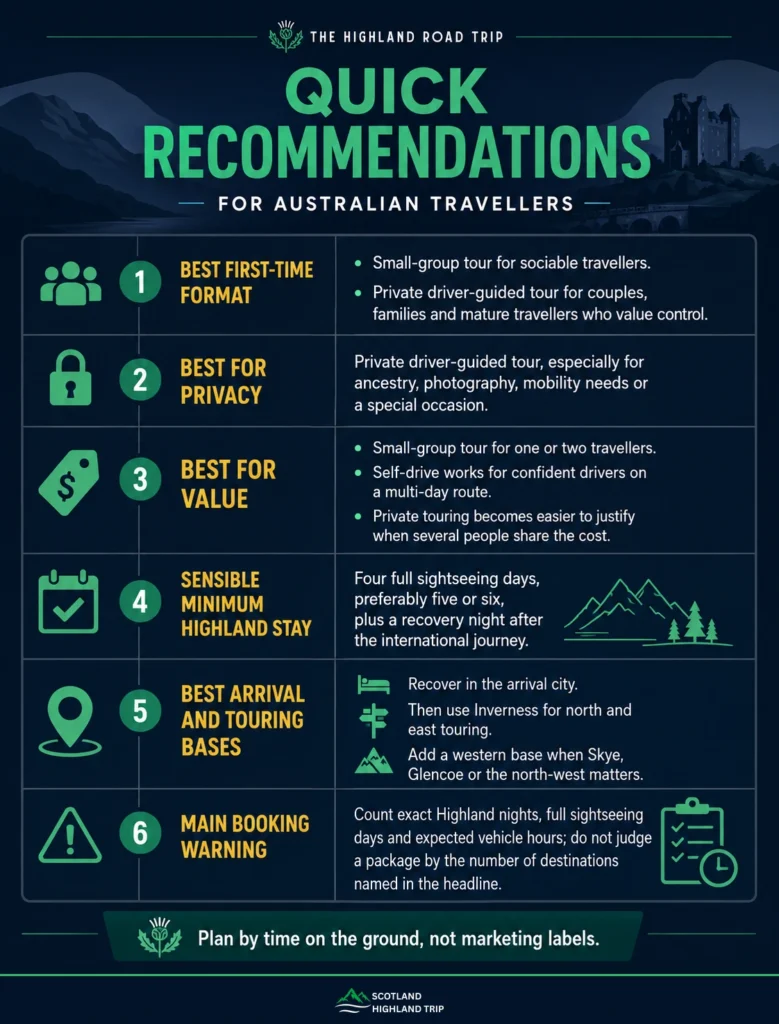
Quick recommendation for Australian travellers
| Planning decision | Practical recommendation |
|---|---|
| Best first-time format | A small-group tour for sociable travellers, or a private driver-guided tour for couples, families and mature travellers who value control over the pace. |
| Best for privacy | A private driver-guided tour, especially for ancestry, photography, mobility needs or a special occasion. |
| Best for value | A small-group tour for one or two travellers. Self-drive can work well for confident drivers on a multi-day route. Private touring becomes easier to justify when several people share the total vehicle cost. |
| Sensible minimum Highland stay | Four full sightseeing days, preferably five or six. Add a separate recovery night after the international journey. |
| Best arrival and touring bases | Recover in the Scottish city where you arrive, then use Inverness for focused north and east Highland touring. Add a western base when Skye, Glencoe or the north-west is a priority. |
| Main booking warning | Count exact Highland nights, full sightseeing days and expected vehicle hours. Do not judge a package by the number of destinations named in the headline. |
If you want to see what a locally based operator currently offers, compare the one-day Highland tours from Inverness. Treat each tour page as its own product, because duration, pickup, format and inclusions vary by route.
What should Australians expect from a Highlands tour?
The Highlands reward distance differently from Australia. A route may look short on a map, yet take far longer than expected because the road bends around lochs, crosses mountain country or narrows to a single lane. The problem is rarely the headline distance. It is the combination of slower roads, parking, weather, photo stops and attractions that deserve more than twenty minutes.
This has three practical consequences.
First, a day with four meaningful stops is usually better than a day with nine names on the itinerary. Secondly, a long coach day may cover a large area without giving you much control over where time is spent. Thirdly, changing base can reduce backtracking. Two or three nights in Inverness followed by two nights in the west often produces a better holiday than returning to the same city after every long drive.
The weather also changes the value of a route. Low cloud can remove a mountain view, heavy rain can slow a walk, and wind can affect exposed island stops. A good itinerary therefore has priorities and alternatives, not a minute-by-minute promise that ignores conditions.
For travellers arriving after a long-haul flight and a major time-zone change, do not make a full Highland road day the first task. Stay the first night in your arrival city or Inverness, eat, sleep and begin the longer route the following morning. Collecting an unfamiliar hire car and immediately attempting a remote itinerary is avoidable fatigue.
Which Highland tour style is best?
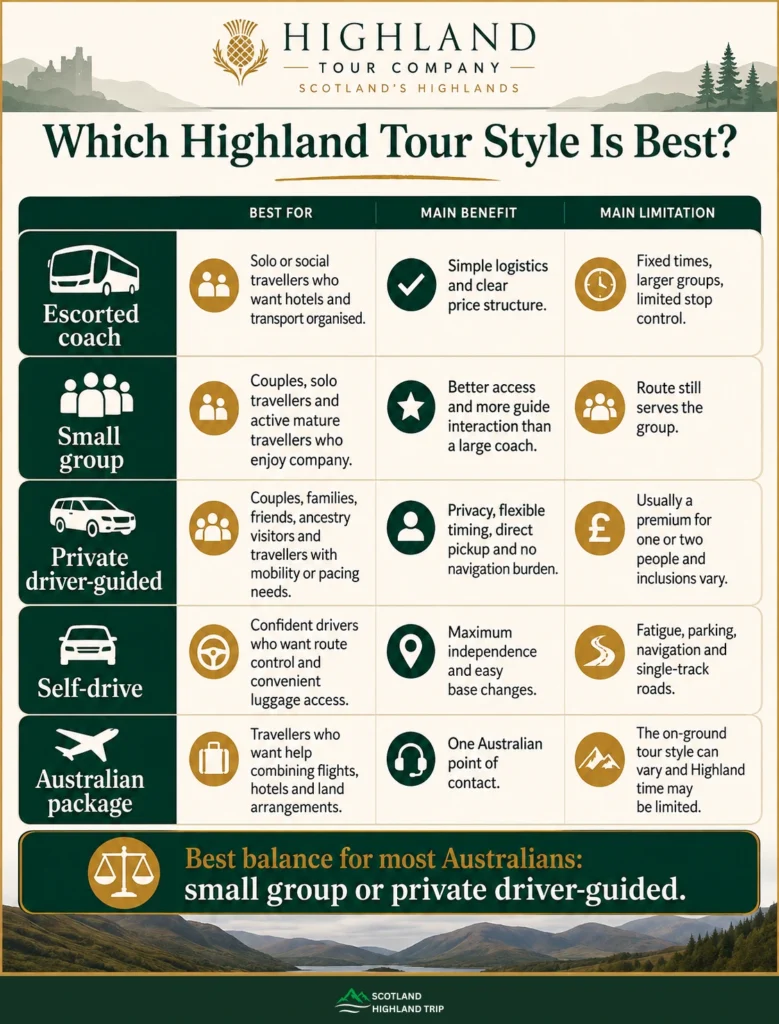
| Tour type | Best for | Main benefit | Main limitation |
|---|---|---|---|
| Escorted coach | Solo travellers, social travellers and people who want hotels and transport organised | Simple logistics and a clear overall price structure | Fixed departure times, larger groups and limited control over stops |
| Small group | Couples, solo travellers and active mature travellers who enjoy company | Better access and more guide interaction than a large coach | The route still serves the group, not one traveller’s priorities |
| Private driver-guided | Couples, families, friends, ancestry visitors and travellers with mobility or pacing needs | Privacy, flexible timing, direct pickup and no navigation burden | Usually a premium for one or two people and inclusions vary by provider |
| Self-drive | Confident drivers who want route control and convenient luggage access | Maximum independence and the ability to change bases easily | Driver fatigue, parking, navigation and single-track roads require attention |
| Australian package | Travellers who want help combining flights, hotels, payments and land arrangements | One Australian point of contact may simplify a complex holiday | The on-ground tour can still be coach, small group, private or self-drive, and Highland time may be limited |
Escorted coach tours
An escorted coach is a sound choice when convenience matters more than individual control. Accommodation is organised, luggage movements are usually structured, and there is a group to travel with. This can be reassuring for a first European trip or for someone travelling alone.
The compromise is not simply group size. It is the timetable. The coach leaves when the group leaves, comfort stops serve everyone, and the guide must keep the itinerary moving. A seven-day Scotland tour may still feel busy if it combines Edinburgh, Skye, Inverness, Glencoe and Glasgow.
Before booking, ask for the maximum group size, the normal departure time, the longest coach day and the approximate time at the places you care about most.
Small-group tours
Small groups usually offer the best balance for one or two travellers who do not want to drive. They retain a social atmosphere but can use smaller vehicles, load more quickly and give the guide more time for questions.
Do not rely on the phrase “small group” alone. One company may mean twelve guests and another may mean twenty-four. Check the actual maximum, the seating layout, luggage allowance and whether accommodation is included or booked separately.
Private driver-guided tours
Private touring is most useful when the value lies in controlling the day. It suits an ancestry visit with specific villages or cemeteries, a family that needs regular breaks, a couple who wants photography stops, or older travellers who prefer hotel pickup and less walking.
For two people, private touring is normally a premium choice. For four or more, compare the total vehicle price with four individual tour fares, hire-car costs, fuel, parking and the value of having no designated driver. The gap can narrow, but private is not automatically cheaper.
Private also does not mean that every expense is included. Ask whether the quote covers the vehicle, driver-guide, fuel, parking, waiting time, attraction entry, meals and hotel accommodation. Review our fleet and vehicle information against your passenger count and luggage, rather than choosing only by the number of seats.
Self-drive holidays
Self-drive works well for Australians who are comfortable with frequent roundabouts, rural roads and daily navigation. It is particularly useful for multi-base trips because luggage stays with you and the route can change with weather.
It is less attractive when only one person will drive, the party wants whisky tastings, or the route contains several consecutive long days. A hybrid can be better: use trains between major cities, take a local guided day for the most demanding route, then hire a car for easier regional days.
For a deeper format comparison, read guided tours versus self-drive in the Highlands.
Australian package tours
An Australian package is a booking arrangement, not one touring style. It may contain an escorted coach, a small-group tour, a self-drive plan or separate day tours. Some packages include international flights and others are land-only.
The advantage is coordination. An Australian adviser may help align flight dates, pre-tour nights, transfers and payments. The risk is assuming that a broad Scotland package gives the Highlands the attention you want. Read the day-by-day plan and count nights physically spent north or west of the central belt.
Best Highland routes for Australian visitors
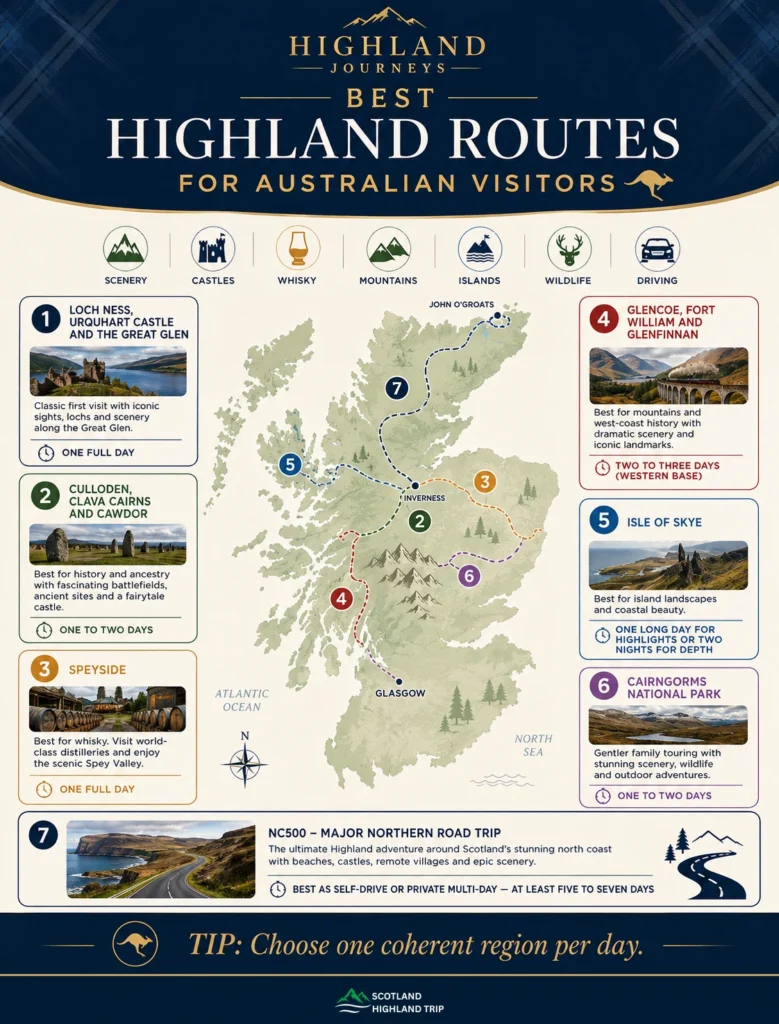
| Traveller priority | Suggested area | Suitable tour format | Time needed |
|---|---|---|---|
| Classic first visit | Loch Ness, Urquhart Castle and the Great Glen | Small group, private or self-drive | One full day |
| History and ancestry | Culloden, Clava Cairns, Cawdor and relevant clan areas | Private or focused small group | One to two days |
| Whisky | Speyside | Private driver-guided or small group | One full day |
| Mountains and west-coast history | Glencoe, Fort William and Glenfinnan | Small group, private or self-drive | Two to three days with a western base |
| Island landscapes | Isle of Skye | Small group, private or self-drive | One long day for highlights, two nights for depth |
| Remote north-west scenery | Wester Ross, Torridon and Assynt | Private or self-drive | Three to four days for Torridon and Assynt together |
| Wildlife and gentler family touring | Cairngorms National Park | Private, small group or self-drive | One to two days |
| Major northern road trip | NC500 | Self-drive or private multi-day tour | At least five to seven days |
Loch Ness, Urquhart Castle and the Great Glen
This is the most sensible single Highland day for a first-time visitor based in Inverness. It combines a famous landscape, a major historic site and shorter stops without requiring an island-length driving day.
It suits couples, families and mature travellers. The compromise is popularity. You are choosing a recognised Highland introduction rather than remote country. Our Loch Ness route from Inverness should be checked for its current duration, optional cruise and entry arrangements before booking.
Culloden, Clava Cairns and Cawdor
This cluster gives more history per kilometre than many Highland routes. Culloden and Clava are close to Inverness, which makes them useful on a shorter first or final day. Cawdor can extend the route when its visitor arrangements suit your dates.
An ancestry traveller should not stop at a generic battlefield itinerary. Research the relevant clan area, parish records and family locations first, then decide whether a private day is justified. Scottish ancestry travel guide is a useful planning companion.
Speyside and whisky country
Speyside works as a full day from Inverness and is one of the clearest cases for using a driver. Nobody in the party has to remain the designated driver, and pre-booked distillery times can be coordinated into a realistic route.
Do not assume tastings and entry are part of the transport price. For example, our Speyside Classic Whisky Tour states that distillery visits must be pre-booked by the customer and that entry, tastings and lunch are not included. Treat that as a product-specific detail, not a rule for every whisky tour.
Glencoe and Fort William
Glencoe is most efficient from Glasgow, Fort William or a western base. It can form part of a transfer between Glasgow and the Highlands, which is often better than driving the same road out and back.
One day can cover major viewpoints and a short walk. Add a second day if Glenfinnan, the Nevis Range or a proper hike matters. Travellers who place Glencoe high on the list should not stay in Inverness for the entire Highland portion simply because Inverness is called the Highland capital.
Isle of Skye
Skye can be visited from Inverness in one day, but it is a long day. Our current Inverness to Skye day tour is published at approximately twelve hours, with an early Inverness departure and a return in the evening. It is designed around major viewpoints and shorter stops.
That format suits travellers who are short on time and comfortable spending a substantial part of the day in a vehicle. It does not provide a full island experience. You will not combine the Trotternish Peninsula, long walks, the far west, multiple castles and an unhurried meal in one sensible day.
If Skye is one of the main reasons for travelling to Scotland, stay at least two nights. One full day on the island plus the arrival and departure journeys gives you room for weather and reduces the pressure to collect every famous photograph before returning to Inverness.
Applecross, Wester Ross, Torridon and Assynt
These areas are for travellers who value landscape and road experience more than a list of ticketed attractions. They also expose the weakness of map-based planning. Single-track stretches, passing traffic and worthwhile stops make progress slower.
Applecross and Torridon can form a long day from Inverness, but an overnight near Shieldaig, Torridon or Kinlochewe gives the route room to breathe. Assynt is better treated as a separate base farther north. The detailed Torridon and Assynt guide explains why combining both deserves three to four days rather than one windscreen tour.
Cairngorms National Park
The Cairngorms suit families, wildlife interests, short walks and travellers wanting a shorter day than Skye. Aviemore and nearby attractions can also work as a second base between Edinburgh and Inverness.
Check every attraction separately because operating dates, entry and weather-dependent activities can change. The current Cairngorms tour from Inverness has its own published duration and inclusion list. Those details should not be applied to other tours.
Selected NC500 sections or the full route
The NC500 is not a one-day attraction. The circular route is about 516 miles, and a sensible first attempt needs at least five to seven days. Even then, the aim should be selected walks, villages and coastlines, not completing the mileage as quickly as possible.
For a first Scotland visit with fewer than seven Highland nights, choose one section. The east offers castles and coastal stops, while the west offers slower roads and stronger mountain scenery. Read the site’s five-day NC500 planning guide before adding the full loop.
Is Inverness a good base for Australian visitors?
Yes, Inverness is one of the most useful Highland bases, but it is not a solution for the whole region.
| Base | Strongest for | Main weakness | Best use |
|---|---|---|---|
| Inverness | Loch Ness, Culloden, Clava Cairns, the Black Isle, Speyside, the Cairngorms and selected northern routes | Skye is a long day, and repeated trips to Glencoe or the far north-west create too much backtracking | Two to four nights for a first visit |
| Edinburgh | Edinburgh itself, St Andrews, Perthshire and an organised start to a wider Scotland tour | A one-day return trip to the deeper Highlands spends too much time reaching them | Arrival city, cultural stay and start of a northbound itinerary |
| Glasgow | Loch Lomond, Glencoe, Oban and the road towards Fort William | Less efficient for Loch Ness, Culloden, Speyside and the far north | Arrival city and gateway to the west |
| Multiple bases | Skye, Fort William, Wester Ross, Assynt and slower regional travel | More hotel changes and planning | Best option when the Highlands have four or more nights |
Inverness is particularly good for travellers who dislike changing hotels. A three-night stay can support a classic Loch Ness day, a heritage or Speyside day, and a shorter local day. Families can also use our guide on trip to Scottish Highlands with children when choosing a base and daily pace.
The better question is not “Edinburgh or Inverness?” It is “Which part of the trip belongs in each?” Edinburgh is a major destination. Inverness is a regional touring base. Treating them as interchangeable starting points leads to unnecessarily long days.
How many days do Australians need in the Highlands?
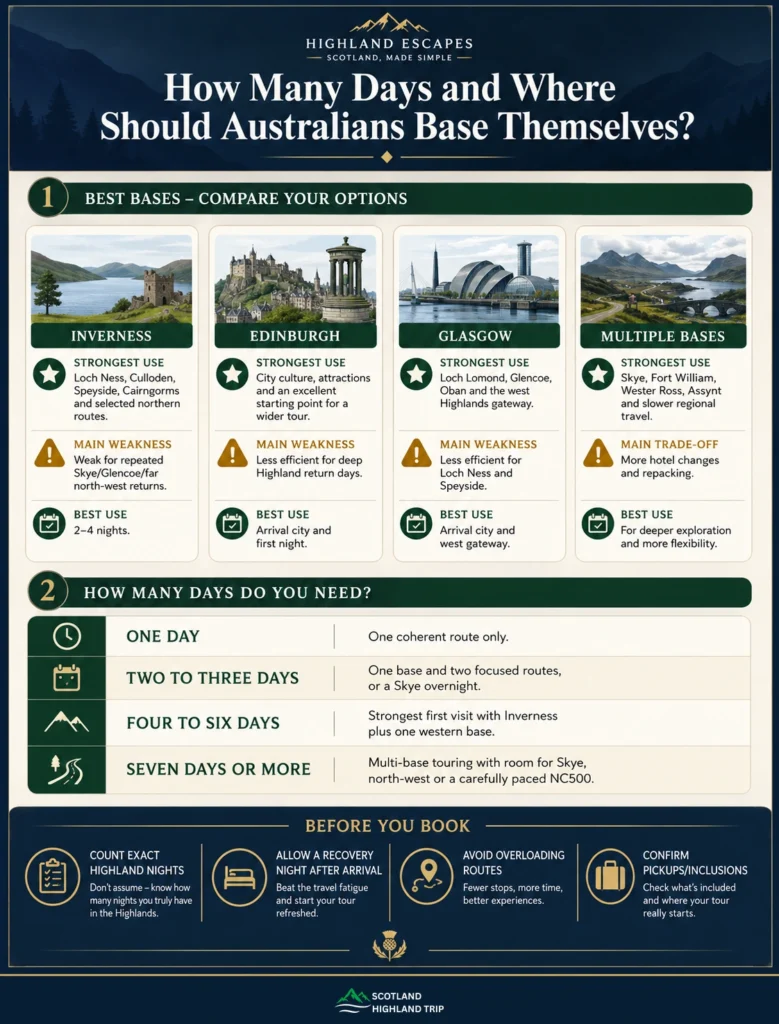
| Time available | Realistic Highland experience | Suitable base | Main compromise |
|---|---|---|---|
| One day | One coherent route, such as Loch Ness or Culloden and nearby heritage | Inverness, Fort William or a base close to the chosen route | A snapshot only, with no weather flexibility |
| Two to three days | One base with two focused routes, or a Skye overnight with limited time elsewhere | Inverness, Fort William or Skye | You must choose between regions rather than combine everything |
| Four to six days | A strong first visit with Inverness plus one western base | Inverness and Skye, Fort William or Wester Ross | The full NC500 and remote islands still do not fit comfortably |
| Seven days or more | Multi-base touring, with room for Skye, the north-west or a dedicated NC500 plan | Two or three bases | More days still require priorities, because the Highlands and islands are extensive |
One day
One day is enough only when the Highlands are a secondary part of a wider holiday. Choose a route close to your base. Do not attempt Skye from Edinburgh or combine Loch Ness, Glencoe, Culloden and a distillery simply because they appear on one map.
If that day immediately follows arrival from Australia, choose a shorter local route or move it to the following day.
Two to three days
Use one base and select two different themes. From Inverness, that could be Loch Ness plus Culloden and Clava, or Loch Ness plus Speyside. If Skye is the priority, travel there and stay overnight rather than using both days for out-and-back driving.
Four to six days
This is the best range for most first-time Australian visitors. Spend two or three nights in Inverness and two nights in the west or on Skye. You can see recognisable Highland landscapes while still having a morning that does not begin with luggage and an early departure.
Five focused days in the Highlands can be more satisfying than ten rushed days circling all of Scotland. The reason is simple: scenic places improve when you can stop, walk, wait for weather and have lunch without watching the coach clock.
Seven days or more
At seven days, the north-west or a carefully paced NC500 plan becomes realistic. It also allows a recovery day if the weather removes a key walk or island view.
Do not convert every extra day into another region. Seven nights split between Inverness, Skye and Fort William can be better than adding Orkney, Assynt and the entire NC500 to the same week.
Is self-driving in Scotland easy for Australians?
It is easier in one respect: Australians and Scots both drive on the left. It is not identical driving.
Scottish road signs use miles and miles per hour, not kilometres. Roundabouts are common, and drivers give way to traffic from the right. Main Highland roads can be winding, while rural routes may be single-track with passing places. Popular viewpoints can have limited parking, and a legal speed limit is not a promise that the road can be driven comfortably at that speed.
How passing places work
On a single-track road:
- Look well ahead and identify the next passing place.
- If the passing place is on your left, pull into it.
- If it is on your right, stop opposite it and let the oncoming vehicle use it.
- Let a faster vehicle behind you pass when it is safe.
- Never park in a passing place.
Review VisitScotland’s driving guidance before collecting a car. Familiarity with left-side driving should not become overconfidence on roads you have never used.
Fuel, daylight and fatigue
Fuel stations are less frequent in remote areas, so top up before the gauge becomes urgent. Download offline maps, but do not follow a navigation app onto an unsuitable minor road simply because it saves a few minutes.
Build the itinerary around daylight, particularly from late autumn to early spring. A route that is pleasant in June can feel demanding when the final hours are dark, wet or icy.
Driver fatigue is the largest Australian-specific concern. Do not make the person who handled the long-haul journey responsible for an immediate full-day road trip. Share driving when the hire agreement permits it, and keep the first self-drive day simple.
What to check with a rental company
Confirm:
- Whether the vehicle is automatic or manual.
- Every driver’s required licence and identification.
- Insurance excess and cover for tyres, windscreens and roadside assistance.
- Additional-driver charges and one-way fees.
- Mileage limits and restrictions on ferries or specific roads.
- Luggage capacity with every passenger seated.
- The process for late collection after a delayed flight.
As of 4 August 2026, the Australian Government’s UK travel advice says visitors can drive for up to twelve months using a full Australian licence and do not need an International Driving Permit. Entry and driving conditions can change, and rental companies can impose their own documentation rules, so recheck both sources before travel.
What is the best time for Australians to visit?
The seasons are reversed. That simple fact affects leave planning, packing and availability.
| Scottish season | Australian calendar equivalent | Main advantages | Main compromises | Best for |
|---|---|---|---|---|
| Spring, March to May | Australian autumn | Lengthening days, spring colour and lower pressure than peak summer | Cool conditions and some seasonal services still reopening | Couples, road trips and travellers who prefer quieter places |
| Summer, June to August | Australian winter | Long daylight, broad attraction opening and the largest choice of tours | Peak demand, busier roads and stronger midge exposure in still, damp conditions | First visits, families tied to school dates and island travel |
| Autumn, September to November | Australian spring | September can balance daylight, colour and lower visitor pressure | Days shorten quickly and some services reduce later in the season | Photography, mature travellers and slower regional stays |
| Winter, December to February | Australian summer | Quiet towns, winter atmosphere and lower demand in some areas | Short daylight, weather disruption and reduced attraction access | Repeat visitors with flexible plans, not most first road trips |
For most Australian visitors, late May, June or early September gives the best balance. May and September are the strongest general recommendations for lower pressure. June is better when maximum daylight matters more than crowd levels.
There is no month that guarantees dry weather. The VisitScotland seasonal weather guide is useful for broad expectations, but check the short-range forecast near departure and keep at least one route flexible.
Midges are most troublesome in still, damp conditions, particularly around water and woodland. Pack repellent and light long layers in the warmer months. Wind, cooler temperatures and moving air can change conditions quickly, so midge risk should influence preparation rather than decide the whole holiday.
What should Australians check before booking?
Use this list before paying a deposit for any Scotland tour package from Australia or local Highland tour.
Itinerary and time
- Exact number of nights physically spent in the Highlands.
- Number of full Highland sightseeing days after arrival and departure days are removed.
- Longest expected day in the vehicle.
- Whether Skye, Glencoe or the NC500 is an overnight route or a return day.
- Which stops are guaranteed, weather-dependent, optional or simple photo stops.
Flights, transfers and pickup
- Whether international and domestic flights are included or separate.
- Exact arrival and departure airports or railway stations.
- Whether an airport transfer is included, optional or unavailable.
- The precise pickup point and time for every day tour.
- What happens after a delayed flight or train.
We also provide airport transfer service. Ask for the transfer and tour to be itemised.
Group, vehicle and luggage
- Maximum group size, not the average.
- Vehicle type and seat layout.
- Actual luggage capacity for your party.
- Air conditioning, step height and access needs.
- Child-seat arrangements where relevant.
Accommodation, meals and attractions
- Hotel names or at least the accommodation category and room basis.
- Whether breakfast, lunch and dinner are included each day.
- Whether castle, cruise, distillery and wildlife-park entry is included.
- Whether optional activities must be reserved independently.
- Porterage and the distance you may need to carry luggage.
Money, changes and protection
- Deposit amount and balance due date.
- Payment currency, exchange-rate basis and card charges.
- Cancellation and date-change terms.
- What happens if weather, a ferry, an attraction or a road change affects the itinerary.
- Travel insurance cover for cancellation, disruption, activities, medical needs and hire-car excess, where relevant.
Entry rules are separate from a tour booking. Smartraveller currently advises that Australian tourists visiting the UK for less than six months need an Electronic Travel Authorisation, subject to exemptions and different rules for some dual nationals. Check the latest official advice before departure rather than relying on a tour article.
Accessibility and personal requirements
Give the provider details before booking, not on the morning of departure. Ask about vehicle steps, walking surfaces, toilet frequency, folding mobility aids, hearing needs, dietary requirements and the ability to shorten a stop. “Suitable for seniors” is too vague to be useful.
Australian operator or local Highland company?
| Booking route | Main advantages | Main limitations | Best fit |
|---|---|---|---|
| Australian operator or adviser | May combine flights, pre-tour hotels, payments and support through one Australian contact | Can add an intermediary between the traveller and local operator, and the package may devote limited time to the Highlands | Complex international itineraries, first European trips and travellers wanting one coordinator |
| Scotland-based Highland provider | Direct route knowledge, easier itinerary discussion and stronger potential for local flexibility | The traveller may need to coordinate flights, hotels, payments and transfers separately | Focused Highland extensions, private days, ancestry, photography and families |
| Hybrid booking | International logistics can sit with an Australian adviser while the Highland segment is booked directly | Requires clear handover points and separate terms | Often the best balance for Australian travellers who want both support and local depth |
The right answer depends on the risk you want someone else to manage. If flight coordination and one point of contact matter most, an Australian adviser can be valuable. If the main question is whether to spend longer at Culloden, stop for photographs in Glen Torridon or change the day around weather, direct contact with a Highland operator is more useful.
For many travellers, the hybrid is strongest. Arrange flights and major city hotels in Australia, include a recovery night, then book a focused local tour or private driver for the Highland section. Keep every inclusion and cancellation term in writing.
Final recommendation by traveller type
For a first-time Australian couple, allow four to six full Highland days. Spend two or three nights in Inverness, then add two nights on Skye or around Fort William if the west is important. Choose a well-defined small group for value or a private driver when pace and privacy justify the premium.
For a family, reduce daily road hours. Inverness and the Cairngorms are easier bases than attempting a new hotel every night. Use a private day when child breaks, luggage or car seats would make a fixed group schedule difficult.
For mature or less-mobile travellers, judge the tour by step height, walking surface, toilet frequency and hotel location, not by a generic activity label. A private driver can be worthwhile because it controls the pace, but only after accessibility details are confirmed.
For a solo traveller, a small group or escorted coach usually provides better value and company. Add an independent Inverness stay if the main Scotland tour gives the Highlands only a brief pass-through.
For confident self-drivers, use at least two bases and resist the urge to collect routes. A five-day Highland plan with time outside the car is stronger than a ten-day checklist covering every edge of Scotland.
For ancestry, a honeymoon or a long-awaited family trip, private touring has the clearest advantage. The value is not luxury language. It is the ability to build the day around your actual reason for coming.
If a locally guided format fits, booking with us the exact route, duration, pickup, vehicle, passenger space and exclusions or let us do it for you.
FAQs
What is the best Highlands tours for Australians?
For most first-time Australian visitors, the best format is a four to six-day Highland plan using Inverness plus one western base. Choose a small group for value and company, a private driver for flexibility, or self-drive only when the driver is comfortable with narrow roads and consecutive touring days.
How many days should Australians spend in the Highlands?
Allow at least four full sightseeing days, with five or six being better. One day provides only a snapshot. Seven days or more makes Skye, the north-west or a carefully paced NC500 route more realistic. Keep the first day after the international journey light.
Is Inverness a good base for Australian visitors?
Yes. Inverness is efficient for Loch Ness, Culloden, Clava Cairns, Speyside, the Cairngorms and selected northern routes. It is less efficient for repeated trips to Glencoe, Skye and Assynt. Add a western or island base when those areas are priorities.
Should Australians drive themselves in Scotland?
Confident Australian drivers often adapt well because Scotland also drives on the left. The challenge is different road conditions: miles per hour, frequent roundabouts, narrow verges, single-track roads, passing places and limited rural fuel. Avoid starting a demanding self-drive route immediately after a long-haul flight.
Is a private Highland tour worth it?
It is worth considering for ancestry, photography, mobility needs, families, whisky touring and travellers who value hotel pickup and flexible stops. For two people it is usually a premium. For a larger party, compare the total private price with individual fares and every inclusion before deciding.
What is the best month to visit Scotland from Australia?
May and September offer the strongest general balance of daylight and lower visitor pressure. June is better for the longest days. July and August provide broad availability but are busier. No month guarantees settled weather, so keep one part of the itinerary flexible.
Are flights included in Scotland tour packages from Australia?
Sometimes, but never assume. Australian travel agents may sell flight-inclusive and land-only options, while Scotland-based tour companies normally describe only the local service. Ask for flights, transfers, accommodation, meals, attraction entry and local transport to be itemised.
Can you tour Skye in one day?
Yes, from Inverness, but it is a long highlights day with substantial driving. It works for major viewpoints and short stops. If Skye is a main priority, stay at least two nights so you have one full island day and some protection against poor weather.
How far ahead should Australians book?
For travel from June to September, book core accommodation and limited-capacity tours as soon as international dates are firm. Prioritise Skye, remote west-coast stays and private vehicles. Shoulder-season trips can be more flexible, but exact availability and cancellation terms matter more than a universal booking deadline.
What should Australians pack for the Highlands?
Pack a waterproof outer layer, warm mid-layer, comfortable water-resistant shoes, light long clothing, a compact day bag and midge repellent for warmer months. Add a UK power adaptor, essential medicines and a small dry bag for electronics. Dress in layers rather than relying on one heavy coat.

Emma is a solo traveler and freelance travel writer from New Zealand who spent three weeks exploring the Scottish Highlands. With a deep appreciation for history and landscapes, she booked a series of day tours and a private chauffeur journey with Scotland Highland Trip. From Loch Ness to the Cairngorms, she documented her experience through vivid blog posts and drone footage.