
Tracing Scottish ancestry through travel works best when you begin with evidence rather than a surname or family legend. Ideally, you should arrive in Scotland with at least one identified ancestor, an approximate date, and a place such as a parish, registration district, village, farm, or county.
You do not need a completed family tree. You do, however, need enough information to distinguish your family from other people who shared the same name.
That preparation changes the trip. Instead of travelling to a castle associated with a surname and hoping for a connection, you can visit the parish where a birth was registered, compare an old map with the modern landscape, consult local records, and learn how people in that community lived.
For diaspora visitors from Canada, the United States, Australia, New Zealand, and elsewhere, this is the difference between a general Scottish heritage holiday and a genuinely personal Scottish roots trip.
Jump to Section
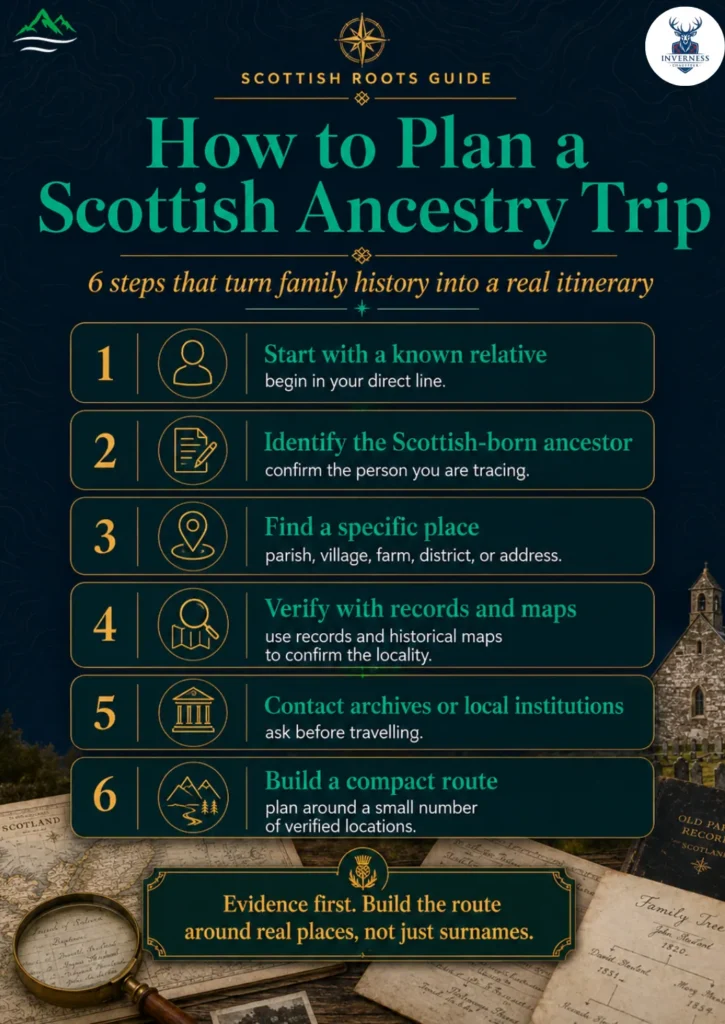
The Quick Answer: How to Plan a Scottish Ancestry Trip
A useful ancestry trip usually follows six steps:
- Start with a known relative and work backwards.
- Identify the Scottish-born person in that family line.
- Find a specific place connected to that person.
- Verify the place using Scottish records and historical maps.
- Contact relevant archives, museums, churches, or landowners before travelling.
- Build the itinerary around a small number of verified locations.
Official guidance from Scotland’s People recommends beginning with someone in your direct line and working backwards through birth, marriage, death, and census records.
The Highlands may be central to the route if your evidence points to Inverness-shire, Ross and Cromarty, Sutherland, Caithness, Lochaber, Skye, or another Highland area. They should not be added simply because the Highlands feel more traditionally “Scottish.”
Are You Ready to Build an Ancestry Itinerary?
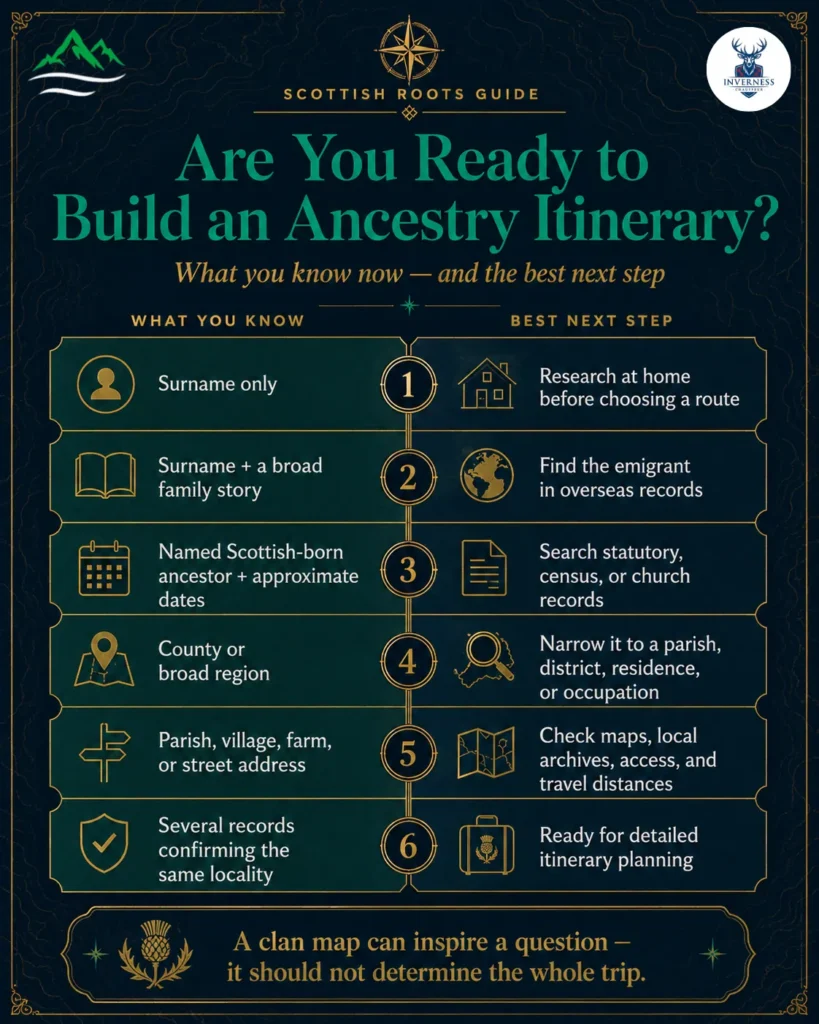
Use this test before booking heritage stops:
| What you currently know | What it means | Best next step |
| Surname only | Not enough to identify a family, clan, or area reliably | Research at home before choosing a route |
| Surname and a broad family story | A useful lead, but still vulnerable to mistaken identity | Locate the emigrant in records from the destination country |
| Named Scottish-born ancestor and approximate dates | Enough to begin targeted Scottish searches | Search statutory, census, or church records |
| County or broad region | Enough to choose a research area, but not necessarily a village | Identify a parish, district, residence, or occupation |
| Parish, village, farm, or street address | Strong foundation for a place-based trip | Check maps, local archives, access, and travel distances |
| Several records confirming the same locality | Ready for detailed itinerary planning | Build a compact route around the documented area |
A clan map can generate a research question. It should not, by itself, determine an itinerary.
What Scottish Ancestry Travel Actually Means
An ancestry trip has three separate layers.
1. Documentary connection
Records help establish who a person was, when they lived, their relationships, occupation, residence, and sometimes their movement between communities.
This layer prevents a trip from being built around the wrong person.
2. Place connection
Parishes, villages, farms, streets, kirkyards, schools, estates, and workplaces locate the family story in a real landscape.
The original house may be gone. A street may have been redeveloped, an estate divided, or a farm name changed. Even so, maps and local records can help reveal the scale and setting of the community.
3. Historical context
Museums, archives, estate papers, school records, poor-relief records, newspapers, and local histories can explain how people in that area lived.
Context is not the same as proof. A crofting museum may show the type of dwelling used in a region without proving that your ancestor lived in that particular building. That distinction should remain clear throughout the trip.
A place can therefore be:
- Genealogically useful because it may answer a research question.
- Emotionally meaningful because reliable evidence connects it to your family.
- Historically useful because it explains the wider community.
The best Scottish ancestry travel includes all three without pretending they are interchangeable.
What to Research Before Coming to Scotland
Start with records in the country where your family settled
For diaspora families, the first useful Scottish clue may be in a Canadian death certificate, an Australian passenger record, a US naturalisation file, a New Zealand marriage record, a family Bible, or an obituary.
The objective is to identify the emigrant’s:
- Full name and known name variations.
- Approximate year of birth.
- Parents, spouse, or siblings.
- Religion or denomination, if known.
- Occupation.
- Scottish birthplace or last residence.
- Approximate year of migration.
This matters because Scotland holds relatively few comprehensive named lists of emigrants. National Records of Scotland advises that many relevant passenger and migration records are held elsewhere. It does, however, hold specific collections, including records of the Highland and Island Emigration Society, which assisted almost 5,000 people travelling to Australia between 1852 and 1857. National Records of Scotland explains the available emigration sources here.
Work backwards, one generation at a time
Do not jump from a living family to a famous historical person with the same surname.
Confirm each parent-child connection using records where possible. Pay attention to spouses, witnesses, informants, siblings, occupations, and addresses. These details help separate people with similar names.
Scottish names also appear under different spellings. Use wildcard, phonetic, and fuzzy-search options where appropriate. Scotland’s People provides dedicated surname and search guidance.
Create a travel research packet
Prepare one digital folder and, preferably, one printed copy containing:
- A simple family tree.
- A timeline for the relevant family line.
- Copies or references for important records.
- Original and alternative surname spellings.
- Place names exactly as written in the records.
- Parish, county, registration district, and current council area.
- Addresses, farm names, occupations, and estate names.
- Historical and modern maps.
- Archive appointments and reference numbers.
- Contact details for museums, churches, societies, or landowners.
- A list of confirmed facts, likely connections, and unresolved questions.
Keep those three evidence categories separate. A family story can be recorded without being presented as confirmed fact.
Identify one question for each research stop
Do not visit an archive with the vague objective of “finding the family.”
A better question might be:
- Did this family remain in the same parish between the 1851 and 1871 censuses?
- Which estate contained the farm named on the birth record?
- Did school admission records survive for the children?
- Is there a burial register or monumental-inscription survey for the parish?
- Did the ancestor receive poor relief before emigrating?
- Does the valuation roll identify the property owner or occupier?
Specific questions help archive staff direct you towards the right collection.
Which Records Can Turn a Family Story into a Place?
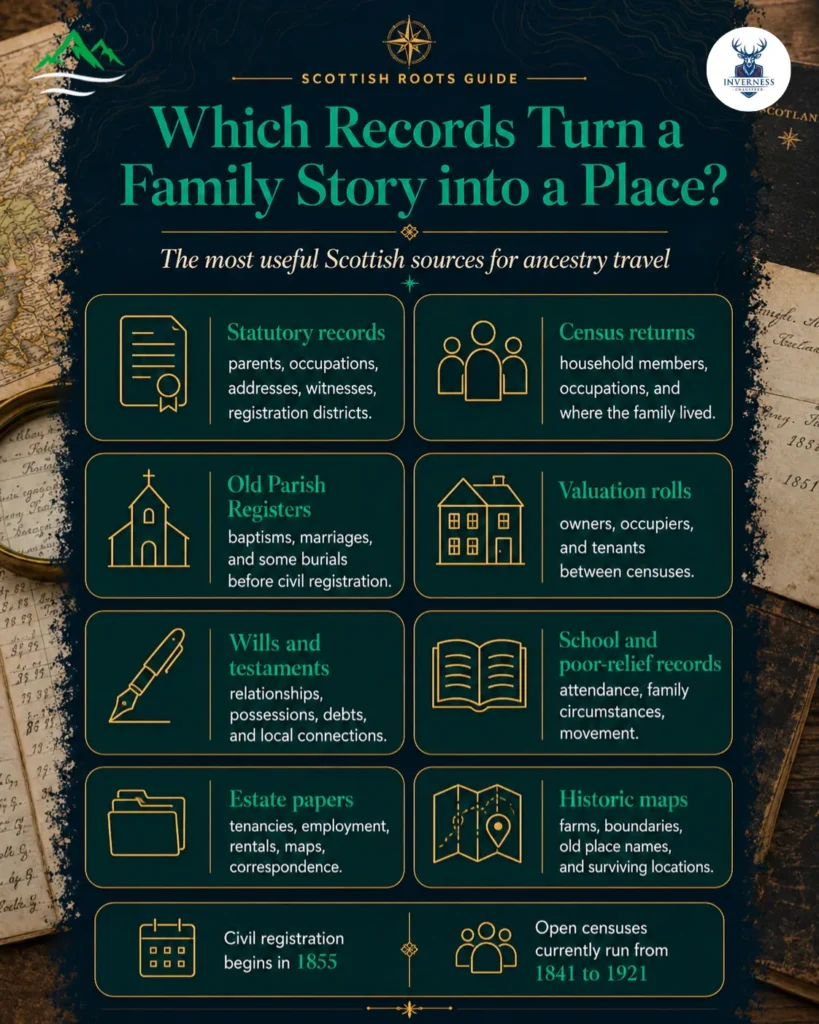
Scotland’s People is the official Scottish genealogy service. Its searchable collections include statutory registers, church registers, census returns, valuation rolls, wills, migration records, prison registers, and other sources. The complete record categories are listed here.
| Record type | What it may reveal | How it helps the trip |
| Statutory birth, marriage and death records | Parents, occupations, addresses, witnesses, informants and registration districts | Identifies people and narrows the location |
| Census returns | Household members, occupations and birthplaces | Shows where the family lived and who lived together |
| Old Parish Registers | Baptisms, banns, marriages and some burials before civil registration | Connects a family to a church parish |
| Other church registers | Events recorded outside the established Church of Scotland | Prevents one-denomination research from missing a family |
| Valuation rolls | Owners, occupiers and tenants | Helps locate a household between censuses |
| Wills and testaments | Relationships, possessions, debts and local connections | Adds family and economic context |
| Kirk session records | Local church-court and community matters | May add social context not found in basic certificates |
| School and poor-relief records | Attendance, family circumstances, residences and movement | Helps reconstruct ordinary lives |
| Estate papers | Tenancies, employment, correspondence, maps and rentals | Particularly useful for rural and estate communities |
| Emigration and passenger records | Origin, residence, destination or travelling relatives | Connects the Scottish and overseas parts of the story |
| Historic maps | Former buildings, farms, boundaries and place-name variants | Converts a written location into a visitable landscape |
Civil registration began in Scotland in 1855. Before then, researchers depend heavily on church registers, which vary by parish and are incomplete. Open Scottish censuses currently run from 1841 to 1921. Scotland’s People explains the limitations and uses of these collections.
The absence of a record does not prove that an event did not happen. It may indicate a missing register, a different denomination, a spelling variation, an incorrect date, or an event recorded in another place.
Clans, Surnames and Family Myths
A surname does not prove descent from a clan chief
People sharing a clan name were not necessarily close relatives. Historically, individuals could be connected through territory, protection, service, alliance, or identity rather than direct descent from the chief. VisitScotland also notes that Scottish surnames can derive from places, occupations, patronymics, and other origins, not only clans. Its clan overview provides useful background.
A surname should therefore be treated as a clue.
Ask:
- Is the surname found in records for the relevant parish?
- Are there multiple unrelated families with that name?
- Does the documented family appear in the region associated with the clan?
- Is the claimed connection supported by records or only by a modern surname list?
A clan association can help, but it cannot replace evidence
A responsible clan or family society may provide:
- Published histories.
- Regional information.
- Name variants.
- Monumental-inscription collections.
- Details of museums, gatherings, or heritage centres.
- Contact with knowledgeable local members.
However, association membership or surname matching does not confirm a particular genealogical line.
Be cautious with coats of arms
There is no general Scottish “family coat of arms” that every person with a surname may use. The Court of the Lord Lyon explains that arms belong to particular individuals, while a clan chief’s arms are personal to that chief. The Court’s heraldry FAQ clarifies the distinction.
DNA is a lead, not an itinerary
DNA matches may help identify cousins or support a documentary hypothesis. An ethnicity estimate alone cannot reliably identify a particular Scottish parish, farm, castle, or clan branch.
Use DNA alongside records, relationships, dates, and places.
Best Places to Include in a Scottish Roots Trip
Scotland’s People Centre in Edinburgh
For family lines spread across Scotland, Edinburgh can be a useful research starting point. The Scotland’s People Centre provides access to digitised records and indexes, including more recent records that cannot always be viewed online.
As of July 2026, visitors must book online. A full-day seat costs £15 and covers 9:00 to 16:00 on weekdays, excluding public holidays. Half-day bookings are currently unavailable. Always confirm details before travelling on the official Scotland’s People visitor page.
Do not automatically add Edinburgh, however. If you have already completed the national-record research and your family is firmly located in the Highlands, more time in the relevant regional archive may be valuable.
National and regional archives
National Records of Scotland holds government, legal, church, family, estate, property, and other historical collections. Some material requires advance identification through its catalogue and may be consulted in a search room.
Regional archives may hold records that never became part of the national collection. These can include:
- Council and parish material.
- School registers.
- Poor-relief records.
- Estate and business papers.
- Local maps.
- Family deposits.
- Photographs.
- Community collections.
Check the catalogue and contact the archive before travelling. Some documents may be stored off-site, closed, fragile, or available only by appointment.
Historical maps
Maps are essential when the evidence gives you a farm, settlement, estate, or street rather than a well-known attraction.
The National Library of Scotland provides more than 400,000 high-resolution historic maps with tools for viewing and comparing places. Its maps and family-history guide is an excellent planning resource.
Compare:
- The place name written in the record.
- Historic county and parish boundaries.
- Earlier and later Ordnance Survey maps.
- Modern road access.
- Whether a building survives.
- Whether the location is now on private land.
Parish churches and kirkyards
A parish church or kirkyard can be meaningful when records connect the family to it, but several cautions apply:
- The current church may not be the building used by the ancestor.
- A family may have belonged to another denomination.
- Burial records and gravestones do not always survive.
- A person recorded in the parish may have been buried elsewhere.
- Weathering can make inscriptions unreadable.
- Some burial grounds have restricted or uneven access.
Look for monumental-inscription surveys before relying on an on-site search. These may preserve wording from stones that have since deteriorated.
Do not clean, chalk, rub, move, or lean on old stones. Treat active burial grounds as places of mourning rather than tourist attractions.
Local museums, libraries and heritage centres
Local institutions can explain occupations, migration, language, industries, housing, farming, fishing, military service, or estate life.
They are especially useful when no family building survives. A museum cannot prove a connection, but it can help you understand the community named in the records.
Villages, farms, estates and workplaces
An ordinary location may carry more family relevance than a major castle.
Depending on the evidence, useful stops might include:
- A former crofting township.
- A fishing harbour.
- A mill or mining area.
- A school.
- An estate village.
- A military site.
- A dockyard.
- A church parish.
- A street in Inverness, Glasgow, Dundee, or another town.
If a location is on private land, seek permission. Scotland’s access rights do not give visitors unrestricted access to houses, gardens, working farmyards, private buildings, or land where access would be irresponsible.
Castles and battlefields
Include a castle when records, estate employment, tenancy, military history, or a supported clan connection makes it relevant. Do not assume the family lived in the castle because they shared the owner’s or clan chief’s surname.
The same principle applies to battlefields. Culloden is enormously important to Highland and Jacobite history, but a surname alone does not establish that an ancestor fought there.
Why the Highlands Matter for Some Ancestry Travellers
The Highlands are highly relevant when records point there. They contain communities connected with crofting, estates, fishing, military service, Gaelic culture, internal migration, forced displacement, and overseas emigration.
But the Highlands are not a synonym for Scottish ancestry. Many Scottish families came from the Lowlands, Borders, north-east, central belt, islands, or urban centres.
Highland ancestry travel becomes particularly valuable when you can identify:
- A historic Highland county.
- A parish or registration district.
- A croft, farm, township, or estate.
- A school or congregation.
- A known migration from a Highland community.
- A record held by a regional archive.
The Highland Archive Service operates four centres covering the Highland region: Inverness, Lochaber, Skye and Lochalsh, and Caithness. Its collections include official records, school and poor-relief material, church records, family and estate papers, maps, and business archives.
These regional divisions matter. A family from Skye may be better researched in Portree than through repeated day trips from Inverness. A Lochaber line may justify time in Fort William, while Caithness research may require Wick.
Is Inverness a Good Base for Ancestry Travel?
Inverness is a strong base when the documented family locations fall within Inverness-shire, Nairn, Ross and Cromarty, Sutherland, or surrounding parts of the central and northern Highlands.
The Highland Archive Centre in Inverness holds collections covering those historic counties. It has a public search room, a family-history facility, local records, and an online catalogue. The centre encourages visitors to request documents in advance, even though general archive booking is not always compulsory. Current visitor information is available here.
Inverness also works well when the route combines research with places around:
- The Moray Firth.
- Beauly and the Black Isle.
- Easter Ross.
- Loch Ness.
- Nairn.
- Culloden.
- Parts of Sutherland.
- The Great Glen.
It is less suitable as a single base when the important locations are in distant Skye, western Lochaber, Argyll, the Outer Hebrides, Caithness, the Borders, or southern Scotland. Long return drives leave less time for archives and local visits.
Choose the base from the evidence, not from the fame of the destination.
How to Build a Realistic Scottish Ancestry Itinerary
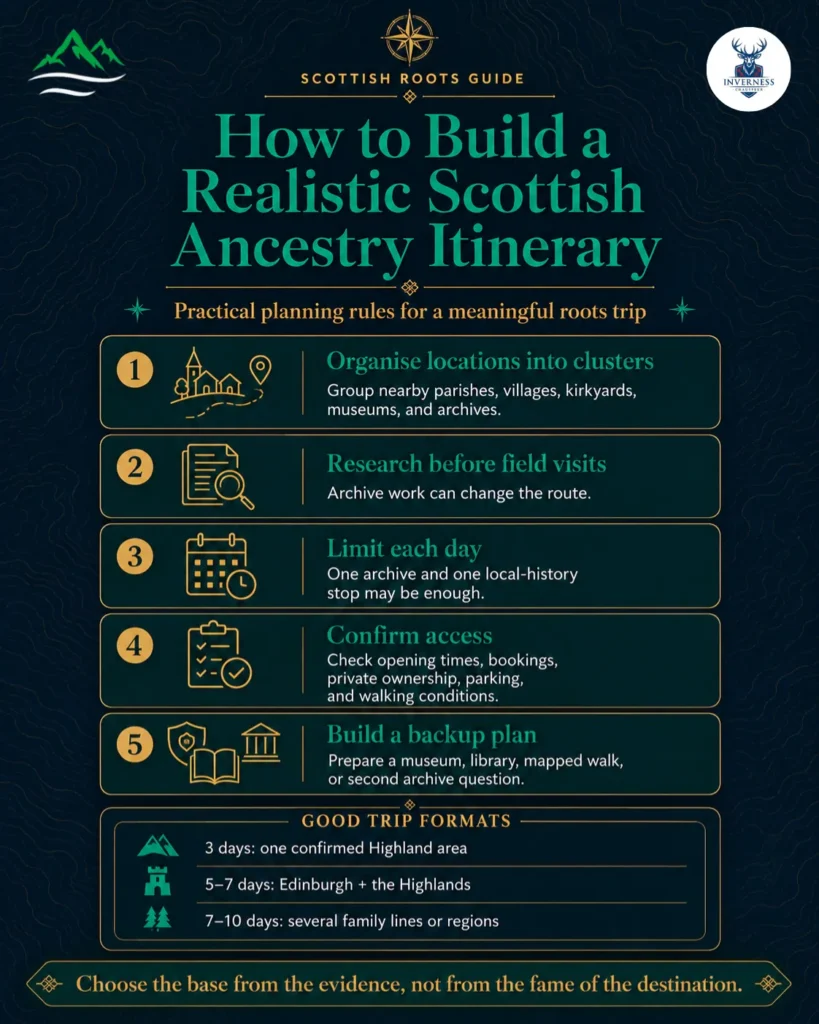
Organise locations into geographic clusters
Put every confirmed place on a map. Group nearby locations rather than following the family chronology across Scotland.
One cluster might contain:
- The parish church.
- A nearby burial ground.
- The village named in a census.
- A former estate.
- A local museum.
- The regional archive.
This is usually more efficient than moving between distant clan attractions.
Schedule research before field visits
An archive day should normally come before the day you visit rural locations. A newly found address, school, estate, or burial reference may change the route.
If possible, complete the basic identity work before arriving. Holiday time is expensive, and much of the initial searching can be done online.
Limit each day
An ancestry day should not resemble a checklist tour.
Allow time for:
- Reading inscriptions.
- Comparing maps.
- Speaking to staff.
- Unexpected closures.
- Weather.
- Photography.
- Short walks.
- Quiet reflection.
- Older relatives or travellers with limited mobility.
One archive and one local-history stop may be enough for a full day. In rural areas, two or three principal locations are usually more realistic than six.
Confirm access
Before finalising a stop, check:
- Opening days and seasonal closures.
- Whether booking is required.
- Document-ordering deadlines.
- Photography and copying rules.
- Parking and walking conditions.
- Public transport limitations.
- Private ownership.
- Church services, funerals, or active burials.
- Whether the attraction is the historic location you actually intend to see.
Build a backup plan
Your first-choice document may be unavailable. A kirkyard may be inaccessible in poor weather. A castle or museum may be closed.
Prepare a secondary stop such as:
- A local library.
- A museum.
- A mapped village walk.
- A second archive question.
- A scenic area connected to the parish.
- A nearby heritage centre.
Three Sample Ancestry-Trip Formats
Three days: one confirmed Highland area
Day 1: Research at the relevant regional archive. Confirm addresses, maps, burial information, and surviving local collections.
Day 2: Visit one compact family cluster: parish, village, kirkyard, farm area, school, or estate.
Day 3: Add social context through a museum or heritage centre, then retain time for one unresolved location or a general Highland experience.
This works best when the family line and locality are already well established.
Five to seven days: Edinburgh and the Highlands
Day 1: Arrive in Edinburgh and organise research materials.
Day 2: Pre-booked research at the Scotland’s People Centre or National Records of Scotland.
Day 3: Travel to the relevant Highland base.
Day 4: Regional archive or local family-history research.
Day 5: Ancestral parish, village, kirkyard, estate, or workplace area.
Day 6: Local museum, landscape, or second family cluster.
Day 7: Buffer time or onward travel.
If the family evidence is already complete, the Edinburgh research day can be replaced with more time in the relevant Highland community.
Seven to ten days: several family lines or regions
Allow at least two or three nights per major region. Do not try to connect Skye, Inverness, Argyll, Glasgow, and the Borders through daily return trips.
Prioritise the best-supported line first. Treat weaker surname or clan leads as optional historical stops rather than the core of the route.
When private transport becomes useful
Private transport can be valuable when the route includes rural kirkyards, former farms, small museums, older travellers, or several stops with limited public transport.
If your evidence points to a cluster of Highland locations, Scotland Highland Trip can help convert that verified place list into a practical driving route. Genealogical conclusions should still come from records, archives, or a suitably qualified researcher; transport planning and family-history proof are different services.
Common Ancestry-Travel Mistakes
Planning from a surname alone
A surname may occur in several unrelated families and multiple regions. Do not book a clan-land route until you have examined the documented family.
Treating a famous castle as the family home
Most people were tenants, workers, tradespeople, labourers, soldiers, farmers, fishers, or town residents. The estate or castle may provide context without having been their residence.
Expecting a gravestone
Many people had no surviving marked grave. Stones weather, inscriptions disappear, burial registers remain incomplete, and family members may be buried in different places.
Trying to research several centuries during the holiday
Resolve the main identity questions before departure. Use Scottish archives for material unavailable online, local context, or carefully defined gaps.
Ignoring changed boundaries and place names
A place may appear under a historic parish, county, burgh, estate, registration district, or Gaelic spelling. Modern map searches may not recognise the old form.
Arriving without archive references
“Anything about the MacDonalds” is not a workable archive request. Bring names, dates, places, catalogue references, and specific questions.
Assuming every historic location is publicly accessible
Castles, estate buildings, farms, houses, churches, and burial grounds have different owners and access rules. Ask before entering private property.
Filling every hour
A roots trip can be tiring and emotionally intense. Leave room for companions who may want scenery, food, whisky, wildlife, or general history alongside the family research.
What Ancestry Travel Can and Cannot Give You
A well-planned trip may give you:
- A clearer understanding of where a family lived.
- New records or local context.
- A sense of distance between important locations.
- Insight into an occupation or community.
- A chance to see the landscape documented in the records.
- Better questions for future research.
- Time to share family history across generations.
It may not give you:
- A surviving family house.
- A readable gravestone.
- Access to private land or buildings.
- Proof of a clan connection.
- A complete family tree.
- A dramatic discovery.
- Certainty about every family story.
A trip does not fail because no unknown document appears. Sometimes the value lies in seeing that two parishes were separated by a mountain, understanding why a harbour mattered, or learning what estate employment involved.
Meaning does not require invention.
Frequently Asked Questions
How do I trace Scottish ancestry through travel?
Identify a documented Scottish ancestor, confirm a place through civil, census, or church records, and build the trip around that locality. Use archives and historical maps before visiting villages, kirkyards, estates, or museums.
Do I need records before visiting Scotland?
You should have at least one identified person, an approximate date, and preferably a parish, district, or residence. You do not need a finished family tree, but a surname alone is rarely enough for a reliable ancestry itinerary.
What if I only know my Scottish surname?
Start with your own family and work backwards through records in the country where the family settled. Treat online clan and surname maps as leads, not proof of origin.
Can I visit my clan castle in Scotland?
You can visit if the property is open to the public or the owner grants access. Sharing a clan surname does not prove that your direct ancestors lived in the castle or belonged to its chiefly family.
Is Inverness a good base for ancestry travel?
Inverness is a useful base for family lines connected to Inverness-shire, Nairn, Ross and Cromarty, Sutherland, and nearby Highland areas. It is not the best base for every Scottish family line.
Are the Highlands useful for a Scottish roots trip?
Yes, when records point to a Highland parish, estate, village, township, or historic county. The Highlands should not be added solely because a surname is marketed as Highland.
How many days do I need for an ancestry trip in Scotland?
Allow at least three days for one well-researched locality. Five to seven days works better when combining national research in Edinburgh with Highland field visits. Multiple family regions may require seven to ten days or longer.
Can DNA tell me where in Scotland to visit?
DNA may identify relatives or support a research theory, but an ethnicity estimate alone cannot reliably identify a specific parish, clan branch, farm, or castle. Combine DNA evidence with records and family relationships.
What should I do before booking a Scottish ancestry trip?
Confirm your Scottish-born ancestor, record surname variants, identify the most precise place available, check relevant archives, compare historical maps, verify access, and choose one or two research goals.
Final Takeaway
The best Scottish ancestry travel begins before you arrive. Start with people, then records, then places. Use clans as historical context rather than automatic proof. Let parishes, villages, kirkyards, workplaces, maps, and local collections shape the route.
If your evidence leads to the Highlands, Inverness can be an excellent research and travel base. If it leads elsewhere, follow the evidence elsewhere.
A Scottish roots trip does not need a castle, a famous surname, or a dramatic discovery to be meaningful. It needs honest research, enough time, and a willingness to value the places your records can genuinely support.
Emma is a solo traveler and freelance travel writer from New Zealand who spent three weeks exploring the Scottish Highlands. With a deep appreciation for history and landscapes, she booked a series of day tours and a private chauffeur journey with Scotland Highland Trip. From Loch Ness to the Cairngorms, she documented her experience through vivid blog posts and drone footage.