

Morning light on the Moray Firth makes even the warm-up range feel like part of the holiday. Then the wind changes, the flag stiffens, and the Highlands remind you that pretty golf is not necessarily easy golf.
A three-day Highland golf itinerary can link Cabot Highlands, Nairn and Royal Dornoch without wasting half the trip in a vehicle. The history is serious too. Royal Dornoch records that Old Tom Morris extended its links from nine to 18 holes in 1886.
The sensible route begins near Inverness Airport, moves west to Nairn, then builds towards Royal Dornoch. You get one modern links, one traditional championship course and one genuine pilgrimage round. This plan covers the playing order, road times, accommodation, costs, booking strategy and the small logistical details that can rescue an expensive trip.
Jump to Section
What is the best three-day Highland golf itinerary?
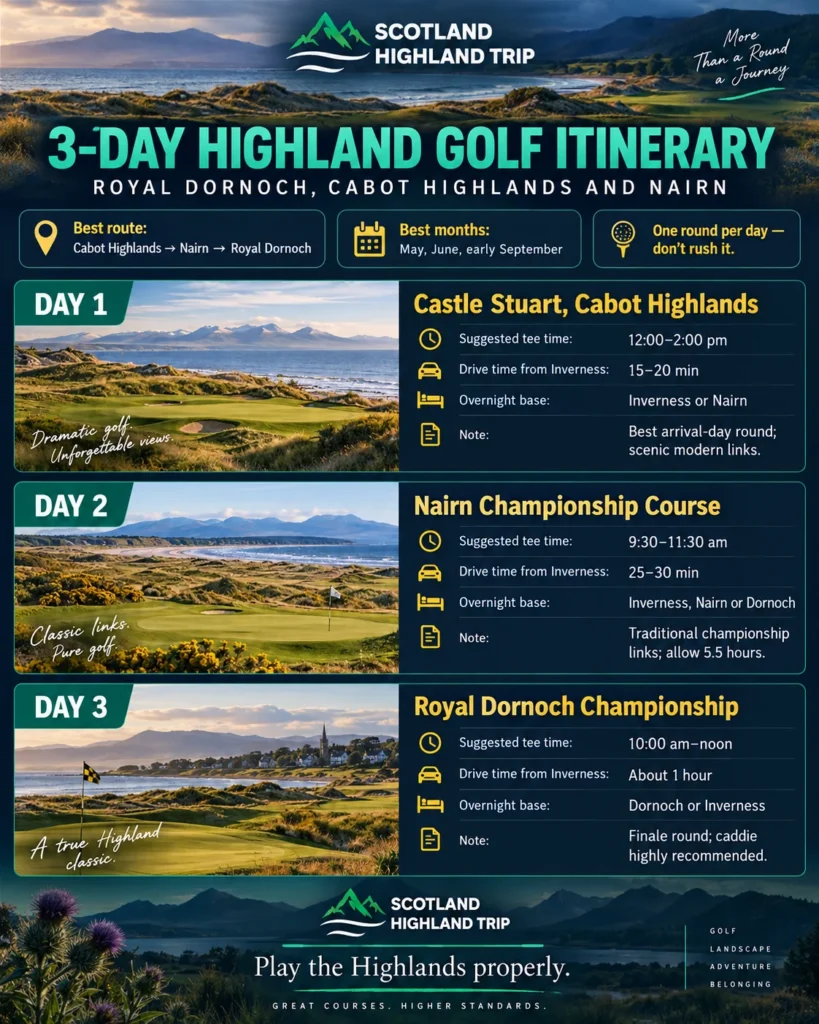
Play Castle Stuart at Cabot Highlands on day one, Nairn Championship Course on day two, and Royal Dornoch on day three. Base yourself in Inverness or Nairn for two nights, then consider Dornoch for the final night if your departure schedule allows.
| Day | Course | Suggested tee time | Typical road time from Inverness | Overnight base |
|---|---|---|---|---|
| 1 | Castle Stuart, Cabot Highlands | 12:00 to 2:00 pm | 15 to 20 minutes | Inverness or Nairn |
| 2 | Nairn Championship Course | 9:30 to 11:30 am | 25 to 30 minutes | Inverness, Nairn or Dornoch |
| 3 | Royal Dornoch Championship Course | 10:00 am to noon | About 1 hour | Dornoch or Inverness |
Arrive the evening before if Royal Dornoch is the emotional centre of the trip. If you must fly and play on day one, Cabot Highlands is the least risky choice because it sits close to Inverness Airport. Trying to squeeze in 36 holes daily misses the point. The best golf courses in the Scottish Highlands deserve more than a hurried scorecard.
Why do these three Highland golf courses work so well together?
Cabot Highlands, Nairn and Royal Dornoch offer three distinct versions of links golf within one compact region. Castle Stuart brings modern width and bold views, Nairn rewards precise traditional play, while Dornoch tests approaches and recovery shots around raised greens.
- Castle Stuart: Wide landing areas, dramatic elevation changes and greens that appear to meet the Moray Firth.
- Nairn: Tight coastal holes, firm turf, gorse and exacting approaches.
- Royal Dornoch: Plateau greens, awkward misses and wonderfully natural movement through the linksland.
The contrast matters. Three similar resort courses would blur together by the final afternoon. These do not.
How should you play Cabot Highlands on day one?
Use Castle Stuart as the opening round because it is close to Inverness Airport and visually spectacular without feeling punishing from every tee. Book an afternoon start, arrive at least 75 minutes early, and choose tees that keep the round enjoyable in the wind.
Which Cabot Highlands course belongs in this itinerary?
Cabot Highlands now has two 18-hole courses: Castle Stuart and Old Petty. Choose Castle Stuart for this route. Designed by Gil Hanse and Mark Parsinen, it delivers the coastal setting most first-time visitors expect. Old Petty is a fine reason to add a fourth day.
What should you expect on the course?
Castle Stuart gives you room from the tee, then makes you earn the correct angle into the green. The official Cabot Highlands golf information confirms that both courses are walking-only, except for medical exemptions. Push trolleys are complimentary, electric trolleys cost extra, and no handicap certificate is required.
Wind changes the course quickly. Keep the ball below the hole and use the contours instead of attacking every flag. Castle Stuart looks generous, but the wrong side of an infinity green is a miserable place to discover false confidence.
What should you do after the round?
Stay around Inverness or Nairn. Inverness has the wider restaurant choice, while Nairn gives you a calmer evening and a shorter morning transfer. If the group still has energy, a riverside walk and a few compact things to do in Inverness fit without turning the night into another itinerary.
What is the best plan for Nairn on day two?
Book Nairn between 9:30 and 11:30 am, allowing time for breakfast and a relaxed warm-up. The Championship Course rewards controlled ball flight and accurate approaches, so day two should feel deliberate rather than rushed after the visual drama of Castle Stuart.
Nairn was founded in 1887 and has hosted the Walker Cup, Curtis Cup and Amateur Championship. The sea stays close through the opening holes, but gorse and firm ground influence more shots than the view suggests. Favour the centre of the green until you understand the turf.
How much time should you allow at Nairn?
Allow about five and a half hours from arrival to departure. The official Nairn visitor information lists the 2026 adult fee at £350 from April to October and a two-round adult ticket at £440. Save the second round for a longer trip. Royal Dornoch deserves fresh legs.
How should you finish the trip at Royal Dornoch?
Give Royal Dornoch the final day, book a mid-morning tee time, and reach the club at least 90 minutes before play. The Championship Course demands thoughtful approaches, so a caddie and a conservative target line are more useful than an extra bucket of range balls.
Royal Dornoch feels older than its scorecard. The fairways move naturally across raised linksland, gorse frames the holes, and the plateau greens reject shots that would survive elsewhere. “Foxy,” the bunkerless 14th, proves a hole does not need sand to cause trouble.
Is a caddie worth booking at Royal Dornoch?
Yes, particularly for a first round. A caddie helps with blind lines, wind, approach angles and the places where a safe-looking miss becomes a difficult recovery. Request one with the tee time because summer availability disappears early.
What can you add around the Dornoch round?
Walk through Dornoch, see the cathedral or spend 20 minutes on the beach. Golfers staying overnight can also fit a tasting along the northern Highland whisky route, but nobody in the group should drive after drinking.
Where should you stay and how should you travel?
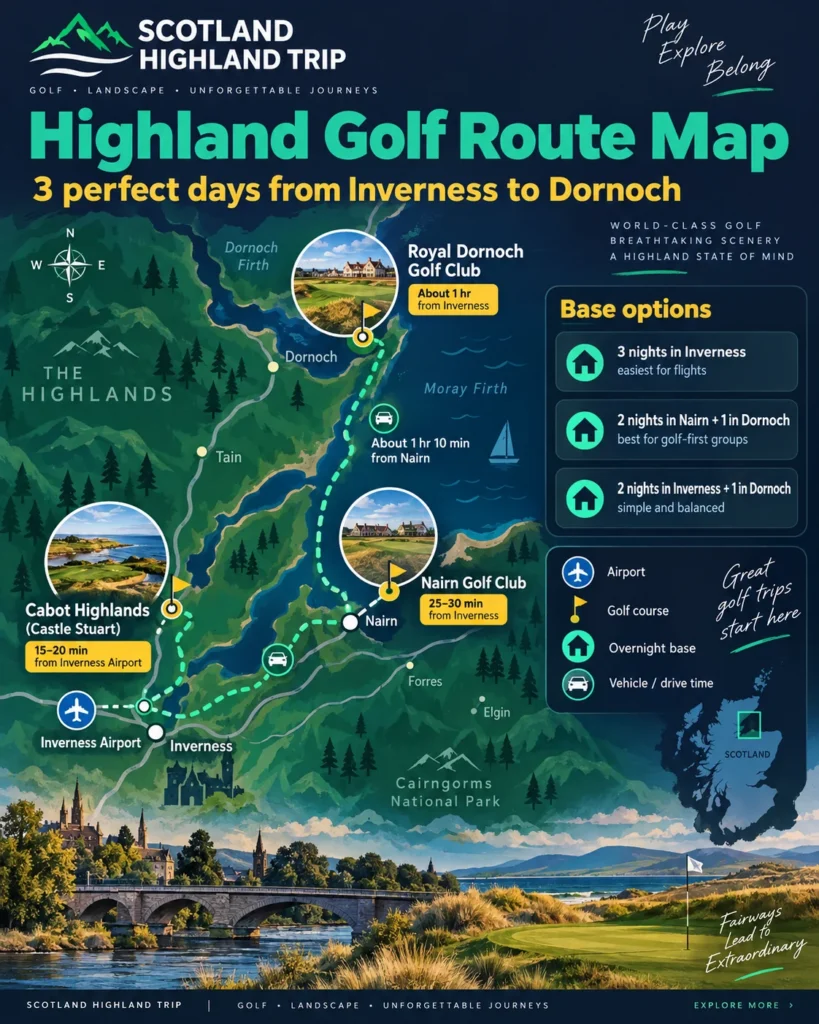
Inverness is the easiest single base, Nairn offers the shortest day-two transfer, and Dornoch creates the best final-night atmosphere. Self-driving suits flexible pairs, while groups with clubs and luggage usually gain more comfort from one private vehicle and a local driver.
| Plan | Best for | Main advantage | Main drawback |
|---|---|---|---|
| Three nights in Inverness | First-time visitors and early departures | One hotel and easy airport access | Longest Royal Dornoch day |
| Two nights in Nairn, one in Dornoch | Golf-first groups | Short transfers and a memorable finish | One hotel change |
| Two nights in Inverness, one in Dornoch | Groups arriving by air | Simple first day and relaxed final morning | Luggage transfer on day three |
The three courses form a practical arc around Inverness. A comparison of the best Highland bases helps if golf is only part of a longer Scotland trip.
Is self-driving or a private transfer better?
Hire a car if two golfers want complete freedom and one person is happy to stay alcohol-free. Choose a private transfer for four golfers, multiple flight arrivals, valuable clubs or a group that wants dinner and whisky without appointing a reluctant driver.
Groups comparing a driver with car hire can use current private Scotland tour costs as a planning benchmark, then request a golf-specific quotation that includes luggage and club capacity.
How much should you budget for three days of Highland golf?
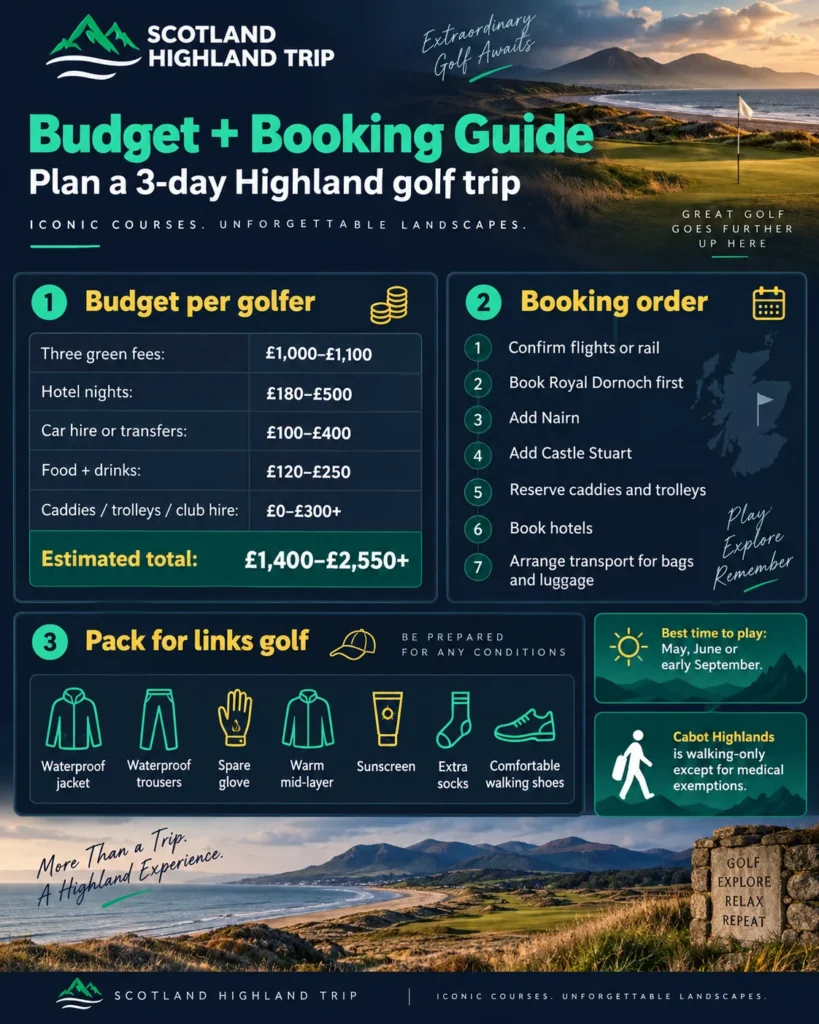
Allow roughly £1,400 to £2,550 per golfer for peak-season golf, two or three hotel nights, meals and transport. Green fees take the largest share, with the three headline rounds alone likely to total about £1,000 before caddies, rentals and optional extras.
| Cost item | Planning allowance per golfer | Notes |
|---|---|---|
| Three green fees | £1,000 to £1,100 | Confirm rates directly before paying |
| Two or three hotel nights | £180 to £500 | Assumes twin sharing, season matters |
| Car hire or private transfers | £100 to £400 | Group size changes the per-person cost |
| Food and drinks | £120 to £250 | Clubhouse lunch plus evening meals |
| Caddies, trolleys or club hire | £0 to £300+ | Reserve caddies early |
| Estimated total | £1,400 to £2,550+ | Flights are not included |
Rates move by month and package. Treat the table as a working budget, not a quotation. April and October can cost less, but colder weather, shorter daylight and course restrictions are the trade-off.
When is the best time to book and play this route?
Target May, June or early September for long daylight, good turf and slightly less pressure than peak summer. Secure Royal Dornoch first, then Nairn and Cabot Highlands, because one unavailable anchor round can force you to rebuild the entire route.
June gives you the most daylight. September often brings excellent links conditions and calmer roads. Coastal wind usually keeps midges down, though still evenings can be different. Scotland’s midge season is an annoyance to plan around, not a reason to cancel.
What booking order reduces the risk?
- Confirm the arrival and departure windows at Inverness Airport or railway station.
- Hold or book Royal Dornoch, ideally six to twelve months ahead for a prized summer time.
- Book Nairn for the preceding day, allowing for its cancellation terms.
- Add Castle Stuart on day one, with enough flight-delay buffer.
- Reserve caddies, rental clubs and electric trolleys at the same time as golf.
- Choose the hotel base only after the three tee times are fixed.
- Arrange a vehicle that can carry every passenger, suitcase and golf bag without folding the group into the seats.
Cabot Highlands states that its courses close only for lightning and does not refund ordinary rain. Bring a waterproof jacket and trousers, two gloves, a warm mid-layer, a hat, sunscreen, spare socks and shoes comfortable enough for three walking rounds. That is links golf. Pack properly and play.
What else should you know before booking?
Three rounds are enough if each day has breathing room. Confirm tee times, cancellation rules, walking policies and equipment before paying for flights. Then protect the schedule with sensible transfers, weather-ready clothing and a final day that gives Royal Dornoch the attention it deserves.
Frequently Asked Questions
Can you play Royal Dornoch, Cabot Highlands and Nairn in three days?
Yes. Play one course per day and use Inverness, Nairn or a split Inverness-Dornoch stay. The route is compact enough for three rounds without a frantic schedule.
Which course should you book first?
Book Royal Dornoch first because the most desirable summer tee times can disappear furthest in advance. Fit Nairn and Castle Stuart around that fixed date.
Do you need a handicap certificate?
Cabot Highlands does not require one. Requirements and visitor policies can change, so confirm directly with Nairn and Royal Dornoch before booking, especially for mixed-ability groups.
Can you use a golf buggy at Cabot Highlands?
Only with a medical exemption. Cabot Highlands operates walking-only courses and offers push trolleys, electric trolleys and advance-request caddie services.
Is Inverness or Dornoch the better base?
Inverness is better for airport access and one-hotel simplicity. Dornoch is better for a relaxed final round and an evening in a small Highland town.
Should you add Old Petty to the itinerary?
Add Old Petty if you can extend the trip to four days. Playing both Cabot courses in one day is possible, but it makes a premium trip feel rushed.
What happens if it rains?
Expect to play unless conditions become dangerous or the course closes. Bring full waterproofs, spare gloves and flexible expectations. Ordinary Highland rain rarely stops links golf.