The A82 leaves Glasgow through the suburbs, dull and grey, and then somewhere past Loch Lomond it changes. The road narrows, the hills close in, and within an hour you’re in a different country. A Glasgow to Inverness day trip is one of the great drives in Britain, and it packs a startling amount into a single day: two national parks, a Bond filming location, the Harry Potter viaduct, and the most famous loch on Earth.
There’s a good reason to think about it right now. The 2026 Commonwealth Games run in Glasgow from 23 July to 2 August, drawing more than 3,000 athletes and a flood of visitors into the city (glasgow2026.com). Most will never see the Highlands. If you’ve got a rest day between events, this is how you use it.
This guide covers the whole thing: how far it is, how long it takes, what you’ll see at every stop, whether to drive, take the train or book a tour, and when to go. By the end you’ll know exactly how to plan your own day, or when to hand the driving to someone else.
Jump to Section
How far is Glasgow from Inverness?
Inverness sits about 168 miles north of Glasgow. The direct route up the A9 takes roughly three to three and a half hours without stops. The scenic west-coast route through Glencoe and Fort William is longer at around 210 miles, but it’s the one worth doing for a day out.
Two roads, two very different days. The A9 is the fast, functional route straight up the middle of the country. The A82 swings west through the mountains and is slower, twistier and far more beautiful. For a day trip built around scenery, the extra time is the whole point.
| Route | Distance | Driving time (no stops) | Best for |
| A9 (direct) | ~168 miles | 3–3.5 hours | Getting there fast |
| A82 scenic (Glencoe & Fort William) | ~210 miles | 4.5–5 hours | A sightseeing day trip |
| By train (ScotRail direct) | – | ~3.5 hours | No car, no driving |
Can you really do Glasgow to Inverness in one day?
Yes, comfortably, if you treat it as a one-way scenic journey rather than a there-and-back sprint. Leaving early and arriving in Inverness by evening gives you time for Glencoe, Glenfinnan and Loch Ness with proper stops. Squeezing in the return to Glasgow the same day is possible but tiring.
The honest version: the scenic route one-way, Glasgow to Inverness, is a full and satisfying day. Doing the loop back to Glasgow on the same day means roughly ten hours in the car, which eats into your stops. Most people either stay a night in Inverness or accept a long evening drive home.
If you’re short on time or energy, the smart move is to end in Inverness and either stay over or arrange a private return. Our private Glasgow to Inverness day tour is built around exactly this one-way run, with the option of a return to Glasgow if you need it.
What’s the best route from Glasgow to Inverness?
The scenic route: north on the A82 along Loch Lomond, over Rannoch Moor into Glencoe, on to Fort William, then up the Great Glen past Loch Ness to Inverness. It trades speed for some of Scotland’s finest landscapes, and it links nearly every must-see stop in one continuous line.
Skip the A9 unless you’re in a genuine hurry. It’s a perfectly good road, but it misses everything. The A82 is the route the tour buses take for a reason: it strings Loch Lomond, Glencoe, Fort William, Glenfinnan and Loch Ness together like beads. The only real downside is that it’s slower and busier in summer, so an early start pays off.
What can you see between Glasgow and Inverness?
The scenic route packs in Loch Lomond, Glencoe, Glen Etive, Fort William, Ben Nevis, the Glenfinnan Viaduct, the Commando Memorial, Fort Augustus, Loch Ness and Urquhart Castle before you reach Inverness. That’s two national parks, several film locations and a thousand years of history in one drive.
Here’s each stop in turn, roughly in the order you’ll hit them.
Loch Lomond and the Trossachs
Barely 40 minutes out of Glasgow, Loch Lomond is the first proper stop. It’s the largest lake in Great Britain by surface area, and the southern gateway to the Loch Lomond and the Trossachs National Park. The “bonnie banks” of the old song are real, and on a still morning the reflections are worth pulling over for. Luss, a tidy conservation village on the west shore, makes an easy leg-stretch.
Glencoe and Glen Etive
Past Loch Lomond the road climbs onto Rannoch Moor, a vast, empty bog that feels like the edge of the world, then drops into Glencoe. Glencoe is the image most people carry of the Highlands: steep black walls of rock, waterfalls, and a brooding sense of history. That history is dark. In 1692, government soldiers murdered members of the MacDonald clan here in what became known as the Massacre of Glencoe. Film fans will recognise the glen from Skyfall, and just off it, the single-track Glen Etive road is where James Bond parks the Aston Martin. It’s a short detour and a favourite photo stop.
Fort William, Ben Nevis and Nevis Range
Fort William is the biggest town on the west Highland coast and the natural lunch stop. It sits at the foot of Ben Nevis, the highest mountain in Britain at 1,345 metres. You won’t climb it on a day trip, but you’ll see it. A few miles north, Nevis Range runs a mountain gondola up Aonach Mòr for anyone who wants the view without the hike.
Glenfinnan Viaduct: the Harry Potter bridge
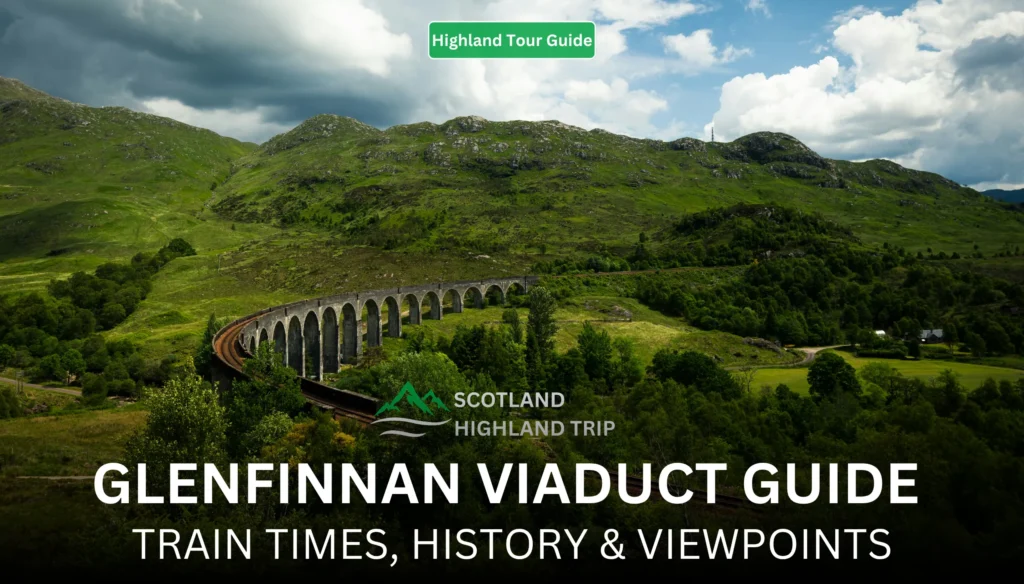
West of Fort William, the Glenfinnan Viaduct curves across a Highland valley on 21 stone arches, completed in 1898. You’ll know it instantly: it’s the bridge the Hogwarts Express crosses in the Harry Potter films. The real train is the Jacobite Steam Train, which runs across the viaduct daily through the 2026 season, roughly 1 June to 23 October, usually crossing around 11am (West Coast Railways). Time your visit to that window and you’ll watch a scarlet steam train sweep over the arches with Loch Shiel behind it. The loch, incidentally, doubled as the Black Lake at Hogwarts. At the head of it stands the Glenfinnan Monument, marking the spot where Bonnie Prince Charlie raised his standard in 1745. Steam-train tickets sell out months ahead in summer, so if you want to ride rather than watch, book early.
The Commando Memorial and Fort Augustus
Heading north again, the Commando Memorial at Spean Bridge is a striking bronze tribute to the British Commandos who trained in these hills during the Second World War. The view from it down the Great Glen towards Ben Nevis is one of the best on the whole route. Further on, Fort Augustus sits at the southern tip of Loch Ness, where a staircase of locks lifts boats up onto the Caledonian Canal. Watching the locks work, gate by gate, is oddly hypnotic.
Loch Ness and Urquhart Castle
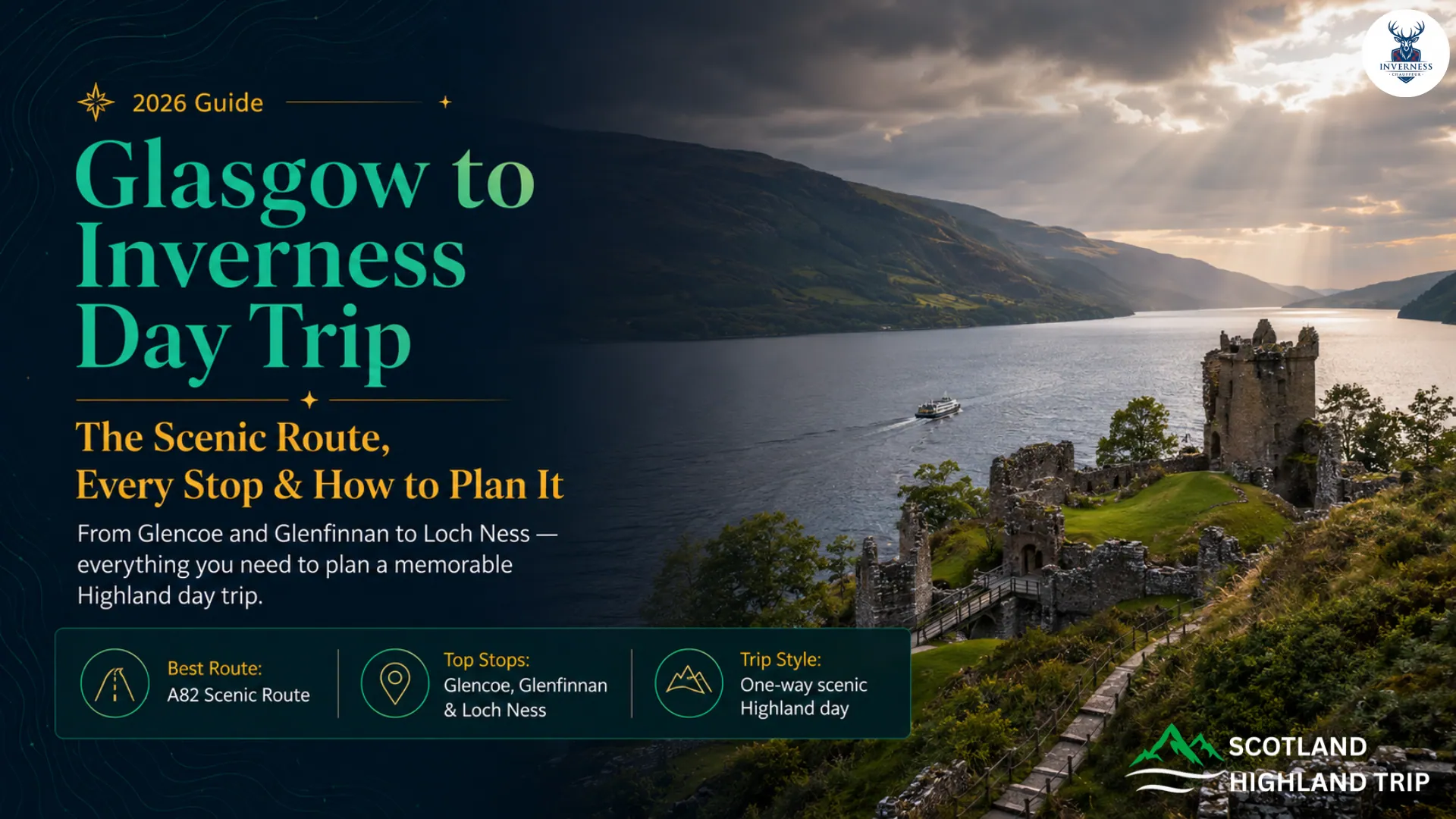
Then comes the big one. Loch Ness stretches 23 miles through the Great Glen and holds more fresh water than every lake in England and Wales combined. It’s deep, dark and cold, and it’s been the home of a legend since the 6th century, when St Columba is first said to have met a beast in its waters. Halfway up the western shore, Urquhart Castle stands ruined on a rocky point, with 1,000 years of history and the best Nessie-spotting odds on the loch. Adult entry runs around £12–£15, and Historic Environment Scotland asks you to pre-book parking, so it’s worth sorting in advance. Nearby, the Loch Ness Centre in Drumnadrochit tells the real, science-first story of the monster hunt, and it’s more interesting than the gift shops around it would suggest.
Inverness
The route ends in Inverness, the capital of the Highlands, on the banks of the River Ness. It’s a small, walkable city with good restaurants, a castle above the river, and an easy pace after a big day. Plenty of day-trippers stay a night here to explore the far north, Culloden or the Black Isle the next day.
Here’s the run of stops at a glance.
| Stop | Roughly from Glasgow | Why stop |
| Loch Lomond | 40 min | Britain’s largest loch, easy first stop |
| Glencoe | 2 hrs | The Highlands’ signature glen, Skyfall scenery |
| Glen Etive | 2 hrs | The James Bond road |
| Fort William | 2.5 hrs | Lunch beneath Ben Nevis |
| Glenfinnan Viaduct | 3 hrs | The Harry Potter bridge and steam train |
| Commando Memorial | 3.5 hrs | Great Glen views |
| Fort Augustus | 3.5 hrs | Caledonian Canal locks |
| Urquhart Castle | 4 hrs | Loch-side ruin, Nessie country |
| Inverness | 4.5 hrs | Journey’s end, Highland capital |
Times are approximate and don’t include stops.
Should you drive, take the train, or book a guided tour?
It depends on your group and how much you want to see. Self-driving gives freedom but ties one person to the wheel. The direct train is easy but skips the scenery. A guided tour handles everything but runs to a set route. A private tour combines the freedom of self-drive with none of the driving.
Each option, honestly weighed:
- Self-drive. The most flexible, and cheapest for solo travellers or couples with a hire car. But UK driving, single-track roads and busy summer car parks are a lot for a first-time visitor, and your driver never gets to just look out of the window. Reckon on car hire plus fuel and parking.
- The train. ScotRail runs a direct Glasgow–Inverness service in around three and a half hours. It’s a lovely ride, especially over the Cairngorms, but it takes the A9 corridor, so you miss Glencoe, Glenfinnan and Loch Ness entirely. Great for reaching Inverness; not a Highland sightseeing day.
- Group coach tour. Cheap per head and no planning required. The trade-off is a fixed timetable, a city-centre meeting point, 40 fellow passengers, and stops chosen for the group rather than for you.
- Private tour. You get the scenic route, hotel pickup, a local driver-guide and total flexibility, at a per-vehicle price that splits well across a group. It’s the least stressful way to see everything in a day. Our private Glasgow to Inverness day tour does exactly this, from £600 per vehicle for up to four, or £700 for up to eight.
There’s no single right answer. Two backpackers on a budget should take the train or hire a car. A family or a group of friends, especially during a busy Games fortnight, will usually have a better day, and often a cheaper one per head, in a private vehicle.
When is the best time to do a Glasgow to Inverness day trip?
Late spring to early autumn is the sweet spot, roughly May to September, when the roads are open, the attractions are running and the days are long. Summer brings the best daylight but also the biggest crowds and the midges. The Commonwealth Games period in late July and early August falls squarely in peak season.
A few things worth knowing before you pick a date:
- Daylight. In June and July, Scotland gets daylight past 10pm. A late finish still leaves your evening intact, which is handy if you’re heading back to Glasgow for events the next day.
- Weather. It changes fast and often. Pack a waterproof whatever the forecast says, and don’t let grey skies put you off; Glencoe is arguably better in moody weather.
- Crowds. July and August are the busiest months on the whole route. Glenfinnan’s car park fills an hour before the train, and Urquhart Castle gets packed by late morning. Early starts win.
- Midges. The Highland midge is out in force from June to September, mostly at dawn and dusk near water. Bring repellent.
- The Games effect. With the Commonwealth Games running 23 July to 2 August 2026, expect heavier traffic leaving Glasgow and tighter accommodation in Inverness. Book ahead.
How much does a Glasgow to Inverness day trip cost?
It ranges widely. Self-driving might cost £60–£120 for a couple once you add hire, fuel and parking. The direct train is around £40–£90 return per person depending on booking. A group coach tour runs roughly £50–£90 a head. A private tour is priced per vehicle, from £600, which splits well across a group.
Rough figures to plan with, before any attraction entries:
| Option | Typical cost | Notes |
| Self-drive (couple) | £60–£120 | Car hire + fuel + parking |
| Direct train (per person) | £40–£90 | Advance fares cheaper; misses the scenery |
| Group coach tour (per person) | £50–£90 | Fixed route, shared vehicle |
| Private tour (per vehicle) | From £600 | Up to 8 guests, scenic route, hotel pickup |
On top of that, budget for the extras you’ll actually use: Urquhart Castle at around £12–£15 an adult, a Loch Ness cruise at roughly £19, and lunch somewhere along the way. A ride on the Jacobite Steam Train is a bigger add-on, with adult returns from about £76.
Tips for Commonwealth Games 2026 visitors
Plan your Highland day around your competition schedule, not the other way round. Pick a rest day, start early to beat both the Games traffic out of Glasgow and the tour crowds up north, and decide in advance whether you’re staying in Inverness or heading back the same evening.
A little planning turns a good day into a great one:
- Use a rest day. The Games run eleven days. Slot the Highlands into a gap between your events rather than trying to cram it around one.
- Start early. City-centre traffic will be heavier than usual, and the best light and quietest car parks are in the morning.
- Book Inverness early. Highland accommodation tightens in high summer, and the Games will push demand further.
- Decide one-way or return. Ending in Inverness is the relaxed option; returning to Glasgow the same night is a long day. Sort it before you go.
- Let someone else drive. If your whole group wants to actually see the scenery, a private tour removes the one job nobody enjoys. We also handle airport transfers if you’re flying in or out around the Games.
Frequently asked questions
How far is Glasgow to Inverness?
About 168 miles by the direct A9 route, or roughly 210 miles by the scenic A82 through Glencoe and Fort William. The direct drive takes three to three and a half hours; the scenic route takes longer but shows you far more.
How long does the Glasgow to Inverness drive take?
Around three to three and a half hours non-stop by the A9. On the scenic route with stops at Glencoe, Glenfinnan and Loch Ness, it becomes a full day out rather than a quick transfer.
Can you see Loch Ness on a day trip from Glasgow?
Yes. Loch Ness sits on the scenic route just south of Inverness, so a well-planned day trip takes in Fort Augustus, Urquhart Castle and the loch itself before finishing in the city.
Is the Jacobite Steam Train running in 2026?
Yes. The Jacobite runs across the Glenfinnan Viaduct daily through the 2026 season, roughly 1 June to 23 October, with an added afternoon service in high summer. Tickets sell out early, so book well ahead.
Do you need to book Urquhart Castle tickets in advance?
It’s strongly recommended. Historic Environment Scotland asks visitors to pre-book parking, and the site gets very busy by late morning in summer. Advance booking saves queueing and guarantees a space.
What’s the best way to get from Glasgow to Inverness without driving?
The direct ScotRail train, in about three and a half hours, is the easiest car-free option, but it misses the west-coast scenery. For sightseeing without driving, a private or guided tour is the better choice.
Is one day enough for the Scottish Highlands?
One day is enough for a memorable taste, taking in Glencoe, Loch Ness and the west coast on a single scenic run. To go deeper, into Skye or the far north, you’ll want two days or more.

Emma is a solo traveler and freelance travel writer from New Zealand who spent three weeks exploring the Scottish Highlands. With a deep appreciation for history and landscapes, she booked a series of day tours and a private chauffeur journey with Scotland Highland Trip. From Loch Ness to the Cairngorms, she documented her experience through vivid blog posts and drone footage.