Scotland is a destination defined by its landscape. The Highlands offer a unique mix of rugged mountains, deep lochs, and coastal roads that attract visitors from around the world. However, the geography that makes this region so appealing also creates a specific set of logistical challenges. When planning a trip, the most significant decision you will make is not which castle to visit, but how you will get there.
The choice generally narrows down to two options: hiring a car to drive yourself or booking a private driver-guide. Both approaches have distinct advantages. Both have potential downsides. The ‘best’ option depends entirely on your group size, your budget, your confidence on the road, and what you value most in a travel experience.
This guide provides a realistic, detailed comparison of these two methods. We will look beyond the brochures to examine the practicalities of Scottish roads, the true costs involved, and how each option impacts the quality of your trip.
Jump to Section
Defining your Highland Travel Style
Before comparing them, it is helpful to clarify exactly what each option entails in the context of a Highland vacation.
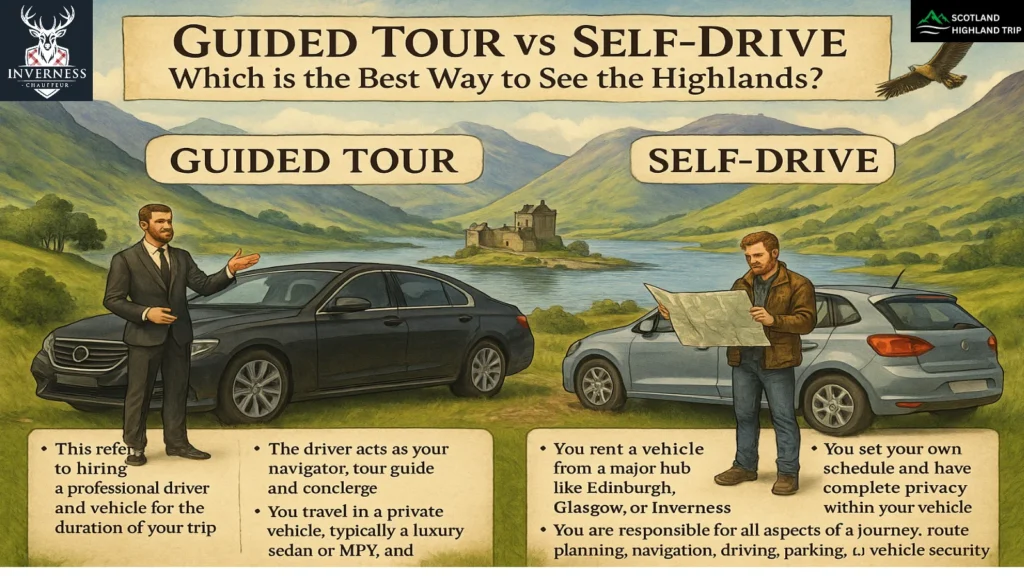
Self-Drive: This is the standard approach for many independent travellers. You rent a vehicle from a major hub like Edinburgh, Glasgow, or Inverness. You are responsible for all aspects of a journey: route planning, navigation, driving, parking, and vehicle security. You set your own schedule and have complete privacy within your vehicle.
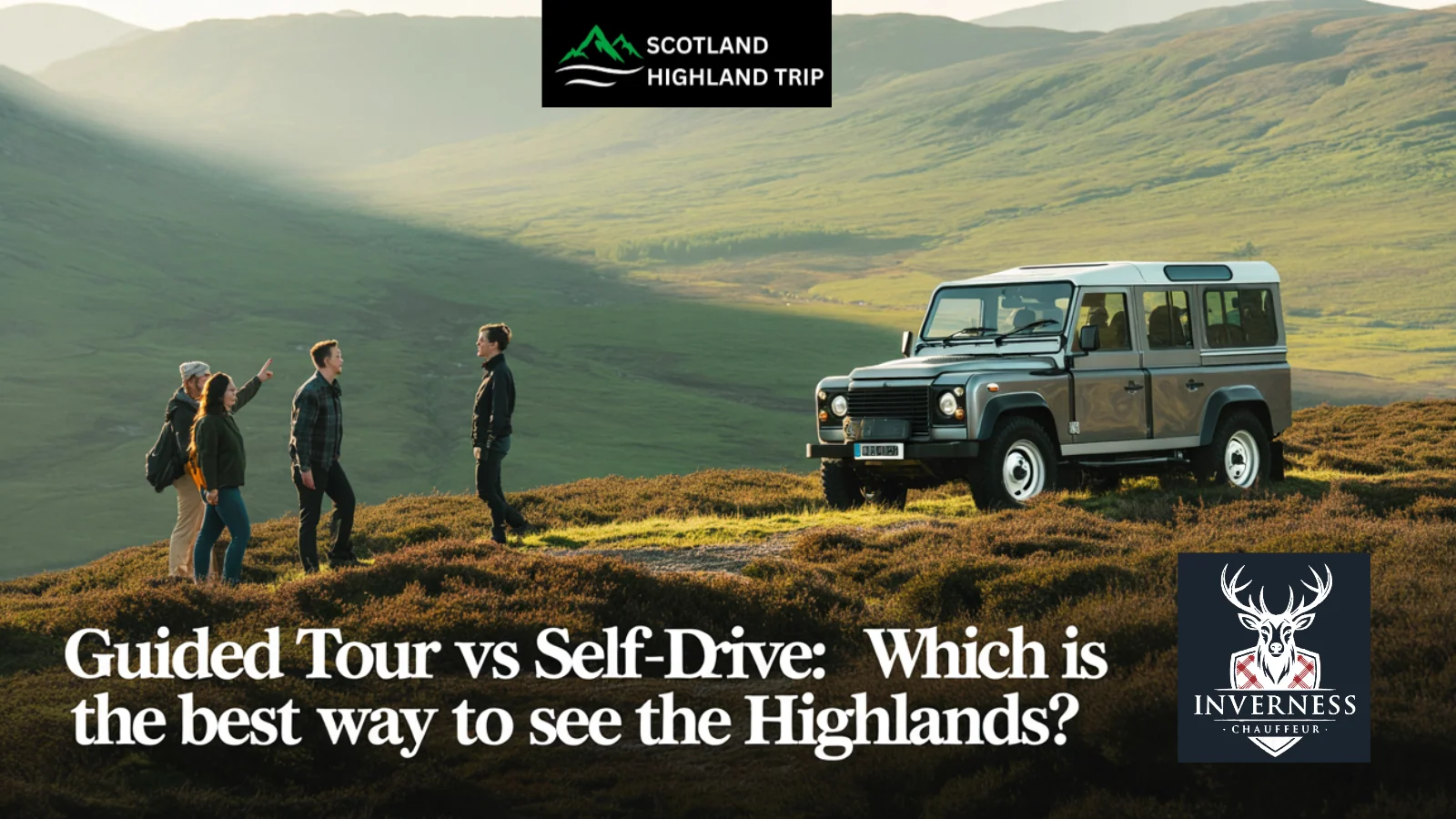
Guided Tour: This refers to hiring a professional driver and vehicle for the duration of your trip. Unlike a large coach tour with a fixed itinerary and 50 strangers, a private guided Tour is bespoke. The driver acts as your navigator, tour guide and concierge. You travel in a private vehicle, typically a luxury sedan or MVP, and the itinerary is tailored to your interests.
The Reality of Driving in the Highlands
The most immediate difference between the two options is the physical act of moving through the landscape. Driving in the Highlands is not like driving on a standard highway. It requires specific skills and high levels of concentration.
The Self-Drive Experience:
If you choose to drive, you must be prepared for the reality of highland roads. The first hurdle for many international visitors is driving on the left side. If you are accustomed to right-hand traffic, this requires a significant mental adjustment. Roundabouts, junctions and gear shifting are a task if you’re driving a manual. It all happens in reverse to your muscle memory.
Beyond the side of the road, the road itself is often the challenge. Key tourist routes, including sections of the North Coast 500 and the Isle of Skye, utilise single-track roads. Imagine a lane barely wide enough for a Mini Cooper, let alone a Highland cow standing in the middle of it. You’ll be constantly scanning for “passing places” and praying you don’t have to reverse half a mile uphill because you met a logging truck. By the time you reach your hotel, your hands might be white-knuckling the steering wheel. It’s an adventure, sure, but the driver is definitely working for their vacation.
Wildlife again is another factor. Sheep, deer and even highland cows often graze unfenced near the road. A self-driver is at all times on focus. This means your attention is focused on the tarmac, the mirrors and the hedgerows, rather than the scenery.
The Guided Tour Experience:
A professional driver navigates these hazards daily. They understand the etiquette of single-track roads instinctively. They know where the blind summits are and where livestock tends to congregate. It reduces your stress; you do not need to worry about reversing for a tractor or judging the width of a gap.
Scotland’s weather can change rapidly. Fog, heavy rain, and ice are common. A professional driver is trained to handle these conditions and knows which routes are safe. The primary benefit for passengers is the ability to look out the window. In a self-drive scenario, the driver sees very little of the landscape. On a guided tour, everyone can watch the scenery pass by.
Navigation and Route Planning
Let’s talk about the physical act of driving in Scotland, because it’s nothing like a Sunday cruise in the suburbs. If you’re coming from North America or Mainland Europe, your first hurdle is the left-hand side of the road. It sounds simple enough until you hit your first ’roundabout’ in a manual transmission car and realise your muscle memory is working against you. You’ll be reaching for the gear shift with your right hand and hitting the door panel instead.
But the real challenge begins once you leave the ‘A’ roads and head into the ‘Single Track’ territory of the West Coast or the Isle of Skye. These are essentially paved paths wide enough for exactly one vehicle. When you see a massive livestock truck or a tour bus hurtling toward you, you have a split second to find a ‘passing place’, a small paved cutout on the side of the road. If the passing place is on your right, you have to wait opposite it. If you miss it, you might find yourself forced to reverse several hundred yards on a blind curve with a steep drop-off on one side.
Then there’s the ‘Highland Traffic Jam.’ In this part of the world, sheep and Highland cows (the ‘Heilan Coos’) treat the asphalt as their personal lounge. They aren’t afraid of your rental car. I’ve spent twenty minutes waiting for a stubborn ram to decide he was finished licking the salt off the road. As a self-driver, your eyes are glued to the tarmac and the hedgerows, watching for deer or stray livestock.
You end up seeing the road, while your passengers get to see the mountains. A professional guide, however, does this every day. They know the ‘etiquette’ of the single track. They know which blind summits are dangerous and where the black ice hides in October. They take the stress so you can take the photos.”
The Navigation Challenge: GPS vs Local Knowledge
We’ve become incredibly reliant on GPS, but in the deep glens of the Highlands, technology often fails just when you need it most. Mobile signal is a luxury here, not a guarantee. As a self-driver, you’ll be driving through a place like Glen Shiel, surrounded by 3,000-foot peaks, and suddenly your blue dot disappears. But even when the GPS works, it lacks ‘local soul.’ It will always suggest the fastest route, which usually means the busiest, most boring trunk roads.
A private guide operates on ‘lived’ knowledge. They know that while the A82 is the most direct way to Loch Ness, there’s a tiny, unmapped road on the south side that offers a much better view and zero tourist traffic. They also understand the ‘real’ timing of the Highlands.
On paper, 60 miles looks like a one-hour drive. In the Highlands, between the winding curves, the photo stops, and the slow-moving campervans, that 60 miles is a two-and-a-half-hour commitment. Self-drivers almost always over-schedule their days, ending up exhausted and arriving at their hotels long after the kitchens have closed. A guide manages the ‘tempo’ of the day, adjusting the route on the fly if they see a storm front moving in or a road blockage ahead.
Types of Freedom on your Highland Tour
Freedom is the most common reason travellers choose to drive themselves. They want the ability to stop whenever they want. However, the nature of “freedom” differs between the two options.
If you’re self-driving, you get to have total autonomy. If you see a nice cafe, you can stop. If you want to wake up late, you can. You have complete privacy in the car to discuss personal matters or listen to your own music. This option suits those who dislike having a non-family member present or who want to change their plans on a whim without consultation.
Contrary to the perception that tours are rigid, a private inverness chauffeur service offers significant flexibility. The itinerary is usually built around your preferences. You can ask the driver to stop for a photo whenever safe. You can ask to spend longer at a castle if you are enjoying it. It takes complete responsibility off your shoulders. You do not need to worry about finding a parking space at a busy site like the Fairy Pools.
The driver drops you off at the entrance and picks you up when you are done. You do not need to worry about the car ferry schedule; the driver has already managed it. Furthermore, if you want to change your lunch plans, the driver can suggest alternatives and call ahead to book, saving you the hassle of researching on the fly.
From Sightseeing to Storytelling
This is perhaps the biggest differentiator. How much context do you want for the sights you are seeing?
On your self-driving tour, you are exploring on your own terms. You might bring a guidebook or download an audio guide. This works well for those who prefer to absorb information visually or through reading. However, you may view a ruined castle without knowing its significance, or drive through a glen without realising a major historical battle took place there. The experience is largely visual.
A driver-guide acts as a narrator for your trip. They provide context that brings the landscape to life. They can explain the history of the clans, the geology of the lochs, and the reality of modern life in the Highlands. Many drivers are locals. They can share personal stories, explain local customs, and bridge the gap between the visitor and the community. Unlike an audio guide, you can ask questions. If you are curious about the farming practices you see or the architecture of the houses, the driver can provide immediate answers.
The Whiskey Dilemma: Tasting or Driving
You cannot talk about the Highlands without talking about Scotch Whisky. Whether you’re heading to the ‘peat-heads’ paradise of Islay or the elegant estates of Speyside, a distillery visit is usually high on the agenda. This is where the self-drive dream often hits a wall. Scotland’s drink-driving laws are among the strictest in the world. The legal limit is so low, essentially 50mg per 100ml, that even a single small dram can put you over the edge.
If you are the designated driver, you are effectively a ‘spectator’ for the day. While your friends are savouring a 21-year-old single malt, you’ll be handed a ‘driver’s kit’. It is a little plastic bottle to take back to your hotel for later. It’s just not the same as experiencing the tasting in the warehouse.
This also applies to the ‘pub culture’ that makes Scotland so charming. There is nothing quite like a pint of local ale and a bowl of Cullen Skink by a peat fire after a day of hiking. If you’re driving yourself, you’re sticking to Diet Coke. On a guided tour, that restriction vanishes. The car is your ‘safe harbour,’ allowing the whole group to participate in the liquid history of the region without a second thought about the law or safety.
Travel in Comfort
When we think about road trips, we often focus on the destination, forgetting that in the Highlands, you’re going to spend six to eight hours a day inside a metal box. If you go the self-drive route, you are essentially playing the ‘Rental Lottery.’ You might book an ‘Intermediate SUV’ and show up to find a basic crossover with seats that feel like church pews and a plastic dashboard that rattles every time you hit a pothole. And in the Highlands, you will hit potholes.
On the flip side, professional chauffeur services treat their vehicles like a five-star hotel room on wheels. Most use Mercedes-Benz V-Class vans or S-Class sedans, which are designed for the long, winding hauls of the A82. There’s a psychological comfort here, too.
I’ve seen many travellers realise halfway through a trip that they didn’t check their tyre pressure or the oil in their rental. When you have a guide, that mental load disappears. You step into a pristine, climate-controlled cabin where there’s already a bottle of Highland Spring water and a charging cable waiting for your phone. It’s the difference between ‘transportation’ and ‘travelling in style.’
Reclaim your Time: Stressful Commute or Productive Journey
How do you want to use the time spent moving between destinations?
The way you spend your time between destinations is perhaps the most overlooked part of planning a Highland adventure. When you choose the self-drive route, travel time is essentially “active” time for the person behind the wheel. The driver isn’t just a traveller; they are a worker. On the winding, undulating roads of the Great Glen or the twisting turns of the Cairngorms, the driver has to be 100% “on.” There is no such thing as a casual glance at a passing waterfall or a quick check of a map while in motion. Even for the passengers, the physical experience can be taxing. The constant gear shifting and sharp corners often make it impossible to read a book or look at a screen without the looming threat of motion sickness. In a rental car, the journey is often something you simply have to “get through” to reach the next landmark.
Choosing a guided tour, however, completely redefines the “dead time” spent in transit. Suddenly, the vehicle is no longer just a mode of transport—it’s a lounge, a mobile office, or a sanctuary. Because professional drivers are trained in a smooth, “chauffeur-style” of driving, the jerky stops and starts of an amateur navigator are replaced by a fluid motion that minimises travel fatigue. For families, this means the car becomes a space for genuine connection. You can actually turn around and chat face-to-face, play games with your children, or share a laugh over a photo you just took, rather than shouting at the back of the driver’s head.
For the modern traveller who can’t entirely unplug, the back of a luxury vehicle becomes a highly productive mobile office. With the driver handling the navigation and the spotty signal areas, you can use the onboard Wi-Fi to catch up on emails or prepare for the next leg of your journey. But perhaps the greatest luxury of all is the permission to simply rest. After an arduous three-hour hike up to the Old Man of Storr or a long morning exploring the ruins of Urquhart Castle, there is immense value in being able to tilt your seat back and nap. You arrive at your next destination refreshed and energised, rather than drained by the mental tax of navigating Scottish traffic. In the end, a guide doesn’t just give you a ride; they give you back hours of your vacation that would otherwise be lost to the stress of the road.
Cost Analysis of Your Highland Adventure
Now, let’s talk about the elephant in the room: the budget. At first glance, renting a car looks like the obvious winner for your wallet. But if you’ve ever looked at a credit card statement after a UK road trip, you know the ‘sticker price’ is a fantasy. Fuel in Scotland is sold by the litre, and once you convert that to US gallons, you’re often looking at $7 or $8 a gallon. Then there’s the insurance. On these narrow roads, the risk of ‘kerbing’ a wheel or getting a scratch from a stray branch is incredibly high. Most rental agencies will hold a massive deposit on your card unless you pay for the ‘Super Collision Damage Waiver,’ which can nearly double your daily rental cost.
When you hire a private guide, that £500 or £600 daily rate feels like a gut-punch initially. But you have to break it down. That fee covers the driver’s expertise, the high-end fuel, the expensive parking fees at places like the Old Man of Storr, and even the vehicle ferry tickets, which can cost a fortune for a tourist. If you’re a family of five, you’d likely need to rent two cars to be comfortable, meaning double the fuel and double the stress. When you split a guide’s fee between a group, the ‘per person’ cost often lands in the same ballpark as a high-end rental, but with the bonus of a personal concierge who knows exactly which pub serves the best haggis.
The Comparison
For a solo traveller or a couple, self-driving is almost always cheaper. The cost of a private driver is significant for one or two people. However, for a group of 4 to 8 people, the math changes. A group of 6 would need to rent two large cars or one large van (which requires a specific license or is hard to find). They would pay for double the fuel, double the insurance, and double the parking. When a private driver’s fee is split between 6 people, the per-person cost often becomes comparable to the total cost of self-driving, while offering a significantly higher level of service.
Highland Tour in Every Season
The timing of your trip changes everything. If you come in the summer, you aren’t just fighting the roads; you’re fighting the crowds. I’ve seen the car park at the Fairy Pools on Skye so backed up that people were abandoning their cars on the grass, only to get a heavy fine from the local police. A local driver knows the ‘backdoor’ timing. They’ll suggest hitting the popular spots at 8:00 AM or 7:00 PM when the tour buses have vanished.
And we have to mention the midges. These tiny, biting insects are the unofficial mascots of the Highlands from June to August. A tourist with a map might park in a beautiful, still glen for a picnic, only to be eaten alive within seconds. A local guide knows the wind patterns; they know that if you move just half a mile to a certain breezy outcrop, you can enjoy your lunch in peace. It’s these tiny, ‘un-googleable’ details that turn a stressful trip into a perfect one.
Your Highland Tour Decision: Which Traveler Are You?
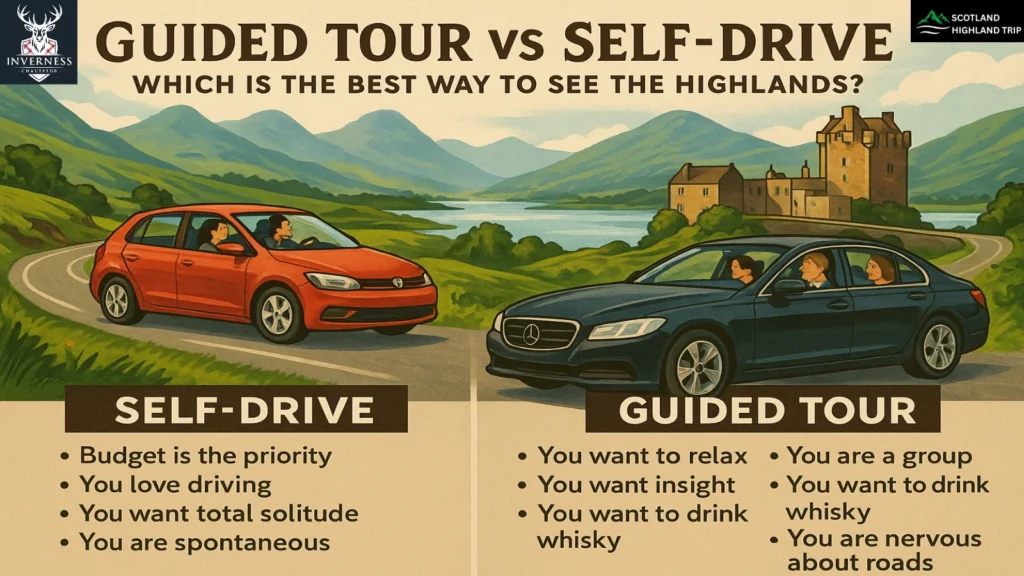
To summarise, here is a guide to which option fits which type of traveller.
Choose Self-Drive If:
- Budget is the Priority: You are travelling alone or as a couple and need to keep costs down.
- You Love Driving: You view the technical challenge of winding, narrow roads as fun rather than work.
- You Want Total Solitude: You want to be completely alone with your travel partner without a third party present.
- You Are Spontaneous: You want the ability to change your plans instantly without explaining it to anyone else.
Choose a Guided Tour If:
- You Want to Relax: You want to see the scenery, not the road. You want to avoid the stress of navigation and traffic.
- You Are a Group: You are a family or group of friends (4+ people) who can split the cost.
- You Want Insight: You value local history, culture, and storytelling.
- You Want to Drink Whisky: You plan to visit distilleries and want to participate fully.
- You Are Nervous About Roads: The idea of left-hand traffic or single-track roads causes you anxiety.
Conclusion: Finding Your Path Through the Highlands
There is no single “best” way to see the Highlands. Both self-driving and guided tours offer access to the same stunning landscapes, but they deliver very different experiences.
Ultimately, the choice between driving yourself and hiring a guide isn’t about which one is ‘better’, it’s about what you want to remember when you’re on the plane home. Do you want to remember the thrill of successfully navigating a manual car through the hairpin turns of the Bealach na Bà? Or do you want to remember the stories your guide told you about the Massacre of Glencoe as you looked out over the very glen where it happened?
If you’re a solo traveller on a tight budget, the rental car is your best friend. But if you’re travelling as a family or a group, the cost-benefit analysis shifts surprisingly quickly. When you factor in the insurance, the petrol, the parking fees, and the sheer mental energy of navigating a foreign land, a private guide starts to look less like a luxury and more like an investment in your own sanity. The Highlands are a wild, unpredictable, and ancient place. Sometimes, the best way to see them is to let someone else handle the road while you handle the wonder.

Emma is a solo traveler and freelance travel writer from New Zealand who spent three weeks exploring the Scottish Highlands. With a deep appreciation for history and landscapes, she booked a series of day tours and a private chauffeur journey with Scotland Highland Trip. From Loch Ness to the Cairngorms, she documented her experience through vivid blog posts and drone footage.