
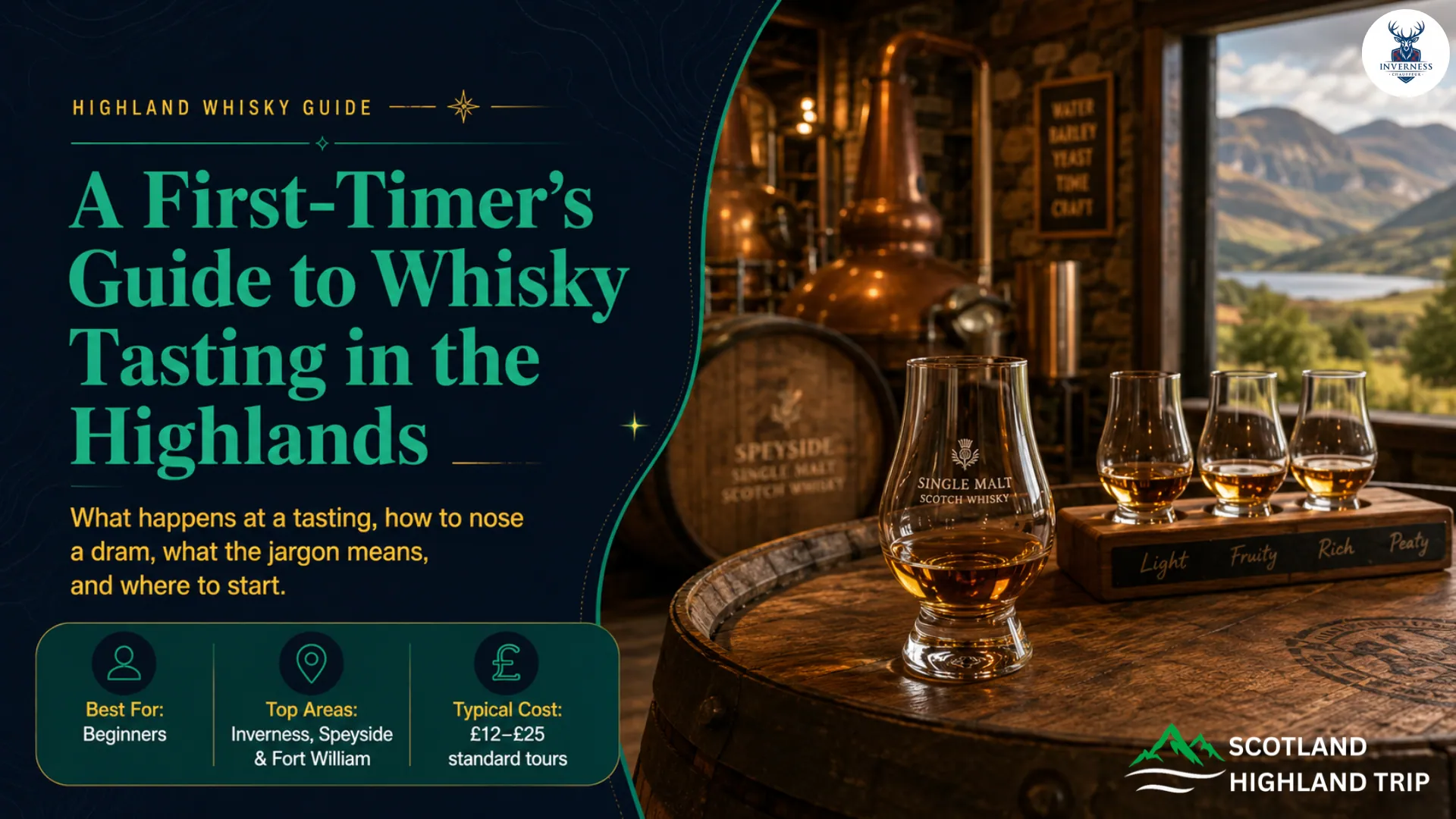
The tasting room smells of warm cereal and old wood, and someone has just put a glass in front of you with two fingers of gold liquid in it. Everyone else seems to know what to do with it. You don’t. That moment, right there, is why this guide exists. Whisky tasting in the Highlands is one of the best things you can do in Scotland, and it’s far less intimidating than it looks from the doorway. Scotland now has 154 operating whisky distilleries, and its distillery visitor centres pulled in 2.7 million visits in 2024, collectively the most popular tourist attraction in the country (Scotch Whisky Association). Most of those visitors are not experts. They’re people like you, holding a glass and hoping nobody asks them a question.
By the end of this guide you’ll know what actually happens at a tasting, how to nose and taste a dram without faking it, what the words on the menu mean, which Highland distilleries suit a first visit, and how to plan the day so nobody has to stay sober behind the wheel.
One opinion up front: the Highlands are the right place to learn. Not Edinburgh, with its polished city whisky experiences. Here, you taste the whisky a few metres from the stills that made it, poured by someone who probably knows the stillman by name. That changes things.
Jump to Section
What actually happens at a whisky tasting in the Highlands?
A Highland whisky tasting is usually a 45 to 90 minute guided session, either on its own or at the end of a distillery tour. A guide pours three to five drams, talks you through each one, and shows you how to get the most from the glass. No experience is expected.
That’s the whole mystery, honestly. You sit at a bar or a barrel-top table, the guide pours, and you follow along. Most first-timers book a standard distillery tour with tasting: you walk past the mash tuns and copper stills, hear how barley becomes spirit, then finish in the tasting room with one to three drams. Dedicated tasting sessions skip the walk and pour more.
A few things nobody tells you before your first one:
- You don’t have to finish anything. Tipping leftover whisky away is normal, and no guide will blink.
- Spittoons exist for a reason, and using one is not an insult to anyone.
- If you’re driving, every good distillery offers a “driver’s dram”, your samples decanted into little bottles to take home. Ask at the start, not the end.
- Questions are welcome. The guides are usually the most enthusiastic people in the building, and a genuine “why does this one taste of smoke?” will get you a better tasting than silence.
How do you taste whisky like you know what you’re doing?
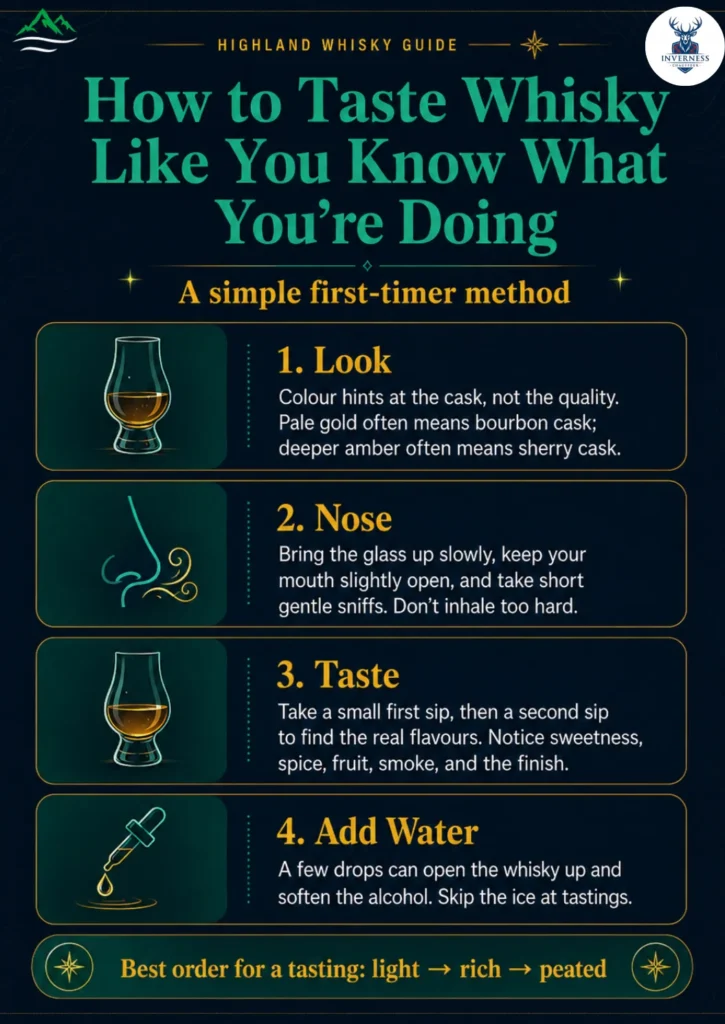
Look at the colour, nose the glass with your mouth slightly open, take a small first sip and let it coat your tongue, then breathe out through your nose. Add a few drops of water to open the whisky up. That’s the entire method.
There’s no secret handshake. But there is a sequence, and following it genuinely changes what you taste.
Step 1: Look
Hold the glass up to the light. Colour tells you about the cask, not the quality. Pale gold usually means an ex-bourbon barrel; deep amber leans sherry cask. That’s it. Don’t spend long here, whatever the connoisseurs on YouTube do.
Step 2: Nose
This is where whisky is won or lost, since most of what we call taste is actually smell. Bring the glass to your nose slowly, lips slightly parted, and take a short, gentle sniff. Not a deep lungful. At 40 to 60% alcohol, a hard sniff just burns, and then you smell nothing for the next minute. Take two or three short passes and name whatever comes to you: vanilla, apples, honey, smoke, seaweed. There are no wrong answers. Someone in your group will say “sticking plasters” and the guide will nod approvingly.
Step 3: Taste
Take a small sip and hold it on your tongue for a few seconds before swallowing. The first sip of any tasting mostly just calibrates your mouth to the alcohol, so judge nothing by it. The second sip is where the flavours arrive. Notice what you get at the front (often sweetness), the middle (fruit, spice, smoke), and the finish, which is whatever lingers after you swallow. A long finish is generally the mark of a good dram.
Step 4: Add water
A few drops, not a splash. Water breaks the surface tension and releases aroma compounds, which is why even lifelong drinkers add it. The whisky will smell noticeably different afterwards, usually softer and sweeter. Try each dram both ways and you’ve doubled your tasting for free.
And ice? You’ll find beginner guides online telling you to load the glass with ice cubes. Please don’t, at least not at a tasting. Cold numbs your palate and locks the aromas away, which defeats the entire point of the session. What you drink at home afterwards is your business.
What do the terms on a whisky menu actually mean?
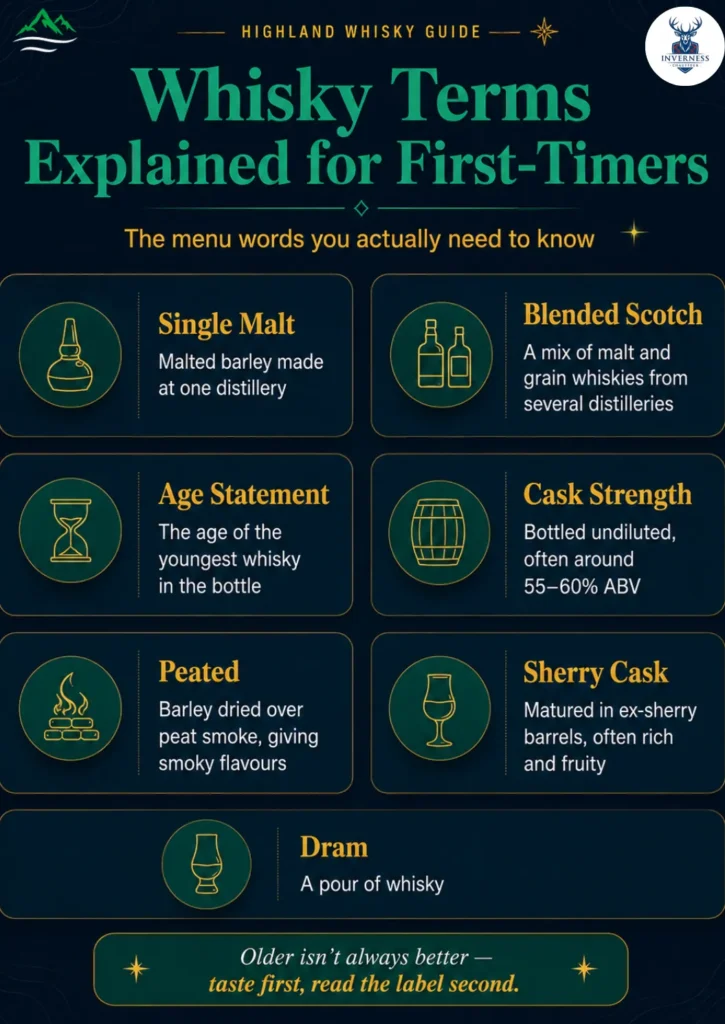
Single malt means whisky from malted barley made at one distillery. A blend mixes malt and grain whiskies from several. The age statement is the youngest whisky in the bottle, cask strength means undiluted, and peated means smoky.
Whisky menus love jargon. Here’s the working vocabulary, and genuinely nothing more is needed for a first tasting:
| Term | What it means | What it tells you |
| Single malt | Malted barley, one distillery | The classic Scotch experience |
| Blended Scotch | Malt + grain whisky, several distilleries | Usually softer and cheaper, nothing wrong with it |
| Age statement (e.g. 12) | Age of the youngest whisky inside | Older = longer in cask, not automatically better |
| Cask strength | Bottled undiluted, often 55 to 60% | Add water; it’s expected |
| Peated | Barley dried over peat smoke | Smoky, medicinal, love-it-or-hate-it |
| Sherry cask | Matured in ex-sherry barrels | Dried fruit, Christmas cake flavours |
| Dram | A pour of whisky | Any size; nobody measures |
The one that trips people up is age. A 10-year-old from a great cask can run rings around a tired 18-year-old, and Highland guides will tell you the same when the marketing team isn’t listening. Taste first, read the label second.
Which whisky regions will you meet in the Highlands?
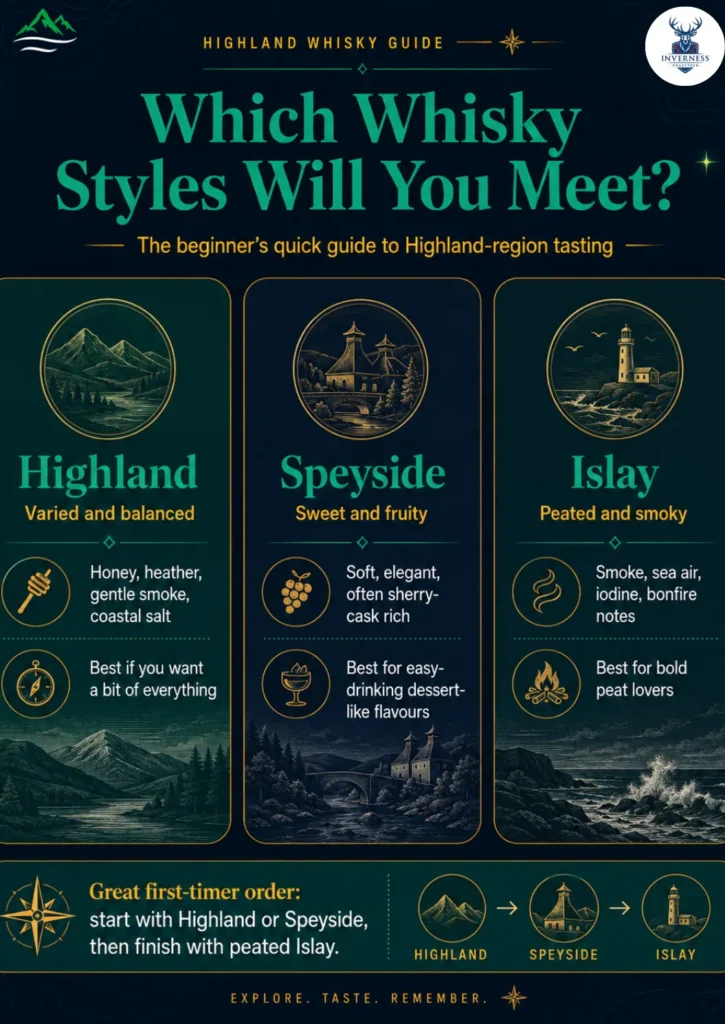
The Highland region itself produces everything from light and heathery to rich and coastal drams. Speyside, technically inside the Highlands, holds the biggest concentration of distilleries and leans sweet and fruity. Peaty, smoky whiskies mostly come from Islay, further west.
Scotland’s whisky map has five official regions, but from a Highland tasting room you really only need three points of reference:
| Region | Character | If you like… |
| Highland | Varied: honey, heather, gentle smoke, coastal salt | A bit of everything |
| Speyside | Sweet, fruity, elegant; sherry casks everywhere | Dessert flavours, easy drinking |
| Islay | Heavily peated, smoke and iodine | Bonfires and sea air |
Almost every first-timer walks in assuming all Scotch tastes like smoke. It doesn’t. Peat is mostly an Islay thing, and plenty of Highland and Speyside drams have none at all. A good first flight runs light to heavy: start with an unpeated Speyside-style dram, move through a richer sherried Highland malt, and finish with something peated so you can find out which camp you’re in. If your tasting host offers to arrange the pours in that order, say yes.
Which Highland distilleries are best for a first tasting?
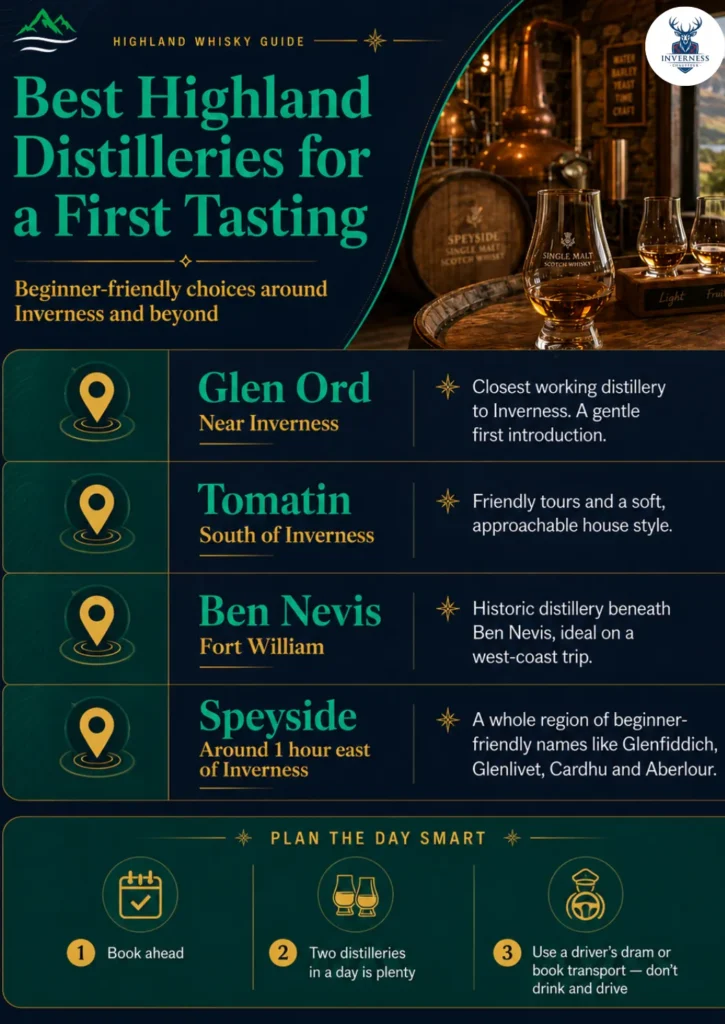
For first-timers based in Inverness, Glen Ord sits 25 minutes away, Tomatin about 25 minutes south, and the whole of Speyside within roughly an hour east. Near Fort William, Ben Nevis Distillery has run since 1825. All offer beginner-friendly tours with tastings.
You’re spoiled here, so pick by geography rather than agonising over brands.
Around Inverness
The Singleton of Glen Ord, near Muir of Ord on the Black Isle side, is the closest working distillery to the Highland capital and a gentle, traditional first visit. Its signature Singleton malt famously isn’t sold commercially in Europe, so tasting it at source has a bit of an occasion about it. South down the A9, Tomatin runs friendly, well-priced tours on a site connected with whisky-making since the 15th century, and its house style is soft and approachable, exactly what a first palate wants. The Dalmore, up the coast at Alness, suits anyone who wants the luxury end of things.
Around Fort William and the west
Ben Nevis Distillery sits at the foot of Britain’s highest mountain and has been licensed since 1825, which makes it one of Scotland’s oldest. The setting alone is worth the stop, and the tour is refreshingly unpolished in the best way. If your trip runs through Glencoe and the west coast anyway, our Fort William and distilleries tour folds a tasting into a full Highland day without any planning on your part.
Speyside, an hour from Inverness
East of Inverness, Speyside crams more than half of Scotland’s malt distilleries into one river valley. Glenfiddich and The Glenlivet run slick, first-timer-friendly visitor centres; Cardhu and Aberlour offer something quieter. You can’t do Speyside badly. You can, however, do too much of it: two distilleries in a day is plenty, three is a blur.
One honest warning that applies everywhere: book ahead, especially May to September. The era of wandering into any distillery on a whim is over, and the small-group tastings sell out first.
What’s the etiquette at a Highland whisky tasting?
Add water freely, skip the ice, don’t wear strong perfume or aftershave, feel free to spit or leave a dram unfinished, and ask as many questions as you like. And if you’re driving, take the driver’s dram rather than “just a small one”.
Whisky people are far less precious than their reputation suggests, but a few habits will make your tasting better for everyone:
- Go easy on fragrance that morning. Strong perfume in a small tasting room flattens everyone’s nosing, including yours. Nobody warns first-timers about this. Consider yourself warned.
- Water is not cheating. Master blenders assess whisky diluted. Anyone who tells you real drinkers take it neat is performing, not tasting.
- Hold the glass by the base or stem, partly to keep the bowl cool, mostly to stop hand-smell drifting into your nose.
- “Slàinte mhath” (roughly slan-ge-var) is the toast, meaning good health. Use it once and you’re a local. Use it every dram and you’re a tourist.
- Zero means zero at the wheel. Highland roads are single-track in places and police patrol distillery routes for a reason. Take the driver’s dram home, or better, don’t be the driver at all.
That last point deserves its own section.
How do you do a whisky tasting day without anyone driving?
Book transport with a driver, since Highland distilleries are rural, public transport barely reaches them, and Scotland’s drink-drive limit is effectively zero. A private tour with a driver-guide lets your whole group taste at every stop.
Here’s the problem with a DIY whisky day: the distilleries are scattered along rural A-roads, buses are sparse to non-existent, and Scotland’s drink-drive limit is the strictest in the UK. One dram can put you over. So on a self-drive day, one of you tastes nothing, collects miniatures, and watches everyone else have the fun. On a group day out, that’s a rough deal for whoever draws the short straw.
The fix is straightforward: let someone else drive. Our private whisky tours run from Inverness and across the Highlands with a local driver-guide, per-vehicle pricing, and a route built around the distilleries you actually want, whether that’s a Speyside day or a west-coast run past Glencoe. Every seat in the vehicle gets to taste, and the guide fills the drives with the stories the distillery tours skip. Guests say as much in our reviews; the driver-guide is usually the bit people remember.
Coming up from Glasgow first? The scenic route north is a day out in itself; our Glasgow to Inverness day-trip guide covers it stop by stop.
How much does whisky tasting in the Highlands cost?
Standard distillery tours with a tasting run about £12 to £25 per person. Premium tastings and warehouse experiences sit around £40 to £100+. Private transport for a group day works out separately, priced per vehicle rather than per head.
Rough numbers to plan with:
| Experience | Typical price per person | What you get |
| Standard tour + tasting | £12–£25 | Distillery walk-through, 1–3 drams |
| Dedicated tasting session | £25–£45 | 4–6 drams, guided, no tour |
| Premium / warehouse experience | £40–£100+ | Cask samples, rare drams, small groups |
| Driver’s dram | Free | Your pours, bottled to take away |
Two budgeting notes from experience. First, the bottle shop at the end is where the real money goes, so decide your limit before the third dram, not after it. Second, distillery gift shops sell miniatures of almost everything you tasted, which is the cheapest way to re-test your favourites at home before committing to a full bottle.
Frequently asked questions
Do I need to know anything about whisky before a tasting?
No. Tastings are built for beginners, and guides genuinely prefer curious first-timers to know-it-alls. If you can smell and sip, you’re qualified. Everything else gets explained in the room.
What if I don’t like whisky?
Then you’ve probably only met peated whisky, or whisky served badly. Light Speyside and Highland drams taste of honey, vanilla and orchard fruit, nothing like the smoky stereotype. Start unpeated and see what happens.
Should I drink whisky neat or with water?
Both, in that order. Nose and sip it neat first, then add a few drops of water and try again. The water releases aromas and softens the alcohol. Ice, though, numbs the flavours; save it for home.
How many distilleries can you visit in one day?
Two is the sweet spot, three is the maximum before every dram tastes the same. Palate fatigue is real. Better to do two properly, with lunch in between, than race four.
Can children come on distillery tours?
Policies vary. Many Highland distilleries welcome children on tours (without tastings, obviously), while some set minimum ages of 8, 12 or 18. Check the specific distillery before booking a family visit.
What should I wear to a whisky tasting?
Comfortable layers and flat shoes. Production areas are warm; warehouses are cold; Highland weather outside is both, sometimes within the hour. And skip the heavy perfume or aftershave, since strong scent interferes with nosing for the whole room.
Is a guided whisky tour worth it for beginners?
Yes, and arguably more for beginners than anyone. A driver-guide handles the routes and bookings, everyone in the group can taste, and you get context between stops that turns random drams into an actual education.

Emma is a solo traveler and freelance travel writer from New Zealand who spent three weeks exploring the Scottish Highlands. With a deep appreciation for history and landscapes, she booked a series of day tours and a private chauffeur journey with Scotland Highland Trip. From Loch Ness to the Cairngorms, she documented her experience through vivid blog posts and drone footage.