One couple may be perfectly happy sharing a well-run minibus, following a fixed route and meeting other travellers over dinner. Another may want a quiet vehicle, their own driver-guide and the freedom to stay beside a loch for twenty extra minutes because the light has finally changed.
Both can book a premium Highland trip. Only one has booked the right kind of luxury for them.
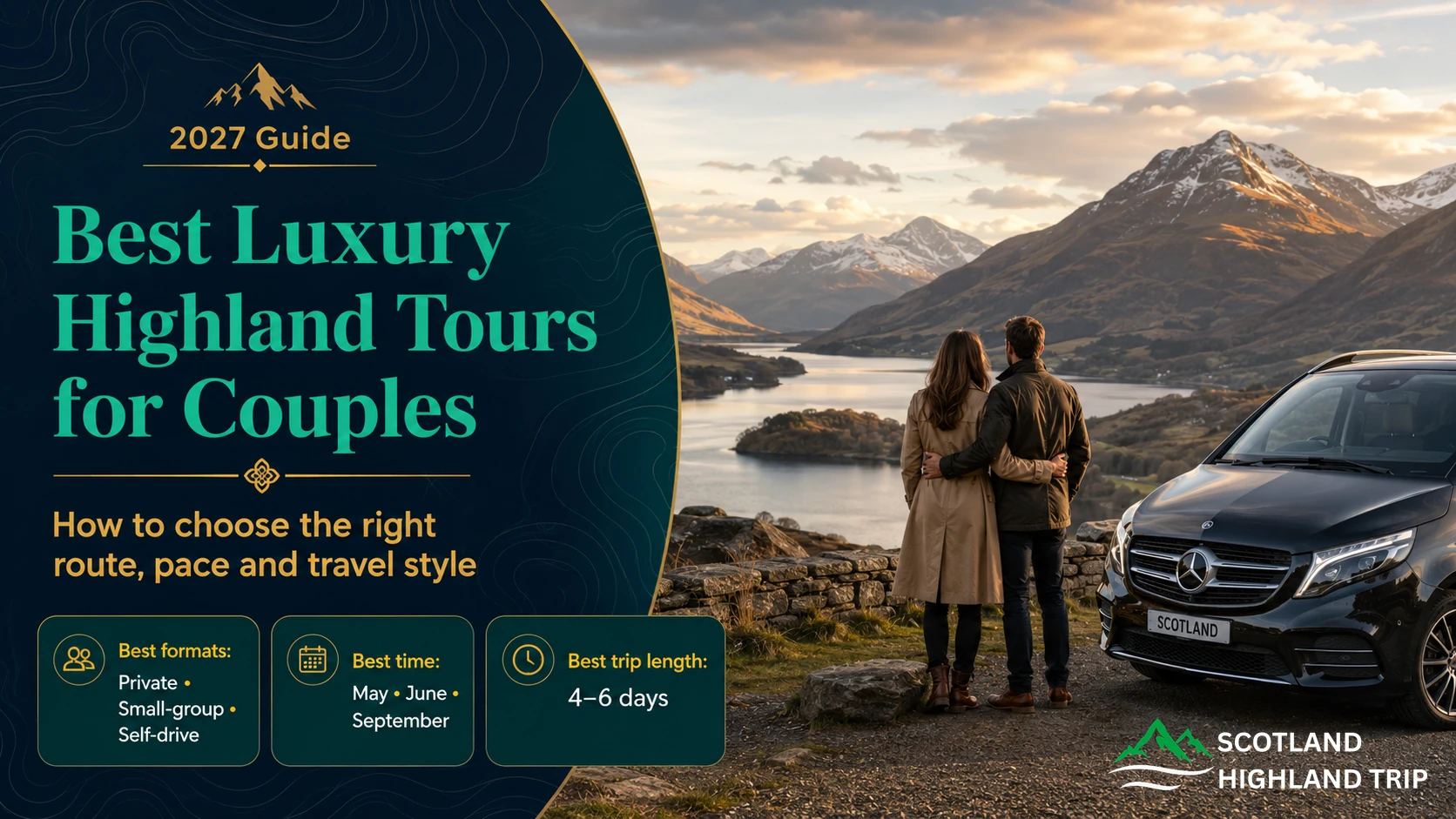
The best luxury Highland tours for couples are not defined by the highest price or longest list of famous stops. They combine privacy, comfort, sensible mileage and a route designed around what the couple actually enjoys. For some, that means a private day from Inverness to Loch Ness or Speyside. For others, it means four to six days with overnight stays on Skye or the west coast. A small-group tour may provide better value when accommodation and guiding are bundled; self-drive may suit couples who genuinely enjoy driving as part of the holiday.
For 2027, choose the format first, then the route. Confirm the exact vehicle, private status, inclusions and cancellation terms before paying. A page labelled “luxury” does not tell you how the day will feel.
The Quick Planning Answer
- Best format for privacy: A private chauffeur-led or driver-guided tour reserved only for the couple.
- Best broad trip length: Four to six days for a relaxed first Highland journey; one day works when it stays within one coherent region.
- Best broad travel periods: May, June and September are strong options, but none guarantees dry weather, clear views or freedom from midges.
- Best first-time combination: Inverness, Loch Ness and the Great Glen, with either Culloden and Clava Cairns or a second day in Speyside and the Cairngorms.
- Best longer scenic journey: Glencoe and Skye, or Torridon and Wester Ross, with overnight stays rather than repeated returns to one base.
- Main 2027 warning: Do not assume that a tour is private, attraction entry is included or a future timetable is confirmed. Ask for the exact written inclusions for your date.
Jump to Sections
What Makes a Highland Tour Genuinely Luxurious?
Luxury in the Highlands is best understood as friction removed from the day.
It is being collected from the agreed place without uncertainty. It is having enough luggage space without bags beside your feet. It is knowing whether castle tickets are included. It is reaching lunch without having spent the morning watching the clock. It is being able to change a short walk when rain closes in without the entire itinerary collapsing.
Leather seats can improve comfort, but they cannot rescue an overpacked route.
Privacy and pace
Privacy matters because it changes how the couple uses the day. They can talk or sit quietly. They can ask basic questions without feeling self-conscious, spend longer at one castle, shorten a walk, or request an extra comfort stop. A photographer does not have to negotiate every pause with a group, and a traveller with limited mobility does not have to keep pace with strangers.
That does not mean every private tour is fully flexible. Timed attraction entries, distillery reservations, ferries, traffic and safe working hours still shape the itinerary. Genuine flexibility operates within those constraints; it is not a promise that every change will be possible.
A vehicle suited to the day
The right vehicle is not necessarily the largest or most prestigious one.
For two people on a paved, regional day tour, a comfortable saloon may provide a quiet ride and easy conversation with the driver. A larger vehicle may be more suitable when the couple has substantial luggage, mobility equipment or wants more cabin space. Step height, door width, seating position, climate control and actual luggage capacity matter more than a model name.
Ask which vehicle is assigned, whether that can change, and how the luggage calculation is made. “Seats up to seven” does not mean seven passengers plus seven large cases will fit comfortably.
Route design and reliable guidance
A well-designed luxury day normally has two or three anchor experiences, a proper meal or rest break and room for short scenic stops. It does not turn every viewpoint into a timed obligation.
A knowledgeable driver-guide should add context, manage the road and explain why a stop suits the route. However, “chauffeur,” “driver-guide” and “tour guide” do not always describe identical roles. Some chauffeurs mainly provide transport; some driver-guides give continuous interpretation; certain sites use their own specialist guides. Ask what commentary and guiding are actually included.
Reliable communication is equally important. The operator should be able to explain:
- where pickup occurs;
- how long the day is expected to last;
- what happens if weather affects the planned route;
- which costs are separate;
- who books timed attractions;
- how delays or overtime are handled.
That clarity is a more useful sign of luxury than a long list of complimentary items.
Best Luxury Highland Tour Styles for Couples
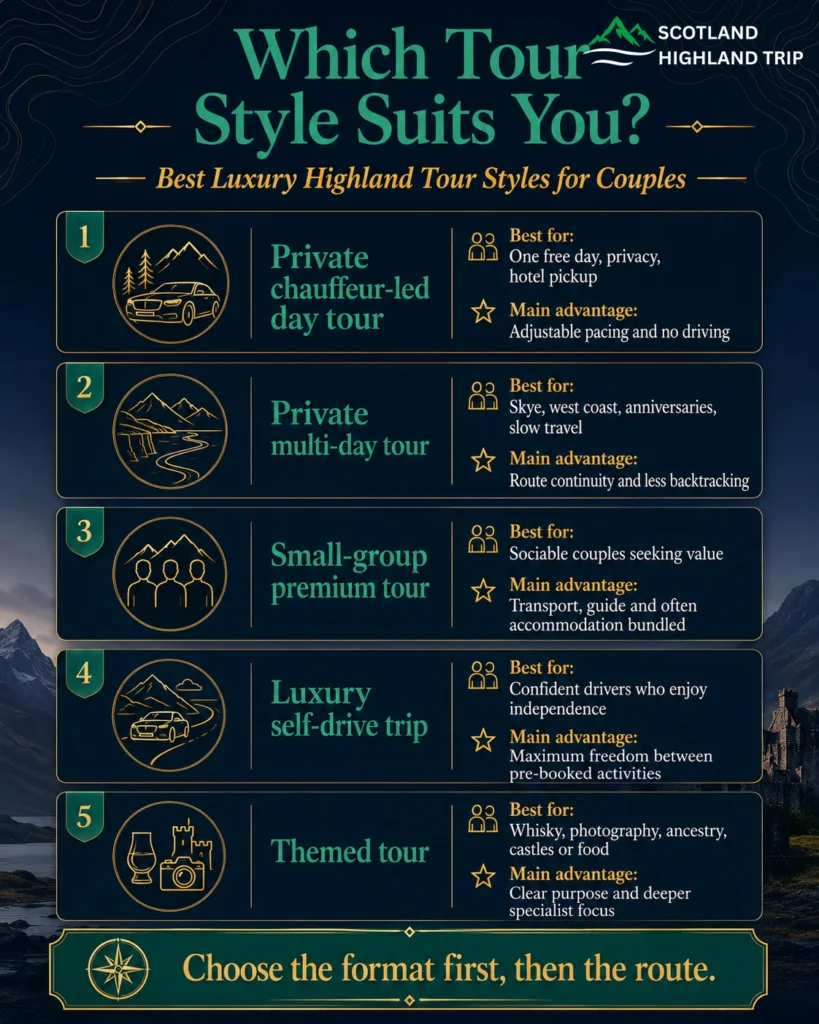
| Tour Style | Best For | Main Advantage | Main Limitation |
| Private chauffeur-led day tour | Couples with one free day, a clear interest or an Inverness base | Privacy, no driving responsibility and adjustable pacing | Higher cost for a single day; distant routes can still feel rushed |
| Private multi-day tour | Skye, the west coast, islands, anniversaries and slow travel | Route continuity, fewer return journeys and more time in remote areas | Accommodation and inclusions need careful coordination |
| Small-group premium tour | Sociable couples seeking packaged value | Guide, transport and often accommodation are shared across the group | Fixed times, less privacy and limited route control |
| Luxury self-drive trip | Confident drivers who value independence | Complete control away from pre-booked activities | Navigation, parking, alcohol limits and daily logistics remain with the couple |
| Themed private or small-group tour | Whisky, photography, ancestry, castles or food | Depth and a clear reason for each stop | A narrow theme can crowd out general sightseeing if badly planned |
Private chauffeur-led day tours
This is usually the strongest format for couples who have one day and value privacy more than a low per-person price.
Inverness is a practical base because Loch Ness, Culloden, Clava Cairns, the Black Isle, parts of the Cairngorms and Speyside can each form a coherent day. The key is to choose one direction. A Loch Ness day should not also pretend to be a complete Speyside whisky tour and a full Culloden visit.
A private day is particularly valuable when:
- one person wants to taste whisky and neither wants to drive;
- the couple has a flight, train or dinner time to protect;
- photography is a priority;
- walking ability or energy levels may change;
- the couple wants guide interaction without a group.
Scotland’s legal alcohol limit for drivers is 50mg per 100ml of blood, according to the Scottish Government. A non-driving format therefore has an obvious practical advantage on a whisky-focused day.
The limitation is distance. The live Scotland Highland Trip Skye page describes its Inverness-to-Skye itinerary as approximately 12 hours, with timing affected by weather and traffic. That makes Skye possible in a day, but not slow. Couples seeking a relaxed meal, longer walks or evening light should stay overnight.
Private multi-day Highland tours
A private multi-day tour becomes the stronger choice when the route moves beyond the easy reach of one base.
It works well for:
- two or more nights on Skye;
- Glencoe followed by the Great Glen and Inverness;
- Torridon, Wester Ross and Applecross;
- Assynt and the north-west coast;
- island journeys involving ferries;
- couples who do not want to repack the route themselves each morning.
The main gain is not simply more sightseeing. It is less backtracking. A couple can finish in a different place from where the day began, use better light at the beginning and end of the day, and choose accommodation that supports the following route.
Before booking, establish whether the operator is providing only the vehicle and driver or also arranging accommodation, meals, ferries and attraction reservations. “Multi-day tour” can describe both models.
Small-group premium tours
Small-group travel can be the best value for couples who like a social atmosphere and do not need the route to respond to them.
The guide, vehicle and sometimes accommodation are shared among several guests, reducing the cost per person. The itinerary is already built, and a well-run group can make evening meals and longer journeys more sociable.
The trade-off is structural. Pickup times, rest stops, meals and departures have to work for everyone. One couple cannot normally extend a photo stop, drop an attraction or change the route because the forecast is better elsewhere. The room is private; much of the day is not.
Ask for the maximum group size, not only the usual size. “Small group” might mean eight people on one product and considerably more on another.
Luxury self-drive trips
Self-drive offers the greatest independence between fixed reservations. It can be a good option for couples who both enjoy driving, want private time and prefer to make decisions without a guide.
The important question is whether driving is part of the pleasure or merely the method of reaching the scenery.
In the Highlands, self-drive responsibility includes:
- driving on the left if that is unfamiliar;
- using single-track roads and passing places correctly;
- finding legal parking;
- monitoring fuel and charge levels;
- adjusting for weather and daylight;
- keeping to timed entries;
- deciding who will not drink at a tasting.
Road Safety Scotland explains that passing places must not be used for parking. When a passing place is on the left, the driver should pull into it; when it is on the right, the driver waits opposite so oncoming traffic can use it.
Self-drive is not an inferior form of luxury. It is a less supported one. Couples should choose it because they want the responsibility, not because an executive hire car makes the logistics disappear.
Themed couples’ tours
A theme can give a private day more depth and prevent the itinerary becoming a generic circuit.
Useful combinations include:
- Scenery and castles: Loch Ness with Urquhart Castle, or Glencoe with a carefully chosen heritage stop.
- Whisky and food: Two booked Speyside distilleries with an unhurried lunch rather than four rushed visitor centres.
- Photography and landscapes: Flexible west-coast or Cairngorms routing planned around light, weather and safe stopping places.
- Heritage and ancestry: Culloden, Clava Cairns, local archives, parish landscapes or family locations supported by prior research.
- Coast and villages: Wester Ross, Dornoch and the east coast, or a slower Assynt journey.
The theme should reduce the number of competing priorities. If it adds more stops without creating focus, it has failed.
Best Highland Destinations for Couples
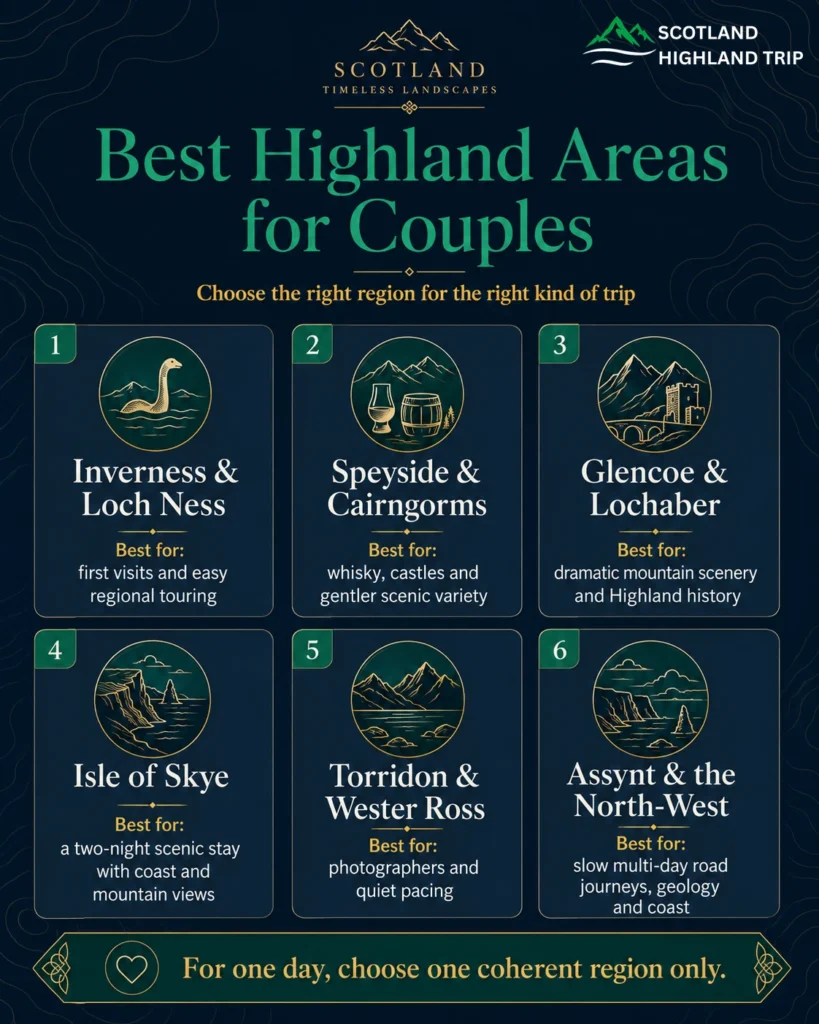
There is no single most romantic Highland route. The better question is: what do you want to share—history, mountain scenery, whisky, photography, road travel or quiet time?
Loch Ness and the Great Glen: best for first-time visitors
Loch Ness is the easiest first Highland day to understand from an Inverness base. The water, Great Glen landscape and Urquhart Castle create a strong combination without requiring a move to another hotel.
Historic Environment Scotland describes Urquhart as a major historic site on the shores of Loch Ness. Entry, opening times and any cruise connection should be checked for the couple’s 2027 date rather than assumed to be part of a tour.
This route suits couples who:
- have only one full day;
- want a recognisable Highland landscape and history;
- prefer moderate road time;
- want optional cruising or short walks rather than a demanding hike.
It is less suitable for travellers whose priority is remote mountain scenery or a full whisky day.
Culloden, Clava Cairns and Cawdor: best for history-focused couples
These locations work geographically from Inverness, but they should not be treated as interchangeable photo stops.
Culloden is a battlefield and place of remembrance. The National Trust for Scotland operates a visitor centre beside the battlefield and publishes its opening periods separately. Clava Cairns adds prehistoric context and requires respectful access. Cawdor is a lived historic estate with its own seasonal arrangements.
A couple genuinely interested in history will gain more from time at two or three connected places than from adding Loch Ness, a distillery and a distant glen to the same day.
Speyside and the Cairngorms: best for whisky, food and a softer landscape
Speyside and the northern Cairngorms offer distilleries, wooded valleys, mountain views and villages within a logical touring area east and south-east of Inverness.
This is one of the clearest cases for a driver-led day. Both travellers can participate in tastings, and pre-booked times can be coordinated with lunch and scenery. Distillery capacity is not unlimited: Cardhu currently recommends advance booking and says some tour dates are released approximately 90 days ahead, while other distilleries use different release windows. Check the chosen distillery directly for 2027.
Two meaningful distillery experiences are normally enough for one day. More can turn the route into a sequence of reception desks and gift shops.
The Cairngorms also suit couples who want estates, forest walks, food producers or quieter scenery without the road intensity of the far north-west. The Cairngorms National Park highlights castles, ruins, food experiences and whisky alongside outdoor attractions.
Glencoe and Lochaber: best for mountain scenery and historical context
Glencoe provides the strongest enclosed mountain-and-glen experience in this guide. It suits couples who want landscape, history and photography without making a serious hill day the centre of the tour.
The area works best:
- as a focused day from Fort William or the west-central Highlands;
- on a transfer between Glasgow and Inverness;
- as the first or final section of a multi-day Great Glen journey.
Trying to combine Glencoe, Glenfinnan, a long Loch Ness visit and a return to the same distant base can leave too little time outside the vehicle. Use Glencoe as a region, not a lay-by.
Isle of Skye: best for a two-night scenic stay
Skye is often the route couples ask for first. Its appeal is understandable: coast, mountain forms, villages and major walking or photography locations occur within one island journey.
It is also frequently compressed.
A day tour from Inverness is possible, but the live Scotland Highland Trip itinerary describes a roughly 12-hour day. That can suit a couple with one available date who accepts substantial road time. It is not the best expression of luxury for someone who wants slow meals, flexible walks or a quieter evening.
For most couples, two nights on Skye is the better minimum. One day can focus on the Trotternish peninsula or another coherent area; the arrival and departure days can include Eilean Donan, Sleat or the route back towards the Great Glen. Avoid building a single island day around every location made famous online.
Torridon and Wester Ross: best for photographers and quiet pacing
Torridon offers concentrated mountain scenery, sea lochs and a strong scenic drive. It works well for couples who are happy with fewer attractions and more time observing the landscape.
It can form a long but focused day from Inverness. It is better with an overnight stay when the couple wants short walks, changing light or the Applecross peninsula. Serious mountain routes are separate activities and should not be added to a sightseeing day.
Scotland Highland Trip’s Torridon and Assynt guide explains the practical difference: Torridon provides the more concentrated mountain-and-glen experience, while Assynt is a wider mix of isolated peaks, geology and coast.
Assynt and the north-west: best for a multi-day road journey
Assynt is not the sensible addition to an already full Inverness day. Its value comes from movement between Loch Assynt, Knockan Crag, Lochinver, beaches, isolated mountains and the route towards Kylesku.
Couples who like slow road travel, geology, low-level walks and landscape photography should allow at least two nights in or near the area. Assynt also works as part of a longer North Coast 500 journey, provided the itinerary does not reduce the west coast to one high-mileage stage.
This is where private multi-day travel can justify its price: the driver manages single-track roads and route changes while both travellers see the landscape. Confident self-drivers may prefer to keep that control themselves.
Applecross: best when the route and driver are suitable
Applecross can be combined with Wester Ross, Shieldaig and Torridon, but the famous Bealach na Bà is not a compulsory ingredient.
Weather, visibility, road conditions, vehicle suitability and driver confidence should determine whether the pass is used. A cautious alternative route is a better luxury decision than making a nervous traveller endure a road for its reputation.
Applecross generally belongs in a full west-coast day or an overnight route, not as an extra name on an Inverness checklist.
Best Tour for Different Types of Couples
| Couple’s Priority | Suggested Highland Area | Suitable Tour Format |
| First visit with one free day | Loch Ness and the Great Glen, or Culloden and Clava Cairns | Private regional day tour or a good small-group day |
| Honeymoon or anniversary | Skye with two nights, or Glencoe–Great Glen–Inverness | Private multi-day tour with time protected for meals and hotel stays |
| Whisky and food | Speyside and northern Cairngorms | Private driver-led day with two booked distilleries |
| Landscape photography | Torridon and Wester Ross; Skye with an overnight stay | Private day or multi-day route with flexible stop timing |
| Mature travellers prioritising comfort | Loch Ness, Culloden, Speyside or the Cairngorms | Private day with verified vehicle access and shorter walking options |
| Couples who dislike rushed schedules | One region per day; Torridon or Assynt with local overnights | Private multi-day or carefully planned self-drive |
| Only one free day | A focused route from the couple’s actual base | Private or small-group day; avoid crossing several regions |
| Four or more days | Inverness plus Skye, or Glencoe–Great Glen, or Torridon–Assynt | Private multi-day, premium small group or confident self-drive |
Direct editorial recommendations
- For a first visit: Start with Loch Ness and one history or landscape day from Inverness. Do not make a first trip harder simply to make it look more ambitious.
- For an anniversary: Choose a private multi-day route only if the schedule protects the accommodation experience. Paying for an excellent hotel has little value if every day arrives late and leaves early.
- For whisky lovers: Use a driver and book fewer, better tastings. Check whether the distillery supplies driver’s samples if one person chooses to self-drive.
- For photographers: Privacy is often worth more than hotel category because the ability to wait or reposition affects the actual experience.
- For mature travellers: Confirm access in detail. “Easy” can still involve gravel, steps, wet ground or a high vehicle step.
- For couples with four or more days: Move base once or twice. Returning to Inverness after every west-coast day wastes the time that a multi-day tour is supposed to save.
Private Tour or Small-Group Tour?
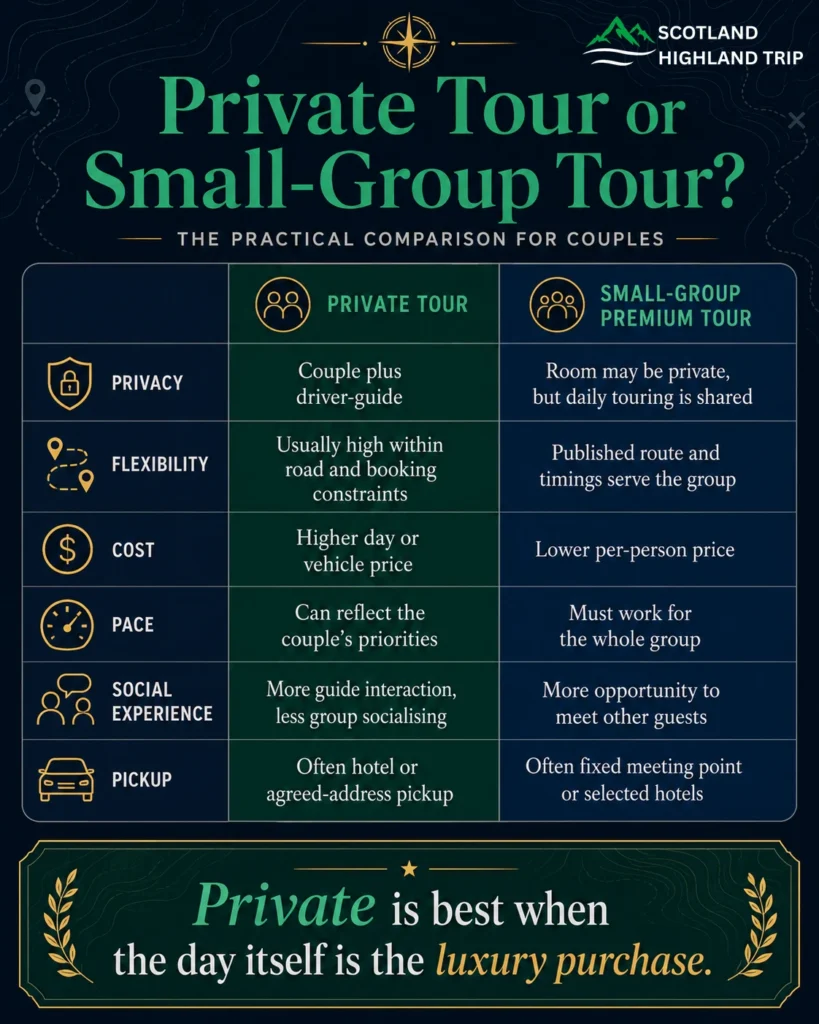
| Factor | Private Tour | Small-Group Premium Tour |
| Privacy | Couple plus driver-guide, if genuinely sold as private | Private room may be included, but transport and activities are shared |
| Flexibility | Usually high within road, booking and working-time constraints | Low; the published route and timings serve the group |
| Cost | Higher vehicle or day cost, often quoted for the party | Lower per-person cost because transport and guide are shared |
| Pace | Can reflect the couple’s walking speed and priorities | Must work for the full group |
| Social experience | More interaction with the guide; less with other travellers | Opportunity to meet other guests |
| Luggage | Depends on assigned vehicle; must be confirmed | Usually subject to a stated per-person allowance |
| Pickup | May be available at a hotel or agreed address | Usually a fixed meeting point or selected hotels |
| Route changes | Often possible when safe and reservations permit | Uncommon unless the operator changes the whole group plan |
A private tour is the better choice when the day itself is the luxury purchase. A small group is often the better choice when the couple primarily wants an organised holiday at a controlled per-person cost.
Neither format should be chosen from the group-size label alone. Ask whether any other passengers may be added, whether airport or hotel pickup is private, and whether excursions marketed within a premium package are shared with other groups.
How to Compare Value Properly
Do not compare a group-tour price per person with a private-tour price per vehicle as if the numbers include the same thing.
Build a simple comparison:
- Convert both options to the total cost for two people.
- Add accommodation where it is not included.
- Add attraction entries, tastings, cruises, ferries and meals.
- Add transfers to the group meeting point or from the final drop-off.
- Check the usable touring time. A lower price may include more hotel pickups and less control over stops.
- Price the remaining planning work. Self-drive may require vehicle hire, insurance, parking, fuel and route management.
- Decide what privacy is worth for this trip. Its value is usually higher for a honeymoon, limited-mobility itinerary, photography day or once-only family-history visit.
The private option does not have to be cheaper per person to provide better value. It has to use the couple’s limited time in a way the cheaper option cannot.
Conversely, paying privately for a fixed standard route provides little extra value if the couple does not want changes, additional guide interaction or hotel pickup.
How Many Days Do Couples Need in the Highlands?
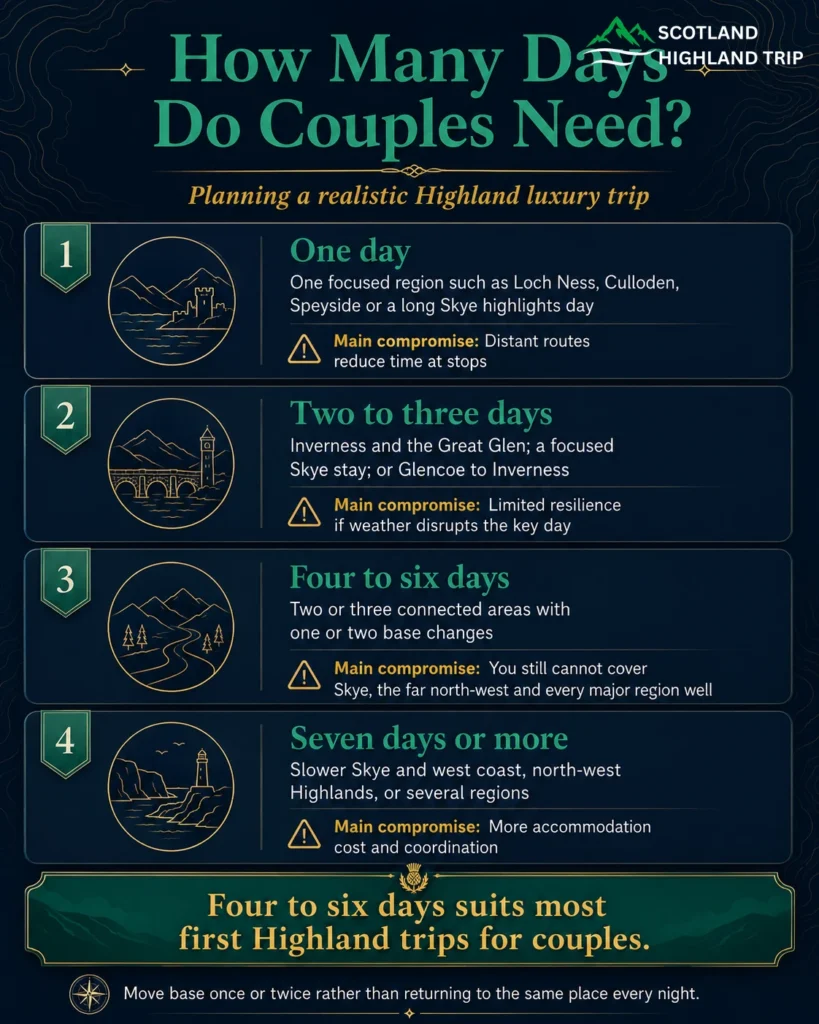
| Time Available | Realistic Experience | Best Route Type | Main Compromise |
| One day | One focused region such as Loch Ness, Culloden, Speyside or a long Skye highlights day | Regional day tour from the actual base | Distant routes reduce time at stops |
| Two to three days | Inverness and the Great Glen; a focused Skye stay; or Glencoe to Inverness | Short private journey, premium mini-tour or self-drive | Little resilience if weather disrupts the key day |
| Four to six days | Two or three connected areas with one or two base changes | Private multi-day, small-group circuit or self-drive | Cannot cover Skye, far north-west, Cairngorms and every major city well |
| Seven days or more | Slower Skye and west coast, north-west Highlands, or several regions | Multi-day private or packaged tour | Higher accommodation cost and more advance coordination |
One day
One day is enough for a high-quality luxury experience when the route is disciplined.
From Inverness, choose Loch Ness, history around Culloden, a Speyside whisky day, the northern Cairngorms or one west-coast direction. Skye is possible, but couples should accept that it becomes a long road day rather than a slow island stay.
Two to three days
Two or three days suit a focused journey:
- Inverness, Loch Ness and one Speyside or heritage day;
- two nights on Skye with arrival and departure stops;
- Glencoe, Fort William and the Great Glen, finishing in Inverness.
Avoid joining distant highlights merely because they fit on a map. This length has little room to move a weather-sensitive day.
Four to six days
This is the best broad range for most couples.
It allows a route such as:
- Glencoe and Lochaber;
- the Great Glen and Loch Ness;
- Inverness and nearby history;
- two nights on Skye or a west-coast alternative.
Another couple might use the same time for Inverness, Speyside, the Cairngorms and a slower east-coast day. The best itinerary is connected, not comprehensive.
Seven days or more
Seven days creates enough space for Skye and the west coast, or Torridon and Assynt, without turning each place into a transfer stop. Island itineraries may require more time because ferries introduce fixed check-in and sailing constraints.
Even with a week, resist combining the Outer Hebrides, Skye, the far north, Glencoe, Speyside and Edinburgh unless the holiday is intentionally a fast-moving circuit.
Best Time for a Luxury Highland Tour in 2027
There is no universally best month. Luxury means matching the season to the couple’s priorities and building a plan that still works when conditions change.
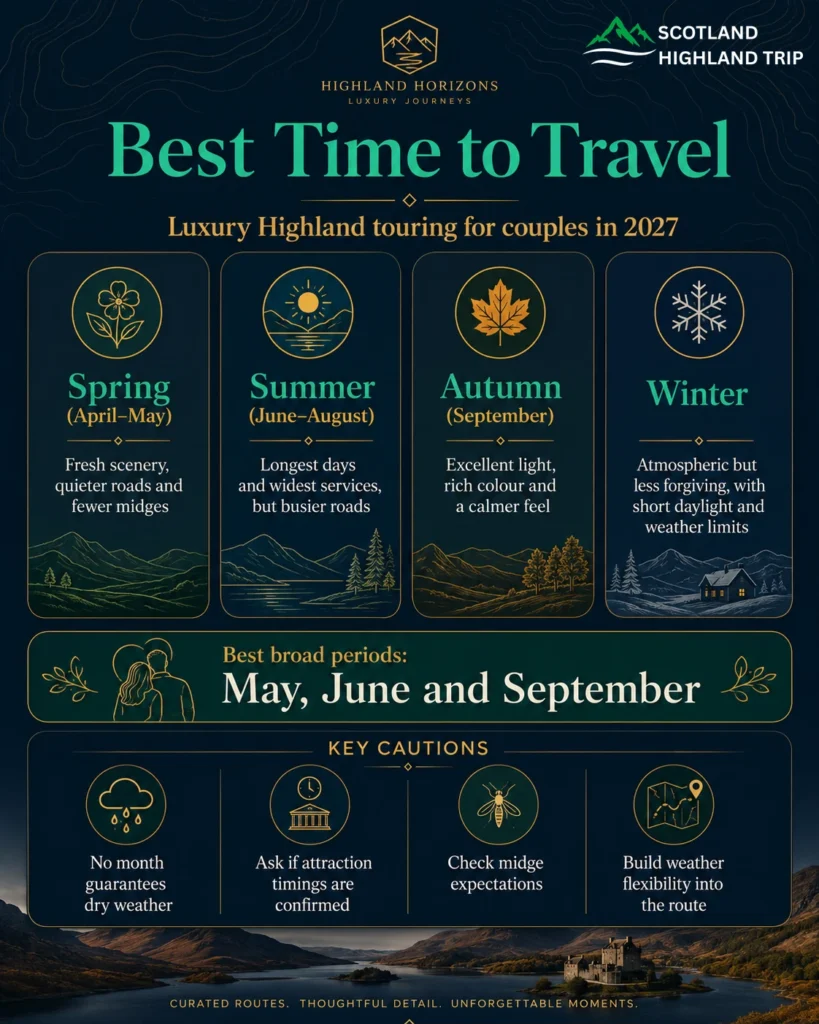
Spring: March to May
Spring offers increasing daylight, lower visitor pressure than high summer and generally less midge activity in the earlier part of the season.
Late April and May are particularly useful for road touring, photography and couples who want a wider choice than winter without peak-summer demand. However, higher ground can retain snow, weather remains variable and some seasonal businesses or attractions may not yet be operating their full schedule.
Best for: First-time road trips, photography, gardens, lower-level walks and quieter touring.
Check: Seasonal opening dates, mountain conditions and whether the chosen accommodation serves dinner on the required nights.
Summer: June to August
Summer provides the longest days and broadest range of visitor services. It also produces the greatest pressure on popular accommodation, Skye locations, ferries and well-known roadside stops.
VisitScotland states that midge season typically runs from May to October, with peak activity in the middle of summer, especially in the west Highlands, islands and damp rural areas. Midges are most active in calm, overcast conditions, particularly around morning and evening. See the current midge guidance.
Long daylight is useful, but it should create flexibility—not permission to schedule fourteen active hours. Couples paying for high-comfort travel still need lunch, rest and time at their hotel.
Best for: Long scenic days, island trips, the widest attraction choice and travellers tied to holiday dates.
Check: Accommodation, ferry and attraction availability well in advance. VisitScotland notes that June to August is especially busy and recommends booking accommodation ahead.
Autumn: September to November
September can combine useful daylight with lower visitor pressure and developing autumn colour. It is an excellent choice for photography, food, whisky and couples who prefer atmosphere to maximum daylight.
Midges do not disappear on 1 September, and weather is not automatically more stable. By October, days shorten quickly and seasonal opening hours become more important. November is better treated as an early-winter trip than a late-summer substitute.
Best for: Photography, whisky, slower touring and couples comfortable with a more changeable schedule.
Check: Sunset time, dinner availability, attraction hours and the operator’s bad-weather alternatives.
Winter: December to February
Winter can offer low-angle light, snow on higher ground and quieter roads at certain times. It also brings short touring windows, possible ice or snow, reduced attraction hours and more frequent weather-led changes.
A winter private tour can reduce driving stress, but it cannot guarantee that a road, viewpoint or attraction will be accessible. The correct luxury response may be a shorter route, later start, alternative attraction or cancellation.
Best for: Couples prioritising hotels, food, whisky, city-and-Highland combinations and conservative low-level touring.
Check: Daylight, cancellation terms, winter tyres or vehicle preparation where relevant, and whether a named attraction is open on the exact date.
The practical 2027 recommendation
For most couples, May, June or September provides the broadest balance. Choose May for lower visitor pressure and generally lower midge risk; June for maximum daylight; September for softer light and a slower feel.
Treat this as a planning judgement, not a weather promise.
What to Check Before Booking a 2027 Tour
Ask for answers in writing. A useful enquiry should cover the following.
Tour status and people
- Is the vehicle reserved only for the two of us?
- Could any other guests be added?
- Is the person driving also providing guided commentary?
- Are specialist guides used at any attractions?
Vehicle, luggage and comfort
- What vehicle is expected, and can the assignment change?
- How many full-size cases and cabin bags fit when travelling as a couple?
- What is the vehicle’s step height and seating arrangement?
- Are climate control, charging and Wi-Fi available, and is connectivity dependent on mobile coverage?
Route and timing
- What are the planned pickup and return locations?
- How long is the day, and what happens if it runs over?
- Which stops are essential, optional or weather-dependent?
- How much time is planned outside the vehicle?
- Can the route change if weather is better in another suitable area?
Inclusions
- Are attraction entries, cruises, tastings, parking and ferries included?
- Are meals included, reserved or only suggested?
- Who makes timed-entry and distillery bookings?
- Is accommodation included on a multi-day trip, and what room category is quoted?
- Are gratuities expected or included?
Terms and contingency
- What deposit is required?
- When does the balance become due?
- What are the cancellation and date-change terms?
- What happens if a ferry, attraction or road disruption changes the route?
- Is overtime charged, and how is it calculated?
- What happens if the operator changes the vehicle or driver?
Accessibility and personal needs
- How much walking, standing, gravel, slope or stair use is involved?
- Can mobility equipment be carried safely?
- Are comfort stops and a longer lunch possible?
- Can dietary requirements be supported at the proposed meal stops?
Scotland Highland Trip’s live website currently presents one-day tours, whisky tours, journeys and a private chauffeur service. Formats and route details vary, so couples should confirm the exact service rather than carrying assumptions from one page to another. The current fleet page can help frame vehicle questions, but the assigned vehicle and luggage capacity should still be confirmed for the booking.
Is a Luxury Private Highland Tour Worth It for Couples?
Yes, when privacy, time control and reduced stress will materially change the trip.
It is most likely to be worth the extra cost when:
- the trip marks a honeymoon, anniversary or major birthday;
- the couple has one or two days and cannot afford a badly matched route;
- whisky tasting is a priority;
- photography requires flexible stops;
- one person has mobility, fatigue or comfort needs;
- the itinerary involves unfamiliar single-track roads;
- the couple wants to finish in a different town from where the day began.
It is less likely to be worth it when:
- the couple enjoys meeting other travellers;
- the published group itinerary already matches their priorities;
- accommodation and meals represent more value to them than transport privacy;
- they both enjoy driving and want unstructured time;
- the private product follows an inflexible standard route without providing better access, pacing or guidance.
The best test is simple: What can the private option do for the two of you that the group or self-drive option cannot?
If the answer is only “a more expensive vehicle,” the premium is difficult to justify. If the answer is “remove the driving, protect our pace, let both of us taste whisky, collect us from our hotel and reshape the day around weather,” the value is much clearer.
Final Recommendation
For most first-time couples, use Inverness as a base for one or two focused days: Loch Ness and the Great Glen, followed by history around Culloden or whisky and scenery in Speyside and the Cairngorms.
Choose a private chauffeur-led day when privacy, whisky, photography, mobility or precise pickup matters. Choose a premium small group when you want an organised itinerary and better per-person value. Choose self-drive only when the driving and daily decisions are part of the holiday you both want.
If Skye, Torridon, Assynt or the wider west coast is the priority, stop treating Inverness as the place you must return to every night. Allow four to six days, move base and use a private multi-day journey or carefully planned self-drive route. Skye can be visited from Inverness in one long day, but an overnight stay is the more luxurious decision.
For 2027, retain flexibility until the exact accommodation, attraction, distillery and ferry arrangements are confirmed. The best luxury Highland tour for a couple is not the route with the most names. It is the one that leaves enough time to experience the places they chose.
FAQs
What is the best luxury Highland tour for couples?
For privacy and flexibility, the best overall format is a private chauffeur-led or driver-guided tour built around one coherent region per day. First-time couples based in Inverness can start with Loch Ness and the Great Glen, then add Culloden or Speyside. Skye and the north-west are better as multi-day journeys.
Are private Highland tours worth the money?
They are worth the premium when the couple values hotel pickup, quiet, route flexibility, whisky tasting, photography stops or pace adapted to mobility and energy. A small-group tour may offer better value when the fixed itinerary already suits the couple and packaged accommodation matters more than privacy.
What is the best month to tour the Scottish Highlands?
There is no guaranteed best month. May often balances increasing daylight with lower visitor pressure and lower midge risk than midsummer. June offers the longest touring days. September suits photography and slower travel, although daylight is shorter and midges or wet weather can still occur.
How many days do couples need in the Highlands?
Allow one day for one focused region, two to three days for a short Inverness, Great Glen or Skye itinerary, and four to six days for a relaxed first journey across several connected areas. Seven days or more is better for Skye plus the west coast, Torridon and Assynt, or island travel.
Is Inverness a good base for private Highland tours?
Yes. Inverness works well for Loch Ness, Culloden, Clava Cairns, Speyside, the northern Cairngorms, the Black Isle and several east-coast routes. Skye is possible as a long day, while Assynt and slower west-coast travel are better with accommodation away from Inverness.
Is Skye possible as a day tour from Inverness?
Yes, but it is a long day. Scotland Highland Trip’s live Skye itinerary states approximately 12 hours including travel and stops, with timing affected by weather and traffic. A day tour suits couples with limited time; two nights on Skye is better for slower meals, walks, photography and route flexibility.
What should be included in a luxury Highland tour?
There is no universal package. At minimum, the quote should clearly identify the vehicle, driver or guide role, duration, pickup area, fuel, parking, taxes and any refreshments. Attraction entry, meals, tastings, cruises, ferries and accommodation must be listed as included or excluded rather than assumed.
How early should couples book for 2027?
Book once the key dates and route are firm, particularly for June to August, Skye, small luxury properties and island travel. Some 2027 departures are already advertised, but individual attraction, distillery and ferry inventory may be released later. Confirm each component directly instead of relying on a general lead-time rule.
Are luxury Highland tours suitable for older couples?
They can be, and a private format can make pacing easier. Suitability depends on the exact vehicle, step height, luggage, walking surfaces, stairs, standing time and attraction access. Couples should describe mobility needs before booking and request a route with realistic comfort stops.
Is a private tour better than self-driving?
It is better when both travellers want to watch the scenery, taste whisky, avoid unfamiliar roads or hand over parking and route decisions. Self-drive is better for confident couples who actively enjoy driving and want complete independence. The more remote and logistically complex the route, the more valuable an experienced driver may become.
Emma is a solo traveler and freelance travel writer from New Zealand who spent three weeks exploring the Scottish Highlands. With a deep appreciation for history and landscapes, she booked a series of day tours and a private chauffeur journey with Scotland Highland Trip. From Loch Ness to the Cairngorms, she documented her experience through vivid blog posts and drone footage.