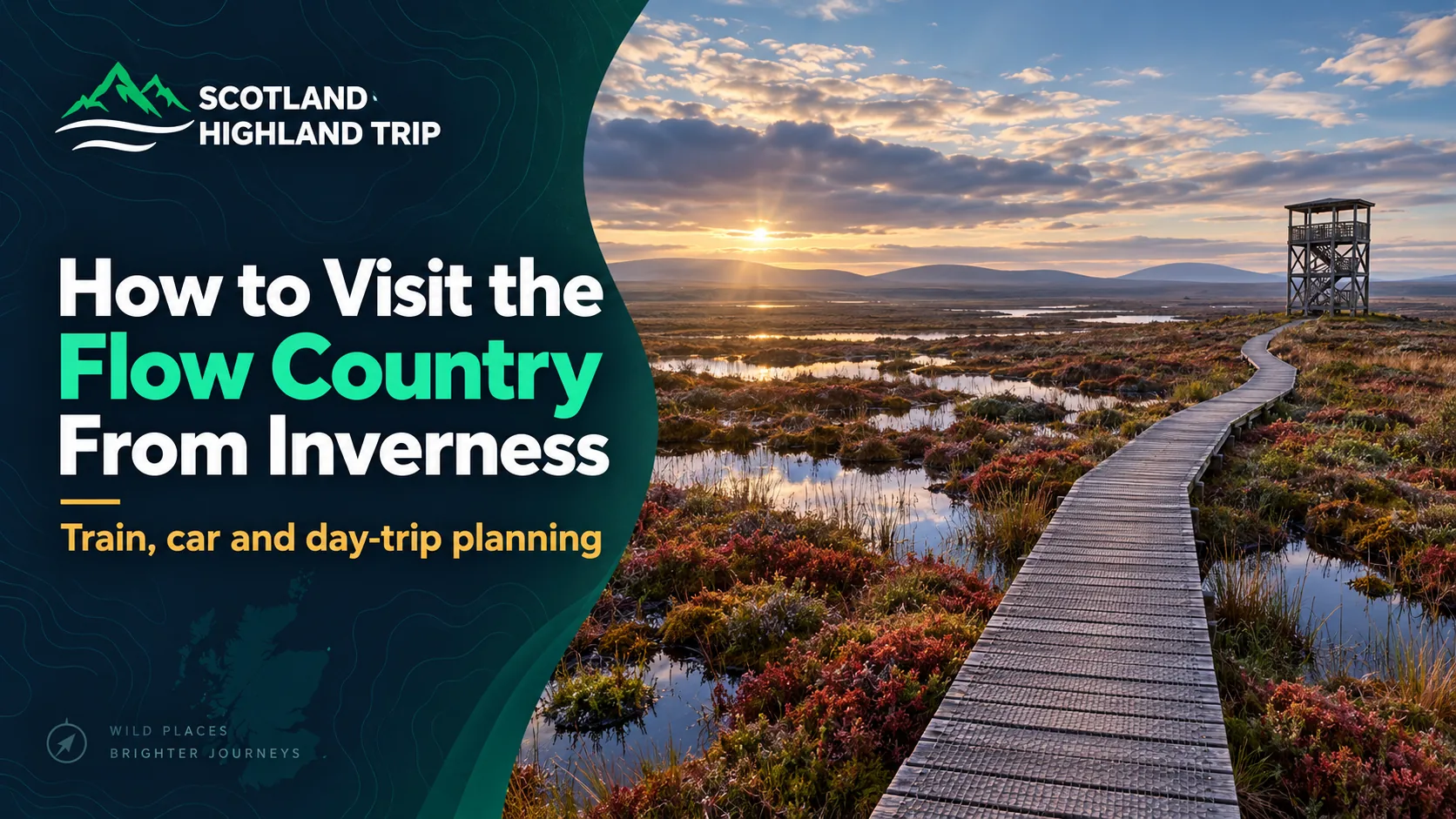
Stand on the Flows Lookout Tower at Forsinard and count the pools. You’ll give up somewhere past forty. Black water, red sphagnum moss, a hen harrier if you’re lucky, and not a single building in any direction. That’s the Flow Country, and it sits less than 100 miles north of the Highland capital.
Most people never get there. They drive the A9, turn off for the North Coast 500, and skip the bog entirely. Which is a shame, because working out how to visit the Flow Country from Inverness takes about ten minutes of planning and one honest decision: train or car.
The scale is hard to grasp until you’re in it. According to NatureScot, the Flow Country’s peat stores around 400 million tonnes of carbon, more than double the amount locked up in all of Britain’s woodlands. UNESCO inscribed it as a World Heritage Site in July 2024, the first anywhere in the world listed purely for its peatland.
This is the practical version. Journey times, which train stops to use, what the single-track road is like, when the visitor centre is open, and how to fit it into one long day from Inverness.
Jump to Sections
What is the Flow Country and why go from Inverness?
The Flow Country is the largest expanse of blanket bog in Europe, spread across Caithness and Sutherland in the far north of Scotland. Inverness is the closest city, with an airport, a train line running straight through the bog, and car hire.
Blanket bog is peatland that forms in cool, wet places where dead sphagnum moss builds up faster than it rots. In the Flow Country that process has been running for around 9,000 years, and the peat is up to 10 metres deep in places. Nothing about the landscape looks dramatic in the way Glencoe does. It’s flat, brown, wet and enormous. Give it an hour and it gets under your skin.
Where exactly is it?
The bog covers roughly 400,000 hectares of Caithness and Sutherland. The World Heritage Site itself is a core of around 190,000 hectares within that. For a visitor, the practical centre is Forsinard, a hamlet on the A897 with a railway station, an RSPB visitor centre and two waymarked trails.
The RSPB puts Forsinard at 94 miles from Inverness and 29 miles from Thurso. Helmsdale on the east coast and Melvich on the north coast are the two road gateways.
Why does the World Heritage status matter?
Inscription happened on 26 July 2024 at the UNESCO World Heritage Committee meeting in New Delhi. The Flow Country became Scotland’s seventh World Heritage Site and the first in the UK listed only for its natural ecosystem. It’s also the only site on the entire list inscribed specifically as a peatland.
That matters for two reasons. Peatlands cover about 3% of the world’s land surface but hold nearly 30% of all the carbon stored on land, so this is one of the most important climate landscapes in Britain. And the status has brought money, interpretation and better trails, which makes it a much easier place to visit than it was five years ago.
How do you get from Inverness to the Flow Country?
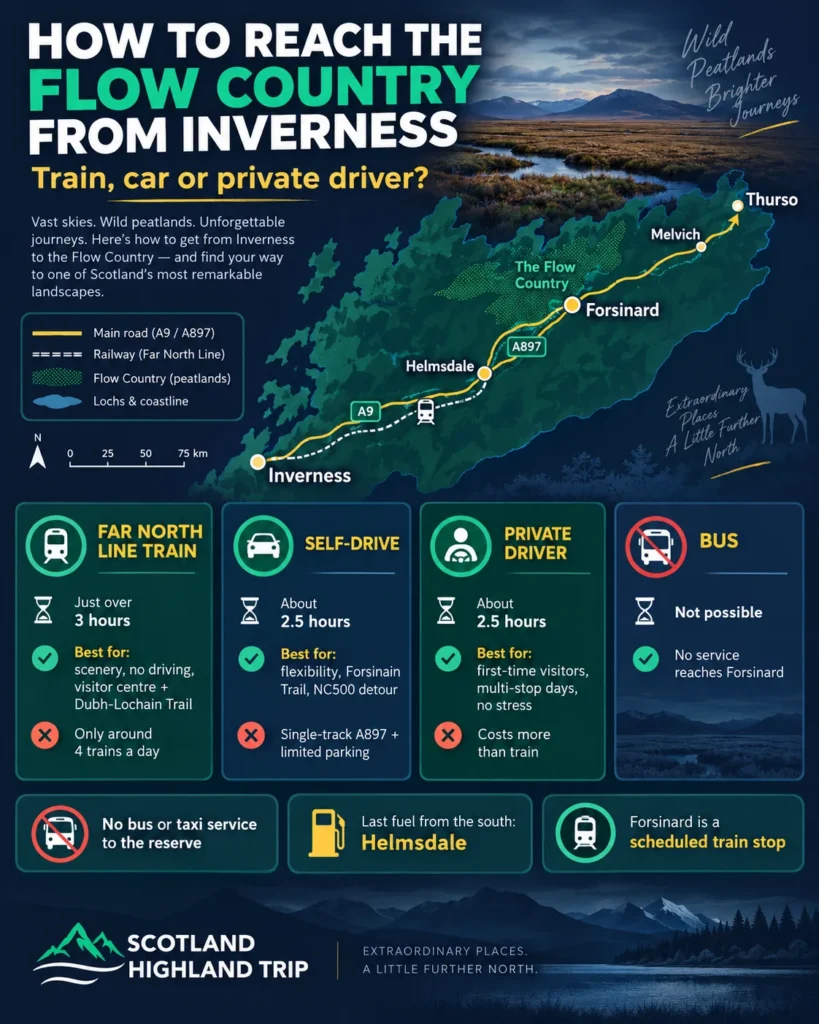
You can reach the Flow Country from Inverness by train on the Far North Line to Forsinard, by car up the A9 and A897, or with a private chauffeur. There is no bus or taxi service to Forsinard, so those are the only realistic options.
By train on the Far North Line
The Far North Line is the honest way to see the bog. ScotRail runs it from Inverness to Wick and Thurso, and it cuts straight through the heart of the peatland between Helmsdale and Georgemas Junction. Inverness to Forsinard takes just over 3 hours, with around four trains a day. Check the ScotRail timetable before you commit, because the gaps between services are long and a missed train means a wait of several hours.
Forsinard is not a request stop. The train pulls in as normal and the RSPB visitor centre is in the old station building, right on the platform. Kildonan, Kinbrace and Altnabreac, on the other hand, are request stops. Tell the conductor if you want off, and flag the train down if you want on.
For a full day on the line, the Spirit of Scotland Travel Pass gave four days of unlimited travel over eight consecutive days for £155 at the time of writing. Worth it if you’re also heading to Kyle of Lochalsh or Orkney via Thurso.
By car via the A9 and A897
Driving is faster and gives you the Forsinain Trail, which you can’t reach on foot from the station in a sensible time. Take the A9 north from Inverness to Helmsdale (about 72 miles), then turn inland on the A897 through the Strath of Kildonan to Forsinard. Allow 2.5 hours without stops.
The A897 is single track with passing places for almost its entire length. That is not a problem if you’ve driven Highland roads before. If you haven’t, the rules are simple: pull into the passing place on your left, or stop opposite one on your right, and let oncoming traffic through. Never park in a passing place. Fill up in Helmsdale, because there’s no fuel between there and Melvich.
Parking at Forsinard is limited. The RSPB lists 5 regular spaces and 2 Blue Badge bays in the tarmac car park shared with the station, plus 12 gravel spaces including 2 for campervans. No overnight parking at the centre, though the Forsinain car park 5 miles north allows up to 24 hours.
With a private driver
A private driver removes the two things that put people off: the single-track road and the return drive after a long day on your feet. It also means you can stop at the Timespan museum in Helmsdale on the way up and squeeze in a whisky tasting on the way back without anyone having to stay dry. Anyone who’s been quoted taxi rates for the Highlands will find the day-hire comparison less painful than expected.
For people who’ve never driven on the left, it’s the option I’d push. The A897 punishes hesitation.
Why can’t you take a bus?
The RSPB is blunt about it: there is no bus or taxi service to the reserve because of how remote it is. Stagecoach runs the X99 from Inverness up the A9 coast to Wick and Thurso, but it stays on the coast and never turns inland at Helmsdale. You’d be 24 miles short with no way to close the gap.
| Option | Inverness to Forsinard | Cost guide | Best for | Main drawback |
| Far North Line train | Just over 3 hours | Single fares vary; £155 for a 4-day Spirit of Scotland pass | Scenery, no driving, reaching the visitor centre and Dubh-Lochain Trail | Around 4 trains a day, so timing is tight |
| Self-drive (A9 then A897) | About 2.5 hours | Fuel plus car hire | Forsinain Trail, flexibility, combining with the NC500 | Single-track road, limited parking, long return drive |
| Private driver | About 2.5 hours | Day-hire rate | First-time visitors, non-drivers, multi-stop days | Costs more than the train |
| Bus | Not possible | n/a | n/a | No service reaches Forsinard |
What can you actually do at Forsinard Flows?
RSPB Forsinard Flows has a free visitor centre in the old station building, a boardwalk trail with a lookout tower, and a longer 4-mile trail through restored bog. Entry to the reserve is free, and the reserve itself is open around the clock.
The visitor centre
The centre is open 9am to 5pm, seven days a week, from April to October. From November to March it drops to Monday to Friday, 10am to 2pm. There are toilets, baby changing, an accessible loo, a small exhibition about how peat forms and what lives in it, and a screening room. Tea and coffee are available in season. A ranger is sometimes on hand, and when they are, ask them where the divers have been seen. Red-throated and black-throated divers breed on the remote lochs and you won’t find them on your own.
The Dubh-Lochain Trail and Flows Lookout Tower
This is the one everybody should do. The trail starts directly across the road from the station. A raised boardwalk runs out over the bog to the Flows Lookout Tower, a modern timber structure that gives you a view down onto the pool systems you can’t get any other way. The return leg follows old flagstones right along the pool edges.
Budget 45 minutes for the 1-mile loop, or 90 if you stop for every sundew and lizard. And you will stop for the lizards. They bask on the boardwalk edges in warm weather. Swallows nest in the tower most summers.
The RSPB is clear that the boardwalk offers reasonably easy access for a wide range of people, but the bog trails as a whole aren’t suitable for everyone. If you’re unsure, phone the reserve on 01641 571225 before you travel.
The Forsinain Trail
Five miles north of the visitor centre on the A897, there’s a small car park opposite the barns at Forsinain Farm. From there a 4-mile waymarked loop takes you through farmland, forestry tracks and three stages of bog: natural, being restored, and restored. It’s the best place in the Flow Country to understand what restoration means in practice, because you walk from ploughed-up plantation ground into pool systems that have been brought back.
Allow 2 hours. There’s a bird hide on the farmland section. Lapwings, dragonflies and, on a good day, a hen harrier hunting low over the heather. A short Viewpoint Trail at the same car park is the RSPB’s recommended spot for exercising dogs without disturbing ground-nesting birds.
What wildlife will you see?
Spring and summer are when the bog is loud. Golden plover, dunlin, greenshank, skylark and meadow pipit all breed here and you’ll hear them before you see them. Hen harriers hunt the edges. Common lizards use the boardwalk. Sundew and butterwort, the two insect-eating plants, grow in the wet hollows and are easiest to spot in June and July.
Otters, red deer and adders are all present. The adder is the UK’s only venomous snake, so keep dogs on a short lead and watch where you put your hands if you sit on the heather.
Can you do the Flow Country as a day trip from Inverness?
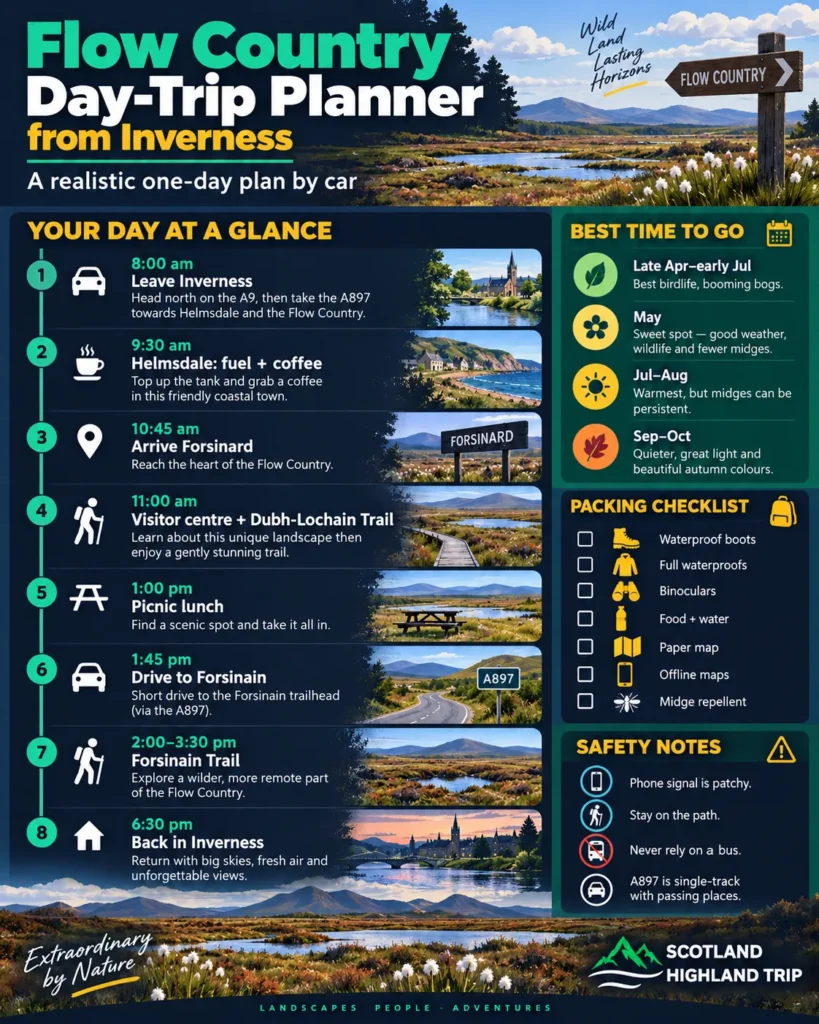
Yes, but only by car or with a driver. A full day gives you the visitor centre, both trails and a stop in Helmsdale. By train it’s possible but tight, with around 2 to 3 hours on the ground before the next service back.
Here’s the day that works. I’ve done versions of it in May and again in September, and the May one was better for birds while September was better for light.
- Leave Inverness by 8am. The A9 north is quiet at that hour and you’ll be past Dornoch Bridge before the tour coaches.
- Stop in Helmsdale around 9.30am. Fill the tank, grab coffee, and if Timespan is open, give it 45 minutes. The Highland Clearances exhibition explains why the strath you’re about to drive up is empty.
- Take the A897 north. The 24 miles to Forsinard take about 40 minutes on the single track. Watch for red deer near Kildonan.
- Arrive at Forsinard around 10.45am. Visitor centre first for the exhibition and toilets, then straight onto the Dubh-Lochain Trail. Give it 90 minutes.
- Lunch. Bring it with you. There’s no café at the centre beyond hot drinks, though the Forsinard Lodge tea room a 20-minute walk away does home baking in season.
- Drive 5 miles north to Forsinain for the 4-mile trail. Two hours, back at the car by 3.30pm.
- Return via Helmsdale. If you’d rather loop, continue north on the A897 to Melvich (30 minutes) and come back down the A9 from Thurso, but that adds around 90 minutes.
- Back in Inverness by 6.30pm. A distillery stop at Clynelish in Brora on the return adds an hour and is worth it.
That’s 11 hours door to door. Long, but it’s the kind of day people talk about years later. Not a bad addition to a list of day trips from Inverness that usually stops at Loch Ness and Culloden.
The train-only day
Trains run roughly four times daily, so you’ll want the earliest departure from Inverness and the mid-afternoon return. Check the live timetable on the ScotRail site the night before, since times shift between summer and winter. On the ground you’ll manage the visitor centre and the Dubh-Lochain Trail comfortably. Forsinain is out of reach without wheels.
A better train plan is an overnight. Stay at Forsinard Lodge, a converted 1870 hunting lodge with three rooms, and take the next morning’s train onward to Thurso for the Orkney ferry, or back south.
Adding it to a North Coast 500 loop
If you’re driving the North Coast 500, the Flow Country is the easiest detour on the whole route. From Melvich on the north coast it’s 30 minutes down the A897 to Forsinard. Most NC500 drivers never turn off, which is exactly why the bog stays quiet in August when the coast road is a queue of motorhomes.
When is the best time to visit the Flow Country?
Late April to early July is the best window, when breeding birds are displaying, the visitor centre is on summer hours, and the insect-eating plants are in flower. May is the sweet spot: long days, active wildlife and midges that haven’t hit full strength.
Season by season it looks like this:
- April to early July: Peak birdlife. Golden plover and greenshank calling, hen harriers sky-dancing. Ground-nesting season, so dogs must be on short leads. Visitor centre open 9am to 5pm daily.
- July and August: Warmest and driest on average, but midges are at their worst on still, damp days. Bring repellent and a head net, and don’t let the midge season put you off; on the boardwalk with a breeze they’re manageable.
- September and October: Quieter, golden light, red deer rutting nearby. The bog turns russet and the pools go glassy. Centre still on summer hours until the end of October.
- November to March: Reserve open but the centre only runs weekday mornings. Short days, real weather, and a train timetable that can be disrupted by snow. Beautiful in frost, but only for people who like a Highland winter trip on its own terms.
Rain falls on the Flow Country in every month. That’s how a blanket bog exists. Plan for it rather than around it.
What should you pack and know before you go?
Pack waterproof boots, full waterproofs, binoculars, food, water and a paper map. Phone signal is patchy to non-existent on the A897 and on both trails, so download offline maps and tell someone your plan before you leave Inverness.
The things that catch people out:
- Footwear. The boardwalk is fine in trainers. The flagstone section and the whole Forsinain Trail are not. Ankle-height waterproof boots, and gaiters if you own them.
- Food. There’s no shop in Forsinard. Buy lunch in Inverness or Helmsdale.
- Fuel. Last petrol before the bog is Helmsdale from the south or Melvich from the north.
- Signal. Don’t rely on it. Screenshot the train times and the RSPB phone number.
- Fire. Barbecues and campfires are banned on the reserve at all times. Peat burns underground for weeks.
- Stay on the path. The bog is 10 metres deep in places and a sphagnum surface looks solid until it isn’t. The Scottish Outdoor Access Code applies, but the trails exist for a reason.
- Dogs. Welcome on a short lead. Water for dogs is available at the centre.
If you’re travelling with someone who doesn’t want to spend the day standing in a bog, Helmsdale has Timespan with its riverside café, and a working harbour. That’s the compromise that keeps couples talking to each other on the drive home.
Where can you eat and stay near Forsinard?
Options are thin on the ground, which is part of the appeal. Forsinard Lodge is the only bed in the hamlet itself. Beyond that you’re looking at the Crask Inn between Lairg and Altnaharra, the Altnaharra Hotel, or the coast towns of Helmsdale and Melvich.
For eating, the Forsinard Lodge tea room does daytime food and home baking in season, and can arrange dinner for guests. The Crask Inn does daytime meals and a three-course dinner if you book ahead. The Altnaharra Hotel has a bar menu. That is more or less the complete list inland, so book anything you’re relying on.
Most people visiting from Inverness will find it simpler to eat properly in Helmsdale or Brora and treat Forsinard as a picnic. If you’d rather base yourself on the coast for a couple of nights and take the bog as one day among several, Dornoch, Brora and Helmsdale all have good hotels in the Scottish Highlands to choose from, with the Flow Country an hour or so inland.
Frequently asked questions
How far is the Flow Country from Inverness?
Forsinard, the main visitor hub, is 94 miles from Inverness by road according to the RSPB. That’s about 2.5 hours driving via the A9 and A897, or just over 3 hours by train on the Far North Line.
Is there a bus from Inverness to Forsinard?
No. The RSPB confirms there is no bus or taxi service to Forsinard Flows. The X99 coach stays on the A9 coast road and doesn’t turn inland. Your options are the train, a hire car or a private driver.
Does the train stop at Forsinard?
Yes. Forsinard is a scheduled stop, not a request stop, and the RSPB visitor centre is in the station building on the platform. Kildonan, Kinbrace and Altnabreac nearby are request stops where you must tell the conductor or flag the train down.
Is it free to visit Forsinard Flows?
Yes. The reserve, the trails, the Flows Lookout Tower and the visitor centre are all free to enter. Parking is free too, but there are only around 19 spaces at the centre, so arrive early in summer.
Can you visit the Flow Country in winter?
You can. The reserve and trails are open all year, but the visitor centre only opens Monday to Friday, 10am to 2pm, from November to March. Daylight is short and the A897 can be icy, so a driver or the train makes more sense than self-drive.
Is the Flow Country worth visiting?
For anyone who cares about wildlife, landscape or climate, yes, without question. It’s the only World Heritage Site on Earth listed purely for its peatland, it’s an hour off the North Coast 500, and it’s almost empty even in August. If you want castles and mountains, look elsewhere.
Can you do Forsinard and the Forsinain Trail without a car?
Not comfortably. The Forsinain car park is 5 miles north of the station along a single-track road with no footpath. By train you’re limited to the visitor centre and the Dubh-Lochain Trail, which is still a full and satisfying visit.

Emma is a solo traveler and freelance travel writer from New Zealand who spent three weeks exploring the Scottish Highlands. With a deep appreciation for history and landscapes, she booked a series of day tours and a private chauffeur journey with Scotland Highland Trip. From Loch Ness to the Cairngorms, she documented her experience through vivid blog posts and drone footage.