The car park below the Old Man of Storr can be full by 10 in the morning during July. Not busy. Full. That single detail tells you more about visiting Skye today than any postcard ever will, and it is exactly why you need a proper Isle of Skye travel guide before you set off, not after you arrive.
Skye now welcomes over 650,000 visitors a year, generating around £260 million for a local economy built on a permanent population of roughly 13,000 people, according to figures published by IsleofSkye.com. The Old Man of Storr alone drew close to 300,000 walkers in 2024, based on Highland Council’s own site reports. The island hasn’t grown. The crowds have.
That doesn’t mean you should skip Skye. It means you should plan it properly. This guide covers everything a 2026 or 2027 visitor actually needs: the sights worth your fuel, current parking charges (they changed recently, and most blogs still quote the old ones), realistic itineraries, where to sleep, and the mistakes that quietly ruin trips here every single week.
Jump to Sections
Why Is the Isle of Skye Worth Visiting in 2026 or 2027?
Skye is worth visiting because no other Scottish island packs this much drama into 50 miles: the Cuillin mountains, the Trotternish ridge, sea cliffs, waterfalls, two clan castles, and a working fishing town, all reachable by road bridge with no ferry required.
The Isle of Skye is the largest island in the Inner Hebrides, anchored to the mainland by the free Skye Bridge since 2004. Its capital, Portree, is a harbour town with a row of painted houses that appears on half the shortbread tins in Scotland. Beyond Portree, the island splits into peninsulas: Trotternish in the north with its landslip formations, Duirinish and Waternish in the west, Minginish with the Cuillin and the Fairy Pools, and Sleat in the south, often called the garden of Skye.
Here’s my honest take after years of bringing travellers here: Skye rewards people who commit to it and punishes people who treat it as a photo stop. If you can only spare four hours, you’ll spend three of them driving. Give it a full day at minimum, two or three if you can, and it becomes the highlight of most Scottish trips.
And the light. Nobody warns you about the light. When a shaft of sun breaks through fast-moving cloud and lands on the Storr, you’ll understand why photographers keep coming back in every season.
Where Is the Isle of Skye and How Do You Get There?
The Isle of Skye sits off Scotland’s northwest coast, connected to the mainland by the free Skye Bridge at Kyle of Lochalsh. It is roughly a 2-hour drive from Inverness, and about 5 hours from Edinburgh or Glasgow.
You have four realistic ways onto the island.
By road bridge. The Skye Bridge crosses Loch Alsh from Kyle of Lochalsh to Kyleakin and has been toll-free since 2004. This is how the vast majority of visitors arrive. If you’re coming up from the capital, the drive from Edinburgh to the Isle of Skye runs through Glencoe or the Great Glen and is a genuine highlight in its own right, not just transit.
By ferry. The CalMac ferry from Mallaig to Armadale is the romantic option, roughly 45 minutes across the Sound of Sleat. Book vehicle spaces in advance during summer through the official CalMac timetables, because turning up and hoping rarely works between June and August.
From Inverness. Inverness is the closest city, about 110 miles away via the A87 past Eilean Donan Castle. Plenty of travellers base themselves in Inverness and do an Isle of Skye day trip from Inverness, which works well when accommodation on the island itself is booked solid.
By public transport. Trains reach Kyle of Lochalsh (from Inverness) and Mallaig (from Glasgow, on the West Highland Line). Citylink buses connect Inverness and Glasgow to Portree. It’s doable without a car, but bus frequency on the island itself is thin, so build your plan around that reality rather than against it.
One route note worth stealing: whichever direction you drive, stop at Eilean Donan Castle just before the bridge. It’s the most photographed castle in Scotland and it sits right on your way. Skipping it to save 45 minutes is a decision people regret at the dinner table that evening.
What Are the Best Things to See on the Isle of Skye?
The essential Skye sights are the Old Man of Storr, the Quiraing, the Fairy Pools, Neist Point, Kilt Rock and Mealt Falls, Dunvegan Castle, the Fairy Glen, and Portree harbour. Elgol and Loch Coruisk reward visitors with extra time.
Old Man of Storr
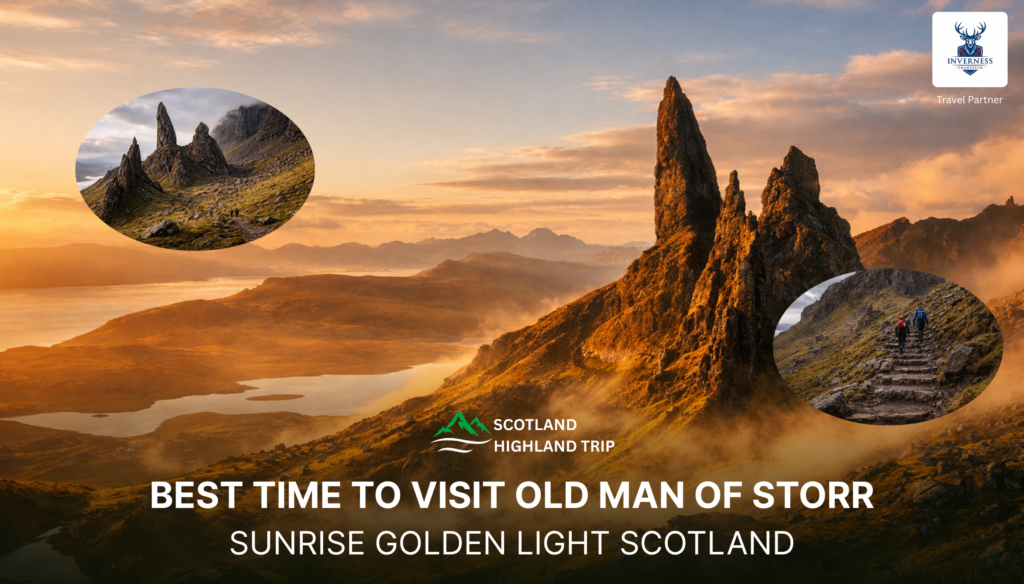
A 50-metre rock pinnacle standing against the Trotternish ridge, about 15 minutes north of Portree. The walk to the viewpoint takes 60 to 90 minutes round trip on a steep, well-built path. Highland Council data shows this is the busiest site on the island, so go before 8am or after 5pm in summer. Early birds get a bonus: the Storr at dawn is one of the finest sunrise spots in the Scottish Highlands, with light coming straight up the Sound of Raasay.
The Quiraing
The northern end of the same landslip, and honestly the more interesting walk of the two. The full loop takes 2 to 3 hours across grassy ramparts, hidden plateaus, and cliff edges. The road over the Quiraing pass from Staffin to Uig is single-track and steep. Take it slowly, use the passing places, and don’t attempt it in a large motorhome.
Fairy Pools
A chain of crystal-clear pools and waterfalls beneath the Black Cuillin in Glen Brittle. The walk in is about 20 to 40 minutes on a gravel path with a couple of stream crossings. The water is beautiful and brutally cold. People do swim here. Most regret it within 90 seconds, then talk about it for years, which is probably the correct trade.
Neist Point
The westernmost tip of Skye, a lighthouse on a dramatic finger of cliff reached by a steep concrete path. Parking is free, which is now a rarity on this island. Come for sunset if the sky is doing anything at all.
Kilt Rock and Mealt Falls
A 90-metre sea cliff with basalt columns that resemble the pleats of a kilt, with Mealt Falls plunging straight into the sea beside the viewing platform. This one takes 15 minutes and requires no walking, so it slots between Storr and Quiraing perfectly.
Dunvegan Castle
Seat of Clan MacLeod for 800 years and the oldest continuously inhabited castle in Scotland. The gardens are better than most people expect and the seal boat trips from the castle jetty are a quiet family favourite. Check seasonal opening before you go, since the castle typically closes over winter.
The Fairy Glen
Miniature cone-shaped hills, a rock tower nicknamed Castle Ewen, and a landscape near Uig that looks shrunk in the wash. No entry fee, small parking area, and please don’t build stone spirals. Locals dismantle them constantly to protect the site.
Portree
The island’s main town and your hub for fuel, cash machines, supermarkets, and seafood. Eat fish and chips on the harbour wall and watch the boats. Some of the best evenings on Skye cost under £15.
If you’re a keen walker, several of these sites are just the entry level. The island features heavily in our roundup of the best Highland hiking trails, from the tourist paths right up to Cuillin scrambles that demand real mountain experience.
When Is the Best Time to Visit the Isle of Skye?
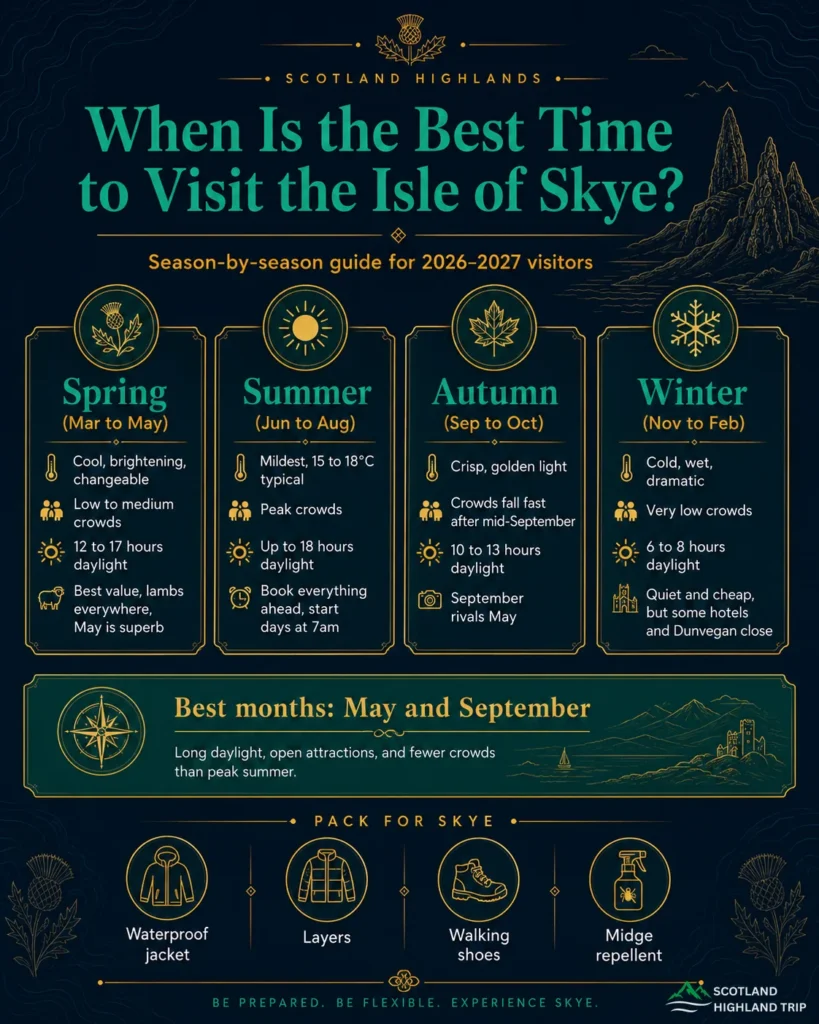
May and September are the best months to visit Skye, combining long daylight, open attractions, and thinner crowds than July and August. Winter offers empty roads and moody scenery but short days and some closed businesses.
There’s no bad month, only trade-offs. Midges (tiny biting insects) are the wildcard nobody prices in: they peak roughly June through August in still, damp conditions, mostly at dawn and dusk. A breeze keeps them away, and Skye’s coast is rarely short of breeze.
| Season | Weather | Crowds | Daylight | Verdict |
| Spring (Mar to May) | Cool, brightening, changeable | Low to medium | 12 to 17 hours | Best value, lambs everywhere, May is superb |
| Summer (Jun to Aug) | Mildest, 15 to 18°C typical | Peak, car parks full early | Up to 18 hours | Book everything months ahead, start days at 7am |
| Autumn (Sep to Oct) | Crisp, golden light | Falling fast after mid-Sep | 10 to 13 hours | September rivals May, October is a photographer’s month |
| Winter (Nov to Feb) | Cold, wet, dramatic | Very low | 6 to 8 hours | Quiet and cheap, but some hotels and Dunvegan close |
Weather on Skye changes by the hour, not the day. You’ll frequently get four seasons before lunch, which is why the packing rule here is layers plus a genuinely waterproof jacket, never an umbrella. Umbrellas last about 40 seconds at Neist Point.
For a broader view of how the seasons play out across the whole region, our guide to the best time to visit the Scottish Highlands breaks it down month by month. And if you’re tempted by the quiet season, a Highlands winter trip needs a slightly different plan: shorter routes, flexible days, and respect for the road conditions.
How Many Days Do You Need on the Isle of Skye?
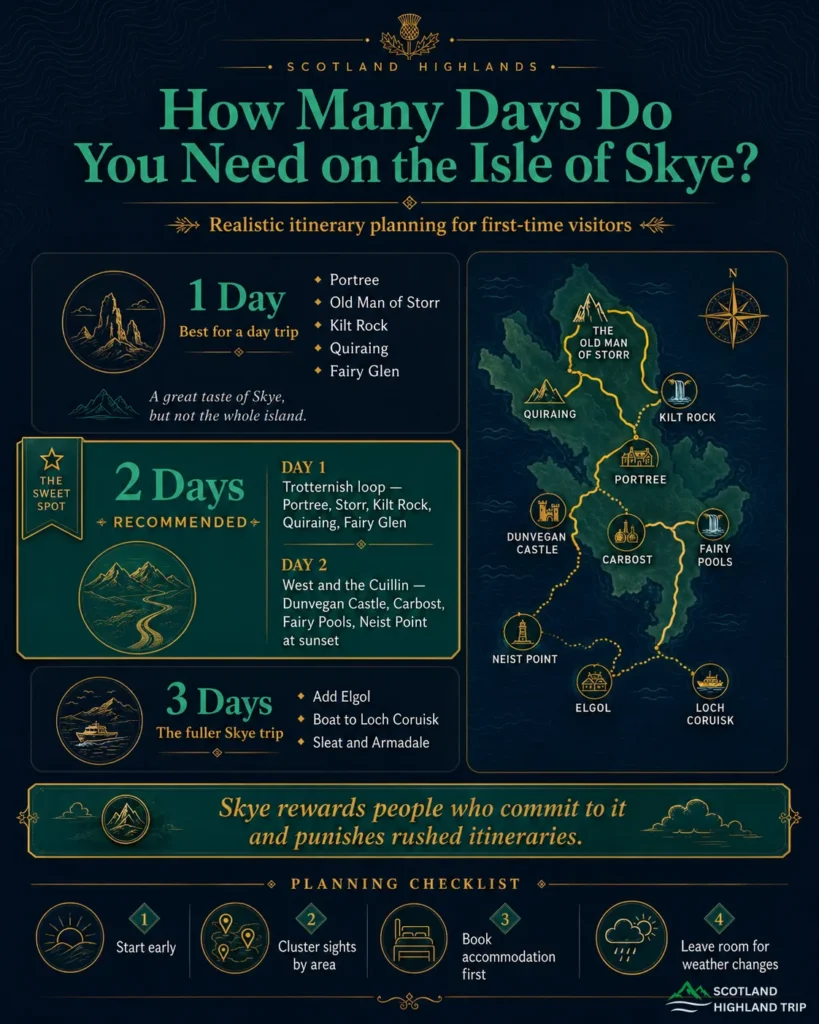
Two full days is the sweet spot for the Isle of Skye. One day covers the Trotternish highlights at a rush. Three days lets you add Dunvegan, Neist Point, and Elgol without ever feeling like you’re racing the clock.
Here’s how I’d structure it, based on what actually fits into Highland daylight and single-track driving speeds.
- Day one, the Trotternish loop. Portree, Old Man of Storr (early), Kilt Rock and Mealt Falls, the Quiraing, then down the west side through Uig and the Fairy Glen. Roughly 50 miles of driving that will somehow take all day, in the best way.
- Day two, the west and the Cuillin. Dunvegan Castle in the morning, lunch in Carbost (the Talisker distillery village), the Fairy Pools in the afternoon, then Neist Point for sunset if the weather plays along.
- Day three, the quiet south. Drive to Elgol for the classic Cuillin view across Loch Scavaig, take the boat to Loch Coruisk if sailings run, then explore Sleat and the Armadale area on the way off the island via the ferry.
A single day trip is still worthwhile if that’s all your itinerary allows. Thousands of people do exactly that from Inverness every year and go home delighted. Just accept upfront that a day trip means Trotternish plus one or two extra stops, not the whole island. Our full Isle of Skye tour guide shows what a realistic single-day route looks like on the ground, stop by stop.
Where Should You Stay on the Isle of Skye?
Portree is the best base for first-time visitors thanks to restaurants, shops, and a central position. Broadford suits travellers arriving late over the bridge, while Dunvegan, Uig, and Sleat offer quieter stays closer to specific sights.
The uncomfortable truth about Skye accommodation: demand exceeds supply from May to September, and the good places sell out four to six months ahead. Book your beds before you book anything else.
- Portree is the all-rounder. Walkable dinners, the widest room choice, and a 15-minute hop to the Storr. It’s also the priciest and busiest option.
- Broadford sits 20 minutes past the bridge, handy for late arrivals and for exploring both Skye and the Kyle of Lochalsh side. Less atmosphere, more availability.
- Dunvegan and the northwest put you near the castle, Neist Point, and some excellent crofthouse B&Bs. You’ll drive further for dinner and won’t mind.
- Uig works if you’re combining Skye with the Outer Hebrides ferry.
- Sleat in the south is green, gentle, and quiet, with a couple of genuinely luxurious country house hotels.
- Off-island bases like Kyle of Lochalsh, Plockton, or even Inverness are sensible fallbacks when Skye itself is full, especially outside July and August when day-tripping in is painless.
Several Skye properties feature in our pick of the best hotels in the Scottish Highlands, from castle stays to budget-friendly options, if you want specific names rather than areas.
How Much Does an Isle of Skye Trip Cost in 2026?
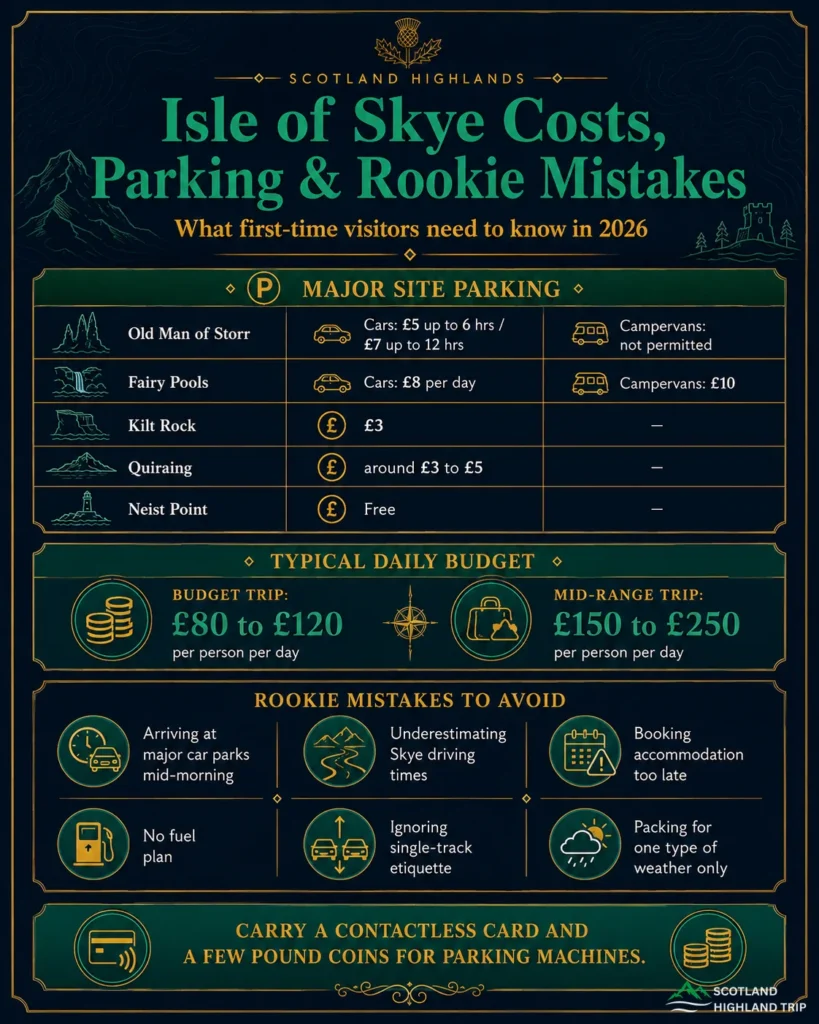
The island’s landscapes are free to visit, but parking now costs £3 to £8 at major sites. Budget travellers can manage on £80 to £120 per person per day; mid-range trips run £150 to £250 with hotel accommodation and restaurant meals.
Parking is the cost that catches people out, because charges rose recently and much of the internet still quotes old figures. The Outdoor Access Trust for Scotland confirmed the Fairy Pools charges that took effect in April 2025, and a Highland Council report from February 2026 covers Storr pricing. Current rates:
| Site | Cars | Campervans | Notes |
| Old Man of Storr | £5 (up to 6 hrs), £7 (up to 12 hrs) | Not permitted (height barrier) | 140 spaces, charges apply 8am to 8pm, a £1 increase was proposed in early 2026 |
| Fairy Pools | £8 per day | £10 | Toilets on site, free overflow parking up the hill |
| Kilt Rock | £3 | £3 | Machine takes card |
| Quiraing | Around £3 to £5 | Limited | Small car park, fills fast |
| Neist Point | Free | Free | Steep walk down to the lighthouse |
Beyond parking, the big line items are fuel (distances add up on 40mph roads), accommodation (Portree summer doubles commonly run £120 to £250 a night), and food (a main course in a Portree restaurant sits around £16 to £25). Dunvegan Castle charges admission; the Storr, Quiraing, Fairy Pools, Neist Point, and Fairy Glen are all free once you’ve parked.
Carry a contactless card and a handful of pound coins. Most machines take cards now, but “most” is not “all”, and the one that doesn’t will be the one you need.
Should You Drive Skye Yourself or Take a Guided Tour?
Self-driving gives maximum flexibility but demands confidence on single-track roads and patience with parking. A guided or private tour removes the two biggest stress points on Skye, driving and parking, and adds local knowledge you can’t Google.
Skye’s main arteries are decent two-lane roads. Everything interesting branches off them onto single-track with passing places, and that’s where visiting drivers come unstuck. The rules are simple: pull into passing places on your left (or stop opposite ones on your right), let faster locals through, and never, ever park in a passing place. But simple rules still take a few days to feel natural, and rental car excess claims from Skye’s stone walls are their own small economy.
The honest comparison looks like this. Self-drive wins on freedom and cost for groups of three or more. Tours win on relaxation, local stories, and actually looking at the scenery instead of the white line. We wrote up the full trade-offs in our guided tour vs self-drive comparison, and for travellers who want the flexibility of a car without driving it themselves, a private Isle of Skye tour with a driver-guide splits the difference: your route, your pace, someone else’s hands on the wheel.
One niche worth mentioning since we’re asked about it more each year: golfers routing between Highland courses sometimes add Skye’s lovely nine-hole course at Sconser, beneath the Cuillin. Dedicated golf transfers in Scotland with club trailers make that detour painless rather than a luggage puzzle.
What Mistakes Do First-Time Visitors Make on Skye?
The most common Skye mistakes are underestimating driving times, arriving at car parks mid-morning, booking accommodation too late, packing for one type of weather, and treating the island as a two-hour photo stop between Inverness and Fort William.
A few specifics that come up again and again:
- Trusting the sat nav’s time estimate. It assumes you’ll average the speed limit. On Skye you won’t, between sheep, single-track sections, and the fact that you’ll stop constantly because everything is beautiful. Add 30 to 40 percent.
- Mid-morning arrivals at the Storr and Fairy Pools. In July and August the golden windows are before 8am and after 5pm. Build your days around them.
- No fuel plan. Fill up in Portree or Broadford. Pumps elsewhere are scarce and pricier.
- Wild camping and motorhome etiquette failures. Use designated sites and facilities. Overnighting in passing places or trailhead car parks is the fastest way to be part of the problem the island is actively wrestling with.
- Ignoring the weather forecast entirely, or trusting it completely. Check it, then pack for it to be wrong.
None of these are Skye-specific character flaws, they’re just what happens when mainland habits meet island logistics. Our full list of mistakes to avoid in the Scottish Highlands covers the rest, from midge management to ferry timing, and most of it applies doubly on Skye.
Frequently Asked Questions About Visiting the Isle of Skye
Do you need a car on the Isle of Skye?
A car (or a driver) is strongly recommended. Public buses connect Portree with Broadford, Uig, and Dunvegan, but frequencies are low and the trailheads for the Quiraing, Neist Point, and the Fairy Pools are poorly served. Without your own wheels, a guided tour is the practical alternative.
Is the Isle of Skye free to visit?
Yes. There’s no entry fee for the island and the Skye Bridge has been toll-free since 2004. You pay for parking at major sites (£3 to £8), for attractions like Dunvegan Castle, and for the Mallaig to Armadale ferry if you choose that route.
How long is the drive from Edinburgh to the Isle of Skye?
Around 5 hours of pure driving over roughly 230 miles, and realistically 6 to 8 hours with stops at Glencoe or Eilean Donan Castle. Most travellers break the journey rather than doing it in one push.
Can you visit the Isle of Skye in winter?
You can, and it’s gloriously quiet. Expect 6 to 8 hours of daylight, changeable roads, and some closed businesses, including Dunvegan Castle. The Storr, Quiraing, and Neist Point stay open year-round because they’re simply landscape.
Are midges a problem on the Isle of Skye?
From roughly June to August, yes, in calm, damp conditions at dawn and dusk. Coastal breezes keep them down, and repellent plus a head net for still evenings solves most of it. May and September visitors largely escape them.
Is one day enough for the Isle of Skye?
One day covers the Trotternish highlights (Storr, Kilt Rock, Quiraing) plus Portree, and it’s a genuinely great day. It is not enough for the Fairy Pools, Dunvegan, and Neist Point as well. Two to three days sees the island properly.

Emma is a solo traveler and freelance travel writer from New Zealand who spent three weeks exploring the Scottish Highlands. With a deep appreciation for history and landscapes, she booked a series of day tours and a private chauffeur journey with Scotland Highland Trip. From Loch Ness to the Cairngorms, she documented her experience through vivid blog posts and drone footage.