The car park at Clava Cairns holds about fifteen cars. On an August morning it’s full by nine, and most of the people walking down that beech-lined path are looking for one thing: the tall stone with the split running through it. They press a palm against it. Nothing happens, obviously. They laugh, take the photo, and move on.
That moment tells you almost everything about hunting Outlander filming locations in the Scottish Highlands. The pull is real, the history underneath is real, and a fair chunk of what fans come looking for was never filmed here at all.
The numbers back up the pull. Culloden Battlefield recorded the single largest visitor increase of any Scottish attraction in 2024, up 42.8%, according to figures from the Moffat Centre at Glasgow Caledonian University and the Association of Scottish Visitor Attractions. Film and TV connections were named as the driver.
So here’s what this guide does differently. Most Outlander articles cover the whole country and lean heavily on sites near Edinburgh and Fife. This one stays in the Highlands, tells you honestly which Highland scenes were shot somewhere else entirely, and gives you 2026 opening times, prices and drive times from Inverness so you can actually build a day around it.
Jump to Section
Which Outlander filming locations are actually in the Scottish Highlands?
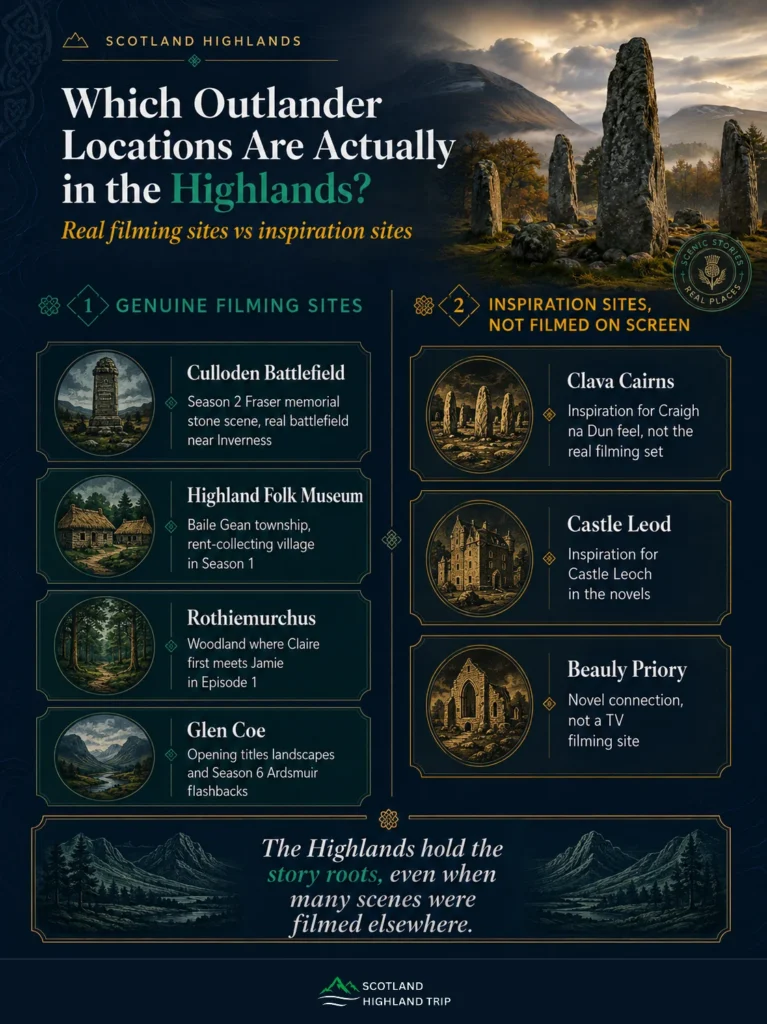
Four sites in the Highlands have a genuine on-screen or on-the-page connection: Culloden Battlefield, the Highland Folk Museum at Newtonmore, Rothiemurchus near Aviemore, and Glen Coe. Clava Cairns, Castle Leod and Beauly Priory are inspiration sites rather than filming sets.
That’s a shorter list than fan blogs usually suggest, and it’s worth understanding why.
Outlander is set in the Highlands. It was mostly filmed near Glasgow. Wardpark Studios in Cumbernauld handled the interiors, and the production team picked exterior locations within easy reach of the crew base. The Central Belt and Fife have castles and 17th-century villages that photograph beautifully and sit forty minutes from the studio. Driving a full unit four hours north to Inverness for a two-minute scene rarely made sense.
What the Highlands got instead were the landscapes nobody could fake and the places the story is actually about.
The genuine filming sites
Culloden Battlefield, six miles east of Inverness. Claire visits the Clan Fraser memorial stone here in Season 2, and the scene was shot on the real battlefield.
The Highland Folk Museum, Newtonmore. The Baile Gean township stood in for the village where Jamie and Dougal collect rent in Season 1, Episode 5.
Rothiemurchus Estate, near Aviemore. The woodland at Tulloch Ghru is where Claire first stumbles into 1743 and meets Jamie in the opening episode.
Glen Coe. Those sweeping ridges in the opening credits are Glen Coe, and the glen returns in Season 6 as the backdrop to Jamie’s Ardsmuir flashbacks.
The inspiration sites
Clava Cairns, Castle Leod and Beauly Priory never appeared on screen. They’re still worth your time, and I’ll explain why below, but go in knowing the difference.
Was Culloden Battlefield really used in Outlander?
Yes, partly. The Clan Fraser memorial stone scene in Season 2 was filmed on the actual battlefield outside Inverness. The battle sequences themselves were shot at Cumbernauld Glen, because Culloden is a war grave and closed to that kind of production.
This is the site that anchors the whole series, and it’s the one I’d tell you not to skip.
The battle happened on 16 April 1746. Bonnie Prince Charlie’s Jacobite army faced the Duke of Cumberland’s government troops on open moorland, and it went badly almost immediately. The National Trust for Scotland puts the toll at around 1,600 men killed in under an hour, roughly 1,500 of them Jacobites. It was the last pitched battle fought on British soil.
Walk out past the visitor centre and you’ll find the clan stones scattered across the moor. The Fraser stone is the one Outlander fans come for. It’s also a mass grave, and the ground around it has been fenced and reseeded more than once because of foot traffic. Stay on the path. That’s not a rule invented for tourists, it’s a burial site.
Red and blue flags mark where each army stood. Standing between them, you realise how little ground separated them, and the whole thing suddenly makes a horrible kind of sense.
Visiting Culloden in 2026
The battlefield itself is open daily and free to walk. The visitor centre is ticketed, and current National Trust for Scotland prices are £12.50 adult, £11.00 concession, £8.00 child and £33.00 family, with parking at £5.00. Trust members and National Trust members from elsewhere in the UK go in free.
Book the visitor centre online in advance during summer. The 360-degree immersion theatre runs on timed entry and it does fill up.
It’s a fifteen-minute drive from the city, which makes it the easiest of all the day trips from Inverness to fit around other plans.
Are Clava Cairns the real Craigh na Dun standing stones?
No. Craigh na Dun was a set built from Styrofoam on private farmland near Kinloch Rannoch in Perthshire, and it was dismantled after filming. Clava Cairns is a genuine 4,000-year-old Bronze Age burial site near Inverness, and it’s the closest thing fans can actually stand in.
I’d argue Clava is better than the fictional version anyway.
Three burial cairns sit in a line, ringed by standing stones, under old beech trees that were planted in the 1800s. Two of the cairns have passages aligned to catch the light of the midwinter sunset. People built this, moved these stones, and buried their dead here around 2,000 BC. Nobody knows their names or what they called themselves.
The famous split stone stands near the western cairn. It does look uncannily like the one Claire touches, which is why it’s become a pilgrimage spot, and why you’ll usually find someone waiting their turn for a photo.
Clava Cairns is cared for by Historic Environment Scotland and it’s free to visit, open year round. The car park is small and it’s on a narrow lane, so early morning or late afternoon saves you a lot of reversing.
One thing worth knowing: Clava and Culloden share a postcode, IV2 5EU, which sends plenty of drivers to the wrong place. Follow the brown signs for Clava Cairns rather than trusting your sat nav on the last mile.
Where was the Outlander rent-collecting village filmed?
The Baile Gean township at the Highland Folk Museum in Newtonmore, about an hour south of Inverness. It appears in Season 1, Episode 5, when Claire rides out with Dougal and the MacKenzies to collect rent from tenants. Almost no set dressing was needed.
This is the one location where you can walk into Outlander’s 18th century rather than look at it from a distance.
Baile Gean is a reconstruction of a Highland township as it would have stood around 1700. Turf and stone walls, thatched roofs, smoke drifting out through the thatch because there are no chimneys. Costumed interpreters cut peat, dye wool and cook over open fires. Duck through a low doorway and the smell hits you first, peat smoke and damp wool, and that does more for the imagination than any museum case ever could.
The museum runs across 80 acres. The township sits at one end, and a mile-long path takes you past a working blacksmith, a 1930s schoolhouse, a crofting township and a small farm with Highland cattle. Give it two to three hours.
Practical details for 2026
The 2026 season runs daily from 1 April to 25 October. Opening hours are 10.00 to 17.00 from 1 April to 31 August, then 10.30 to 16.00 from 1 September to 25 October.
Entry is free with donations welcome, though a small parking charge was introduced to cover running costs, payable by card at the meters in the car park. Groups and coaches need to pre-book.
It’s roughly 44 miles from Inverness on the A9, and it pairs naturally with the Cairngorms, so if you’re already planning the Highland Wildlife Park at Kincraig, the two sit within twenty minutes of each other.
Which Highland landscapes appear in the Outlander opening credits?
Glen Coe carries most of the opening titles, and the glen reappears in Season 6 as the backdrop for Jamie’s Ardsmuir Prison flashbacks. Rannoch Moor, just south of the glen, supplies several riding sequences across the early seasons.
Glen Coe is about two and a quarter hours from Inverness on the A82, and it’s a genuinely different kind of place from anything else on this list. Volcanic ridges rise almost vertically from the valley floor. The weather changes three times an hour. The 1692 massacre happened here, which gives it a heaviness the show leaned into hard.
You don’t need to hike anything to get the shot. The lay-bys along the A82 near the Three Sisters and the viewpoint known as The Study give you the exact perspective the credits use.
Glen Coe also appears in Harry Potter, Skyfall and Highlander, which is why our wider guide to famous films shot in the Scottish Highlands keeps circling back to it. If you’d rather build a full day around the glen and its neighbours, the Glencoe and Glenfinnan route covers the ground properly.
Further north, Rothiemurchus Estate near Aviemore hides a quieter one. The woodland at Tulloch Ghru is where Claire first meets Jamie after passing through the stones in Episode 1. It’s forest, so pinning down the exact frame is impossible. Take the walk anyway. Caledonian pine, deer, the Cairngorms behind you, and hardly anyone else about.
Can you visit the real Castle Leoch in the Highlands?
Castle Leoch was filmed at Doune Castle in Stirlingshire, not the Highlands. The building that inspired it in Diana Gabaldon’s novels is Castle Leod near Strathpeffer, about 35 minutes from Inverness, and it opens to the public on a limited number of days each year.
Castle Leod is still a family home. John Mackenzie, 5th Earl of Cromartie and chief of Clan Mackenzie, lives there, and his family has held it for more than 500 years. That’s the part that gets me: this isn’t a preserved ruin, it’s a working seat of the clan that Outlander’s MacKenzies are modelled on.
The tower house dates mainly from the early 17th century and sits below Ben Wyvis in a grove of remarkable trees. Scotland’s oldest recorded Spanish chestnut, planted in 1556, grows in the grounds, alongside what’s reckoned to be Britain’s largest giant sequoia.
Access is the catch. The castle and grounds open for at least 25 days a year, usually clustered in summer, and dates shift annually. Private tours can be arranged with at least two weeks’ notice. Check the castle’s own site before you drive out, because plenty of visitors turn up in August and find the gates shut.
Beauly Priory is the other one fans ask about. The 13th-century ruins sit twelve miles west of Inverness, free to visit, with Fraser and Mackenzie graves in the churchyard. It appears in the Dragonfly in Amber novel rather than the series. If you’re heading onward, Beauly is a natural first stop on the North Coast 500.
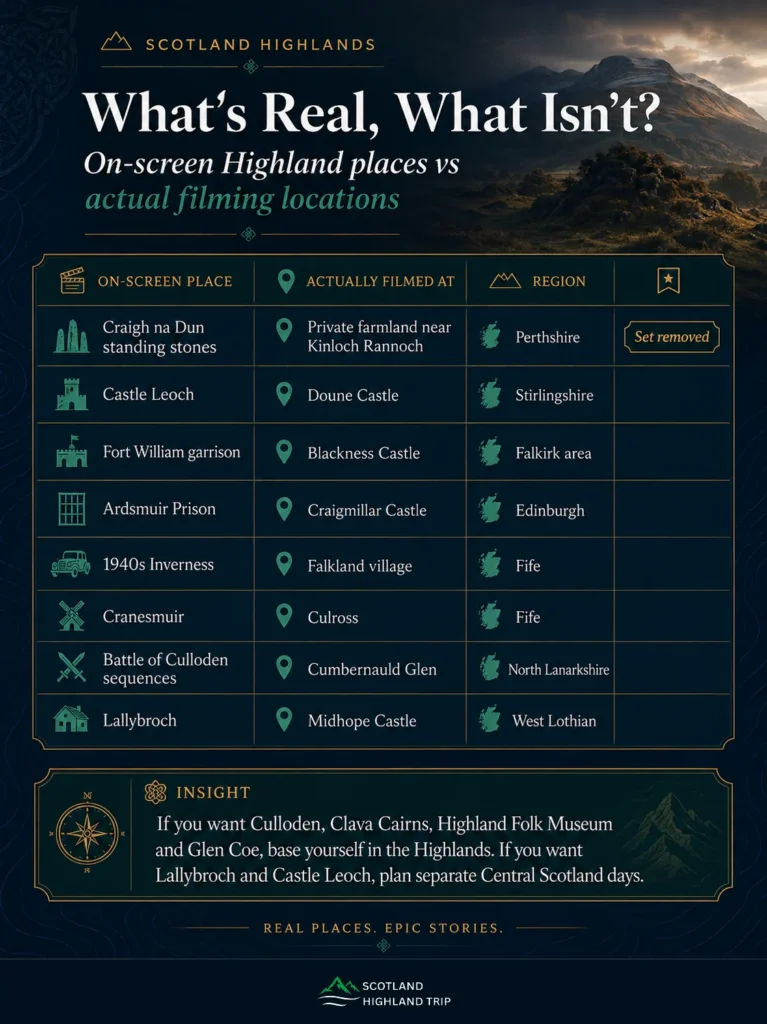
Which “Highland” Outlander locations were filmed outside the Highlands?
Several of the most recognisable Highland settings were shot hundreds of miles from the Highlands. Craigh na Dun, Castle Leoch, Fort William, Ardsmuir Prison and 1940s Inverness were all filmed in Perthshire, Stirlingshire, the Falkirk area, Edinburgh and Fife respectively.
This is the section I wish more guides included, because it saves people wasted driving days.
| On-screen place | Where it was actually filmed | Region | Can you visit? |
| Craigh na Dun standing stones | Private farmland near Kinloch Rannoch | Perthshire | No, the set was Styrofoam and was removed |
| Castle Leoch | Doune Castle | Stirlingshire | Yes, Historic Environment Scotland site |
| Fort William garrison | Blackness Castle | Falkirk area | Yes, Historic Environment Scotland site |
| Ardsmuir Prison | Craigmillar Castle | Edinburgh | Yes, Historic Environment Scotland site |
| 1940s Inverness | Village of Falkland | Fife | Yes, free to walk |
| Cranesmuir | Culross | Fife | Yes, village free, palace ticketed |
| Battle of Culloden sequences | Cumbernauld Glen | North Lanarkshire | Yes, wildlife reserve |
| Lallybroch | Midhope Castle, Hopetoun Estate | West Lothian | Exterior only, seasonal access |
Notice what that table does to trip planning. If your heart is set on Lallybroch and Castle Leoch, those are Edinburgh-and-Stirling days, not Highland days. If you want Culloden, the Baile Gean township and Glen Coe, that’s a Highlands trip based out of Inverness.
Trying to do both in three days means a lot of motorway and not much Scotland. I’d pick one.
How do you plan an Outlander trip around the Highlands?.
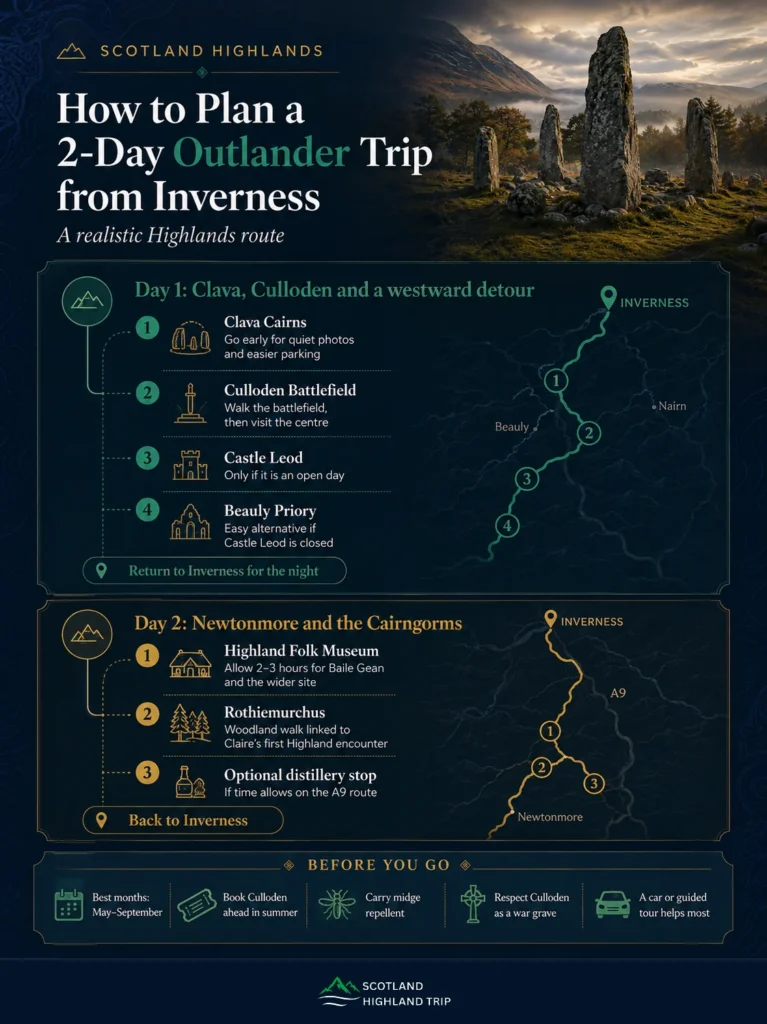
Base yourself in Inverness for two nights. Day one covers Culloden and Clava Cairns with time to spare, day two runs south to the Highland Folk Museum and the Cairngorms. Add a third day for Glen Coe if you’re driving onward to Glasgow or Edinburgh.
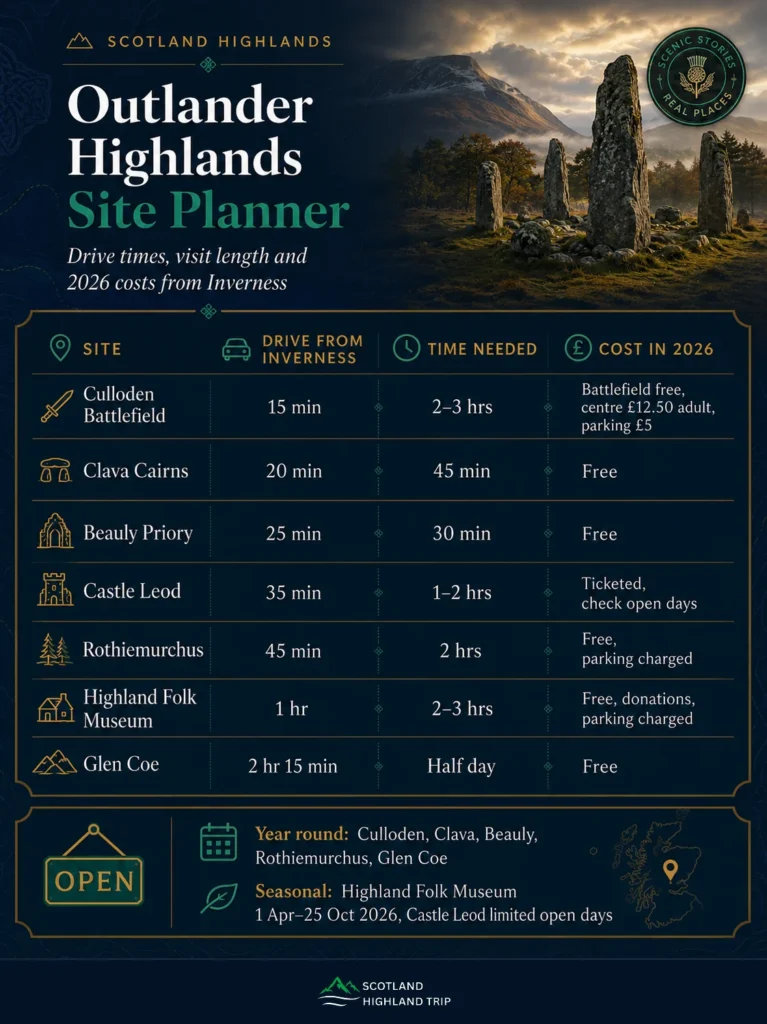
Here’s how the Highland sites stack up.
| Site | Drive from Inverness | Time needed | Cost in 2026 | Open |
| Culloden Battlefield | 15 min | 2 to 3 hours | Battlefield free, centre £12.50 adult, parking £5 | Year round |
| Clava Cairns | 20 min | 45 min | Free | Year round |
| Beauly Priory | 25 min | 30 min | Free | Year round |
| Castle Leod | 35 min | 1 to 2 hours | Ticketed, check open days | About 25 days a year |
| Rothiemurchus, Aviemore | 45 min | 2 hours | Free, parking charged | Year round |
| Highland Folk Museum | 1 hour | 2 to 3 hours | Free, donations, parking charged | 1 Apr to 25 Oct 2026 |
| Glen Coe | 2 hr 15 min | Half day | Free | Year round |
A workable two-day plan
- Morning, day one. Clava Cairns first, before nine if you can, while the car park is still empty and the light is low through the beeches.
- Late morning, day one. Drive five minutes to Culloden. Battlefield first, visitor centre after, so the exhibition lands with the ground fresh in your mind.
- Afternoon, day one. Head northwest to Castle Leod if it’s an open day, or Beauly Priory if it isn’t. Both are short detours.
- Evening, day one. Back to Inverness. Wander the riverside, and if you want more than Outlander, our guide to things to do in Inverness covers the rest of the city.
- Day two. South on the A9 to Newtonmore for the Highland Folk Museum, then Rothiemurchus near Aviemore on the way back. Add a distillery if you’ve time, since several sit along this stretch and our Inverness whisky tours guide maps them out.
If you’d rather not drive it yourself, our Culloden and Clava Cairns Outlander tour from Inverness covers day one with a driver-guide who knows which scenes were shot where. Whether that beats self-driving depends on your group, and we’ve laid out the trade-offs in guided tour versus self-drive.
What should you know before visiting Outlander sites in the Highlands?
Go between late April and early October, when seasonal sites are open. Book Culloden’s visitor centre ahead in summer, carry midge repellent from May to September, and treat Culloden’s grave markers as the burial ground they are.
A few things I’d want a first-timer to hear.
The season really matters: The Highland Folk Museum shuts from late October to April, and Castle Leod’s open days cluster in summer. Turn up in February and you’ll get Culloden, Clava Cairns and Glen Coe, which is still a decent trip, but it’s a thinner one. May and September are the sweet spot for weather and crowds both, and our notes on when to visit the Scottish Highlands go into the seasonal detail.
Midges are not a myth: From May through September they gather near water and in still air, and Clava Cairns and Rothiemurchus are exactly the kind of sheltered, damp woodland they like. Repellent costs a few pounds and saves the afternoon.
Weather changes fast: Glen Coe can be clear at the north end and invisible at the south. Waterproofs, layers, proper shoes. Not for the sites themselves, which are mostly easy walking, but because you’ll want to stand outside for longer than you planned.
Respect the graves: Culloden’s clan stones mark real burial pits. The Clan Fraser stone has needed repair work because visitors stepped off the path to get closer. Diana Gabaldon herself has asked fans to treat it as a war grave. Photograph it from the path.
Some places are private: Castle Leod is a family home. Rothiemurchus is a working estate. Access is generous and the Scottish Outdoor Access Code is broad, but that generosity depends on people behaving. Our list of mistakes to avoid in the Highlands covers the rest.
The story isn’t finished: The original series wrapped with its eighth season in May 2026. The prequel, Outlander: Blood of My Blood, started on STARZ in August 2025 with a second season on the way, and its Scottish locations sit mostly in Perthshire, Stirlingshire and Glasgow rather than the Highlands. Expect that to shift where the fan traffic goes over the next few years.
Frequently Asked Questions
Where can I see the Outlander standing stones in the Scottish Highlands?
Clava Cairns near Inverness is the closest real equivalent. The Craigh na Dun circle was a Styrofoam set built near Kinloch Rannoch in Perthshire and no longer exists. Clava is a genuine 4,000-year-old Bronze Age site, free to visit and open year round.
Was Outlander filmed at Culloden Battlefield?
Partly. The Season 2 scene at the Clan Fraser memorial stone was filmed on the real battlefield. The battle sequences themselves were shot at Cumbernauld Glen in North Lanarkshire, because Culloden is a protected war grave.
How far is Culloden Battlefield from Inverness?
About six miles east, which is a fifteen-minute drive or roughly forty minutes by local bus. Clava Cairns sits five minutes further on. The two are easily combined in a single morning.
Is the Highland Folk Museum free to visit?
Yes. Entry is free with donations welcome, though there’s now a small parking charge payable by card at the car park meters. The 2026 season runs daily from 1 April to 25 October.
Can you go inside Castle Leod?
Only on public open days or by arranging a private tour at least two weeks ahead. The castle opens for at least 25 days a year, usually in summer, and dates change annually. Check the official Castle Leod website before travelling.
Which Outlander locations near Inverness can I visit for free?
Clava Cairns, Beauly Priory, the Culloden battlefield itself and the Rothiemurchus woodland walks are all free. Only Culloden’s visitor centre and Castle Leod charge admission, plus parking at several sites.
Do I need a car to see the Highland Outlander sites?
A car helps considerably. Culloden is reachable by bus from Inverness and Newtonmore has train and bus services, but Clava Cairns, Castle Leod and Rothiemurchus are awkward without one. A guided tour or private driver solves the same problem.
Emma is a solo traveler and freelance travel writer from New Zealand who spent three weeks exploring the Scottish Highlands. With a deep appreciation for history and landscapes, she booked a series of day tours and a private chauffeur journey with Scotland Highland Trip. From Loch Ness to the Cairngorms, she documented her experience through vivid blog posts and drone footage.