
The North Coast 500 (NC500) is Scotland’s most famous road trip, a 516‑mile loop around the Highlands that takes in towering mountains, wild beaches, castles and villages. But once you’ve ticked off the headline attractions, Bealach na Bà, Smoo Cave, Dunrobin Castle, the route still has countless pull‑ins, detours and short walks that many drivers sail past. This guide focuses on the lesser‑known stops: the ones that add texture and personality to your trip without turning it into a treasure hunt. They might be historic bridges, remote waterfalls, quirky architectural follies or community pubs. Most importantly, they’re easy to weave into a realistic itinerary and often reveal a quieter side of the Highlands.
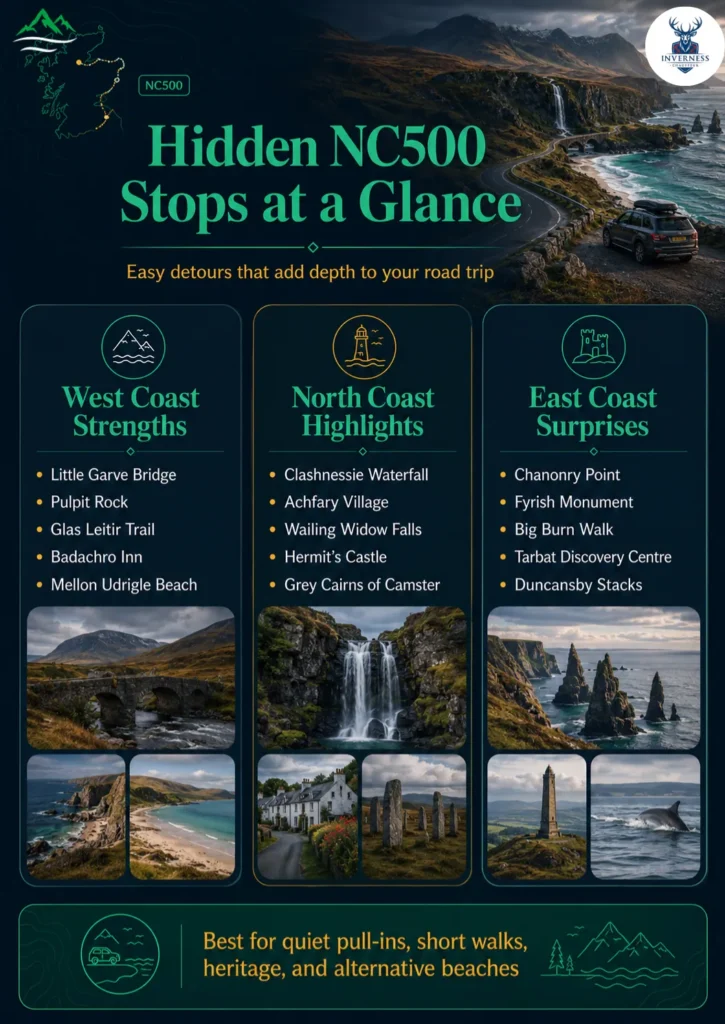
Hidden NC500 Stops at a Glance
- West coast strengths: the section between Inverness and Ullapool is packed with scenic lay‑bys, woodland trails and alternative beaches. Here you’ll find a historic 1762 bridge at Little Garve, an open‑air church, tranquil woodland walks around Loch Maree, and quiet beaches like Mellon Udrigle.
- North coast highlights: the remote stretch through Assynt and Sutherland hides dramatic waterfalls like Wailing Widow Falls (accessed via a rough 10‑minute track from the A894) and quirky structures such as Hermit’s Castle, a tiny concrete bothy built by architect David Scott in 1950.
- East coast surprises: don’t rush back to Inverness. The return leg offers dolphin watching at Chanonry Point, hill‑top monuments like the Fyrish Monument built in 1783, the Big Burn Walk near Golspie with bridges and waterfalls, and the Duncansby Stacks, sea‑stack “fangs” visible from a footpath near the Duncansby Head lighthouse.
- Why these stops? They’re not “secret”, but they are often overshadowed by nearby headline attractions. Each stop offers either a fresh perspective, a quieter atmosphere or a piece of Highland history that enriches your road‑trip story.
What Counts as a “Didn’t Know About” Stop?
In this guide, “didn’t know about” doesn’t imply secrecy or trespassing. Instead, it refers to stops that are easy to overlook when you follow the standard NC500 itinerary. They might be just off the main route (within a 10–15‑minute detour) or tucked between more famous landmarks. Each must meet at least one of these criteria:
- Overlooked lay‑bys and picnic spots that offer atmosphere or history (e.g., a historic bridge or viewpoint).
- Alternative beaches or waterfalls that provide a quieter experience than the crowded main sites.
- Heritage detours like Neolithic burial chambers, Pictish museums or small village museums that add cultural depth.
- Quirky structures (folly, sculpture or monument) that tell a unique story.
- Short walks (generally under two hours) that break up long drives without consuming a full day.
West Coast: Lesser‑Known Stops
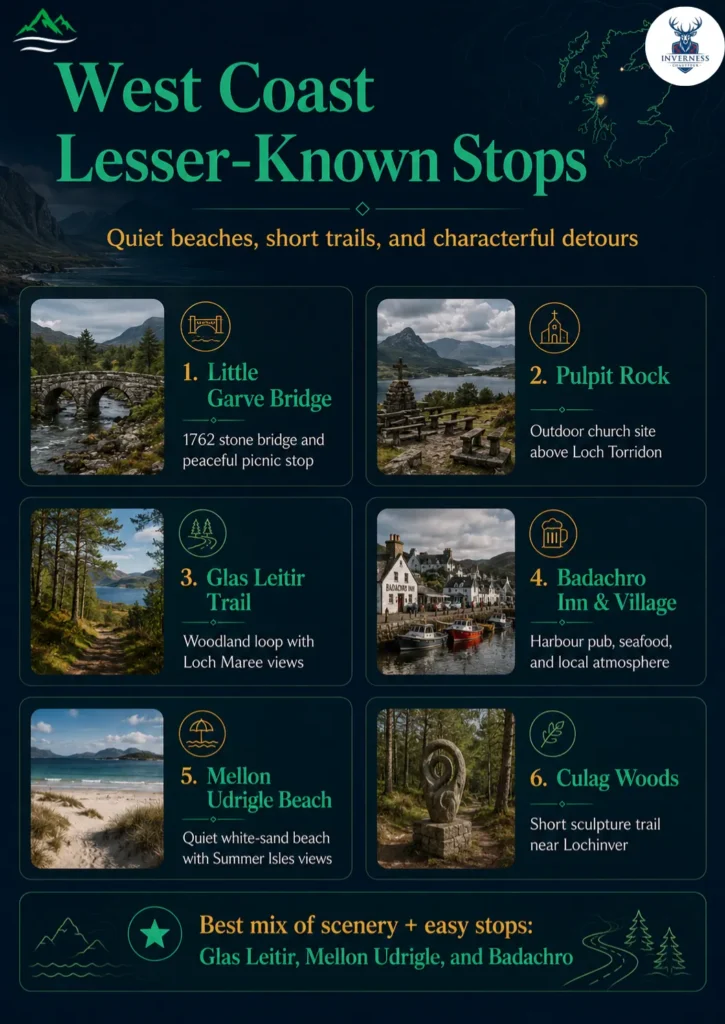
The NC500 usually starts in Inverness and heads west to the rugged coastline. Beyond the famous Bealach na Bà and Torridon villages, consider these additions:
Little Garve Bridge (Near Garve)
Just off the A835, this 1762 stone bridge spans the Black Water at Little Garve. Built during General Wade’s military road programmes, it provides a peaceful picnic spot and photo opportunity. Many travellers rush to Rogie Falls a few miles north, but Little Garve offers a quieter riverside setting. A small car park sits beside the bridge, and you can walk across and follow the riverside path for a short stroll. It’s a great way to break up the first day without adding driving time.
Pulpit Rock at Am Ploc (Loch Torridon)
Overlooking Loch Torridon, Pulpit Rock is a natural amphitheatre where the Free Church of Scotland held outdoor services after the Disruption of 1843. Locals carved stone pews and a pulpit into the rock; services continued here until the 1980s. Despite its cultural significance, it’s rarely mentioned in NC500 itineraries. Park at a small lay‑by on the single‑track road through Glen Torridon and follow the obvious path up to the rock (look out for midges in summer). It makes an atmospheric pause between Torridon and Shieldaig.
Glas Leitir Trail & Loch Maree Viewpoint
Between Kinlochewe and Gairloch, look for the Glas Leitir Trail in the Beinn Eighe National Nature Reserve. A signed car park leads to a 1.5‑hour loop through ancient Scots pine woodland. The path climbs gently to a viewpoint overlooking Loch Maree and the mountain Slioch. This walk offers tranquility and wildlife (look for crossbills) and makes a rewarding alternative to the busier Fairy Lochs or Beinn Eighe ridge walks. Pack a picnic for the seating area near the start.
Badachro Inn & Village
As you drive around Gairloch, detour to the fishing hamlet of Badachro. The Badachro Inn is a cosy pub loved by locals; it serves seafood, local ales and has a deck overlooking the harbour. It’s a perfect lunchtime stop before continuing to the beaches further north. The village itself has colourful cottages and is far quieter than neighbouring Gairloch.
Mellon Udrigle Beach
A 10‑minute detour from the A832 near Laide brings you to Mellon Udrigle, a stretch of white sand with views across to the Summer Isles. Its Gaelic name references the small headland (‘meallan’) and the tidal sands. Unlike the busy sands at Gruinard or Firemore, Mellon Udrigle remains relatively quiet. Park at the small car park at the end of the single‑track road and follow the path through dunes. On a clear day, the view of mountains like An Teallach and Suilven is magnificent.
Stac Pollaidh (Alternative Hike)
The distinctive sandstone peak of Stac Pollaidh (Stac Polly) rises above Loch Lurgainn near Ullapool. A well‑maintained path climbs to the ridge in about 90 minutes, offering panoramic views over Assynt and the Summer Isles. The true summit requires a scramble, but many walkers stop at the ridge for the vistas. Car parking is limited; arrive early or late to secure a space. For a more obscure alternative, combine Stac Pollaidh with lesser‑known hills like Cul Beag or walks around Loch Sionascaig.
Lower Diabaig & Gille Brighde
From the Beinn Alligin trailhead, a narrow single‑track road winds down to Lower Diabaig, a remote harbour village with a handful of houses. There’s a shipwreck on the foreshore, and the Gille Brighde restaurant serves seafood and home baking in summer (check opening times). The setting is cinematic, scenes from the 1996 film Loch Ness were filmed here. This detour is best for confident drivers; the road is single track with passing places, but the sense of isolation is worth it.
Culag Woods, Lochinver
Near Lochinver harbour, the community‑run Culag Woods offer a gentle leg‑stretch after driving the twisting B869. Waymarked trails wind through spruce and birch, passing carved sculptures like giant spiders, a troll bridge and a wish tree, making this a fun stop for children. The loop is short (about 1–2 km) and can be enjoyed in 30–45 minutes. There’s a small car park by the woods.
North Coast: Hidden Highlights
The remote north‑west and north coasts deliver raw beauty but can feel sparse between the headline stops of Handa Island and Dunnet Head. These lesser‑known places add intrigue:
Clashnessie Waterfall
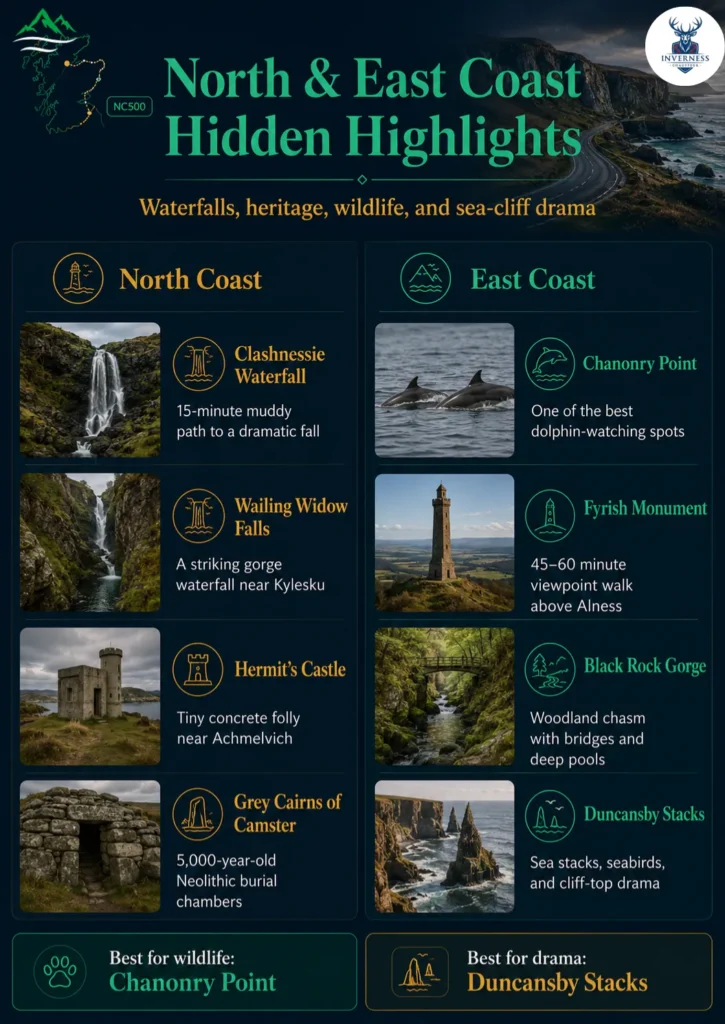
Just off the single‑track B869, Clashnessie Waterfall cascades about 15 metres down a rocky cliff. A small lay‑by marks the start of a muddy path; follow it for roughly 15 minutes to reach the pool at the base. This waterfall is easy to drive past because there are no big signs, but it’s a worthwhile pause between Stoer and Drumbeg. Wear waterproof shoes, the path can be boggy.
Achfary Village
Between Laxford Bridge and Loch Stack lies Achfary, a tiny estate village built for workers of the Duke of Westminster’s Reay Forest estate. It features a distinctive black‑and‑white telephone box repurposed as a defibrillator and a timber‑clad village hall reminiscent of Bavarian architecture. Many people cruise past on their way to the Kylesku Bridge; stopping in Achfary offers a glimpse of Highland estate life and a peaceful picnic spot by the loch.
Wailing Widow Falls
One of the north coast’s most dramatic waterfalls, Wailing Widow Falls (also known as Loch na Gainmhich Waterfall) is tucked just off the A894 between Loch Assynt and Kylesku Bridge. The falls drop around 30 metres from the outflow of Loch na Gainmhich into a steep gorge. There is no official car park, just informal lay‑bys; arrive early as space is limited. A rough track leads from the lower lay‑by into the gorge, the 10–15‑minute walk is rocky and uneven, so wear sturdy footwear. Alternatively, park near Quinag Viewpoint and walk a few minutes to the top of the falls for a safer view. The site is free to visit. Local folklore says the name comes from a grieving widow who jumped after her son fell to his death.
Hermit’s Castle, Achmelvich
Beside Achmelvich Bay stands Hermit’s Castle, a concrete folly sometimes called Europe’s smallest castle. Architect David Scott built the tiny bothy around 1950, single‑handedly carrying materials by boat and spending six months on the project. Stories suggest he only stayed for a weekend before leaving the structure to the elements. The “castle” is essentially a one‑room shelter with a narrow entrance, bed platform and fireplace. To find it, walk along the fence at the end of Achmelvich Beach campsite until you reach an old ruin, then cross the rocky headland. It’s a quirky stop that sparks curiosity, a reminder of how remote places inspired eccentric projects.
Grey Cairns of Camster
The Grey Cairns of Camster are a pair of Neolithic burial chambers tucked away on a moor north of the A99. Dating back over 5,000 years, they are among the most intact burial cairns in Britain. A short boardwalk leads to two chambers, a long cairn and a round cairn, each accessible by crouching through low passages (bring a torch). Their remote setting and haunting atmosphere make them one of the north coast’s most underrated archaeological stops.
East Coast: Underrated Heritage and Trails
Returning south along the eastern side of the NC500 offers historic towns, wildlife watching and accessible walks that many travellers miss.
Chanonry Point, Black Isle
Near Fortrose on the Black Isle, Chanonry Point juts into the Moray Firth. It’s widely considered one of the best land‑based places in the UK to watch bottlenose dolphins, particularly on a rising tide when salmon run past the point. From the car park it’s a short walk past a lighthouse to the shingle spit. Bring binoculars and patience; dolphins often surface close to shore. Boat tours from nearby Cromarty and Avoch offer a different perspective.
Fyrish Monument, Alness
Overlooking the Cromarty Firth above Alness stands the Fyrish Monument. Built in 1783 by Sir Hector Munro to commemorate his service in India, the stone structure replicates the Gate of Negapatam. The 4 km (2.5 mile) path to the summit climbs steadily through forest and takes about 45 to 60 minutes. From the top, you’ll have panoramic views over the Black Isle and Ben Wyvis. It’s an invigorating stop that’s far less busy than Munro bagging or longer hill walks.
Black Rock Gorge, Evanton
Close to the village of Evanton lies Black Rock Gorge, a narrow chasm carved by the Allt Graad. A woodland path leads to bridges over the gorge, revealing sheer rock walls and deep pools. The gorge features in the film Harry Potter and the Goblet of Fire, yet many NC500 travellers drive past without realising it. The full loop takes about an hour and provides a refreshing break from coastal driving.
Big Burn Walk, Golspie
Just north of Golspie (and near the famous Dunrobin Castle), the Big Burn Walk follows a forested gorge with multiple bridges and waterfalls. The path culminates at a dramatic waterfall viewed from a platform. The walk is about 1.7 miles and takes roughly an hour. Conditions are mostly clear woodland paths but can be muddy after rain. Dogs are welcome, but the route is not wheelchair accessible. It’s a perfect leg‑stretcher when heading towards the north coast.
Tarbat Discovery Centre & Pictish Trail
The Tarbat Peninsula east of Tain is rich in Pictish history. At its heart lies the Tarbat Discovery Centre, housed in St Colman’s Church in Portmahomack. This museum displays artefacts unearthed during a 20‑year excavation, including intricate carved stones and tools from a Pictish monastery destroyed around AD 820. A statue of the “Pictish Queen” and information boards greet visitors outside. The centre forms part of the Highland Pictish Trail, linking dozens of carved stones and sites across Easter Ross. Nearby Seaboard Villages host Pictish stones (Shandwick and Hilton of Cadboll) and a sculpture trail featuring the Mermaid of the North, a modern 11‑foot‑tall mermaid sculpture.
Duncansby Head & Stacks
Most travellers stop at John o’ Groats, but a short drive along a single‑track road leads to Duncansby Head, the north‑east tip of the mainland. A large car park by the lighthouse marks the start of a footpath. Follow it south for about a mile to the Duncansby Stacks, where two 60‑metre sea stacks and a third stack attached to the cliffs (with a natural arch called Thirle Door) rise like giant fangs from the North Sea. On the way you pass the Geo of Sclaites, a cleft alive with seabirds. Watch for puffins, kittiwakes and razorbills in summer. This short walk is one of the most dramatic on the entire NC500 yet is often skipped by those hurrying back south.
How to Fit Hidden Stops into a Real NC500 Itinerary
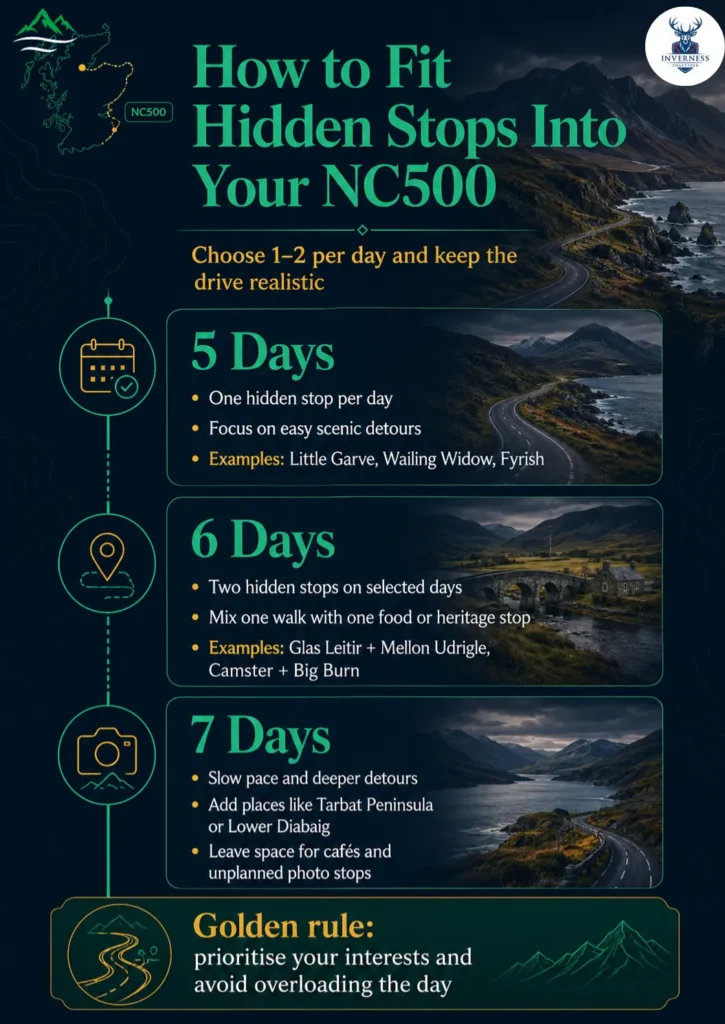
Adding every overlooked stop to one trip would turn the NC500 into a month‑long odyssey. The key is to choose stops that match your interests and distribute them sensibly across your days. Here are some practical tips:
5‑Day Itinerary
The classic five‑day NC500 loop is fast‑paced. Limit yourself to one hidden stop per day:
- Day 1 (Inverness to Torridon): Stop at Little Garve Bridge for a picnic. If you have extra time, include Pulpit Rock before reaching your accommodation in Torridon.
- Day 2 (Torridon to Ullapool): Choose either Glas Leitir Trail or Mellon Udrigle Beach to break up the drive; they’re both short and scenic.
- Day 3 (Ullapool to Durness): Opt for Wailing Widow Falls. Arrive early to secure parking and allow 45 minutes for the walk and photos.
- Day 4 (Durness to Wick): Detour to Achfary Village or the Grey Cairns of Camster depending on whether you prefer cultural heritage or rural atmosphere.
- Day 5 (Wick to Inverness): Add one east‑coast stop such as Fyrish Monument or Duncansby Stacks before returning to Inverness.
6‑Day Itinerary
With six days you can weave in two hidden stops most days:
- Combine Little Garve and Pulpit Rock on Day 1.
- Split Day 2 between Glas Leitir Trail and Badachro Inn/Mellon Udrigle.
- On Day 3, hike Stac Pollaidh in the morning and visit Culag Woods in the afternoon.
- Day 4 could include Wailing Widow Falls and Hermit’s Castle (allow 90 minutes for each).
- Day 5 covers the Grey Cairns of Camster and the Big Burn Walk.
- Finish with Tarbat Discovery Centre and Duncansby Stacks on Day 6.
7‑Day Itinerary
A week allows for a slower pace and more exploration. You can include most of the stops listed, but avoid scheduling more than two per day to maintain flexibility. Consider spending an entire afternoon in Portmahomack exploring the Tarbat Peninsula or taking a dolphin‑watching boat trip from Cromarty. On the west coast, take the time to climb Beinn Alligin or Beinn Eighe if you’re a confident hillwalker.
Common NC500 Hidden‑Stop Questions (FAQs)
What are the best hidden stops on the NC500?
It depends on your interests. For waterfalls, Wailing Widow Falls and Clashnessie are impressive. For quiet beaches, Mellon Udrigle and Clachtoll are great alternatives to Achmelvich. For heritage, visit the Grey Cairns of Camster or Tarbat Discovery Centre.
Which NC500 west coast stops are most underrated?
The west coast hides gems like Little Garve Bridge, Pulpit Rock, Glas Leitir Trail, Badachro Inn and Mellon Udrigle. They offer history, picnic spots, woodland walks and quiet sands without long detours.
How many hidden stops should you add to a 7‑day itinerary?
Aim for one or two per day. The NC500 already has long driving stretches; overloading your schedule can lead to fatigue and missed experiences.
Are the best NC500 stops all on the main route?
Many lesser‑known stops are very close to the main loop (within a 10–15‑minute detour). Exceptions include Lower Diabaig, Hermit’s Castle and the Grey Cairns of Camster, which require longer detours. Balance detours with your time budget.
What are the best castle stops on the NC500?
Aside from Dunrobin and Castle of Mey, consider Hermit’s Castle for its quirkiness and the castle‑like form of the Fyrish Monument. If you love history, add a day trip to Dunbeath Castle Gardens (by appointment).
Do hidden NC500 stops require big detours?
Most of the stops listed are short diversions. Plan your days around clusters of stops to avoid backtracking and respect single‑track road etiquette.
How do you avoid overloading an NC500 day?
Prioritise the experiences that match your interests (wildlife, beaches, history) and remember that the NC500 is as much about the journey as the destinations. Schedule time for slow drives, unplanned photo stops and local cafés.
Final Takeaway
The North Coast 500 is more than a checklist of famous views. By weaving overlooked bridges, quiet beaches, woodland trails, remote waterfalls, quirky architecture and Pictish heritage into your itinerary, you’ll experience a richer and more varied Highland road trip. These stops are not about bragging rights but about understanding the landscape and the communities that live along the route. Choose the ones that resonate with you, build in extra time for detours, and remember that the best NC500 memories often come from the places you didn’t know about.

Emma is a solo traveler and freelance travel writer from New Zealand who spent three weeks exploring the Scottish Highlands. With a deep appreciation for history and landscapes, she booked a series of day tours and a private chauffeur journey with Scotland Highland Trip. From Loch Ness to the Cairngorms, she documented her experience through vivid blog posts and drone footage.